


 Download PDF
ABSTRACT
Environmental correlations affect how a multiqubit system loses phase information because different components of the joint state can interact with the environment at different effective rates. Here, that effect is studied in a two-qubit open system with exchange coupling in the Hamiltonian and completely positive Markovian dephasing in the dissipative part. A single correlation coefficient, c, is used to vary the Kossakowski matrix continuously from anticorrelated noise, through independent noise, to fully correlated noise. The density matrix is propagated numerically, and the evolution is described using concurrence, l1-norm coherence, purity and von Neumann entropy. For the main separable initial state |++>, with J=0.7 and γ=0.2, the maximum concurrence increases from 0.2834 at c=0 to 0.4095 at c=1, while the time-averaged concurrence over 0≤t≤20 increases from 0.0190 to 0.0469. Over the same interval, the time-averaged l1-norm coherence increases from 0.3125 to 0.7656. The correlation sweep also shows that peak entanglement and integrated entanglement can behave differently: at c=-1 the peak concurrence is below the independent-noise value, whereas its time integral is larger. Bell-state tests provide an analytical check and show the expected sector dependence. Positive correlation protects |Ψ+> in the pure-dephasing limit but accelerates the dephasing of |Φ+>. The main result is a compact numerical resource map that places correlation, coherent coupling, dephasing strength, coherence retention and transient entanglement on the same parameter axes. The calculation is intended as a transparent benchmark for later extensions to more realistic noise spectra and memory kernels.
Keywords: Two-Qubit System; Open Quantum Systems; Correlated Dephasing; Quantum Coherence; Entanglement; Concurrence; Lindblad Dynamics; Numerical Simulation
INTRODUCTION
An isolated quantum system evolves unitarily, but real systems are never completely isolated. Coupling to uncontrolled degrees of freedom causes the reduced state to lose phase information and, depending on the interaction, energy as well. This loss of quantum information is the central feature of decoherence and is one reason open quantum systems have to be treated differently from closed systems [1–3]. In a multiqubit system, the environment acting on one qubit can also be statistically related to the environment acting on another. The two qubits then experience correlated rather than independent noise, and the dynamics depend on how that correlation is structured.
In a chosen reference basis, coherence appears in the off-diagonal elements of the density matrix. It is useful to treat coherence as a physical resource because quantitative measures make its generation, transformation and loss accessible to systematic study [4,5]. For numerical open-system work, a single scalar measure is convenient because different parameter sets can then be compared without examining every density-matrix element. In this study, the l1 norm of coherence is used because it is obtained directly from the magnitudes of the off-diagonal elements [4].
Entanglement describes a different form of nonclassical correlation. For two qubits, Wootters concurrence gives a closed measure for mixed states, which makes it suitable for simulations where environmental coupling drives an initially pure state into a mixed one [6]. Noise can destroy entanglement while leaving some local or basis-dependent coherence behind, and finite-time entanglement loss is a well-known feature of open-system dynamics [7]. This distinction is important here because the calculation follows coherence and entanglement separately under the same noisy evolution.
For weakly coupled Markovian environments, the Gorini–Kossakowski–Sudarshan–Lindblad framework provides a practical description of the dynamics [1,2]. For the present calculation, its useful feature is that correlations between noise channels can be included through the Kossakowski matrix while the system Hilbert space remains unchanged. In the two-qubit model, local dephasing operators can therefore be supplemented by a cross term without introducing explicit environmental degrees of freedom.
Correlated noise also occurs in physical quantum devices. Common environmental fluctuations can produce errors on more than one qubit at a time, which makes error correction more difficult and can change how encoded information is protected [8,9]. Correlations have been measured in real qubit platforms. Wilen et al. reported correlated charge-noise and relaxation effects in superconducting circuits [10], while Yoneda et al. measured the noise-correlation spectrum of a pair of silicon spin qubits and found substantial interqubit correlations at low frequency [11]. These observations provide a physical basis for examining how correlation changes the dynamics of a simple two-qubit model.
Correlations can also have a protective role. Collective coupling to an environment can make certain states or subspaces insensitive to the dominant noise operator, which is the basic principle behind decoherence-free subspaces [8]. More recent studies have shown that correlated Markovian dephasing can affect entanglement generation in nontrivial ways, with correlated channels either slowing or accelerating the decay of quantum correlations depending on the channel and the initial state [12–14]. Zou, Bosco and Loss considered spatially correlated classical and quantum noise in driven qubits and showed why Markovian and non-Markovian regimes need to be distinguished [15].
These results motivate a more focused computational question. Correlation can protect some quantum correlations and damage others, but the trade-off is harder to see when coherence retention and entanglement generation are examined together while one correlation parameter is varied continuously. The present study keeps the Hamiltonian form fixed and uses a bounded cross-correlation coefficient to move from anticorrelated to independent and then correlated dephasing. Both resource measures are followed in time and across the J–c and γ–c parameter planes, with additional Bell-state tests used to separate general behavior from effects that depend on the initial state.
Research gap
The research gap considered here is methodological rather than a claim that correlated noise has not been studied. Experiments have shown that noise correlations can be measured in realistic qubit devices [10,11]. Earlier work has examined correlated effects on entanglement and coherence, including analytical treatments of multiqubit robustness and channel-memory models [12–14], while broader theoretical work has addressed spatially correlated classical and quantum noise in both Markovian and non-Markovian regimes [15]. What is less clear in those wider settings is the joint resource landscape produced by a single tunable correlation coordinate in a minimal Markovian model. This study therefore asks how coherent exchange, dephasing strength and noise correlation work together to determine transient entanglement generation and coherence retention, and how differently those two resources respond.
Aim
The aim of this work is to quantify how a continuously tunable spatial correlation in Markovian dephasing changes the time evolution of entanglement and coherence in an exchange-coupled two-qubit system.
Objectives
- Construct a completely positive two-qubit Lindblad model containing coherent exchange and correlated dephasing.
- Calculate concurrence, l1-norm coherence, purity and von Neumann entropy during the evolution.
- Compare anticorrelated, independent, partially correlated and fully correlated dephasing through the parameter c.
- Map the maximum transient concurrence over the (J,c) and (γ,c) parameter planes.
- Test state dependence using a separable state and two Bell states, and validate the implementation against analytically solvable pure-dephasing limits.
Novelty and Contribution
The paper does not propose a new master equation. Instead, it uses a standard correlated-dephasing model as a controlled numerical experiment. The same coefficient c is used throughout, so independent noise is simply one point on a continuous correlation axis rather than a separate model. This allows transient peak concurrence, time-averaged concurrence and time-averaged coherence to be compared while the coherent exchange J and dissipative scale γ are varied independently. The second part of the study examines the dependence on the initial state. The |++> state shows how correlated dephasing changes entanglement generated by coherent exchange, while the Bell states reveal symmetry sectors in which the same noise can either protect or suppress coherence and entanglement. The conclusions are therefore tied to the specified Hamiltonian, dissipator and initial state rather than treating correlation as universally helpful or harmful.
| Study | System / noise | Main focus | Connection to this work |
|---|---|---|---|
| Klesse & Frank (2005) [9] | Multiqubit, spatially correlated noise | Effect of spatial correlations on error correction | Motivates treating interqubit correlations as a distinct noise structure. |
| Wilen (2021) [10] | Superconducting multiqubit circuit | Correlated charge and relaxation errors | Shows that correlated errors occur in realistic hardware. |
| Yoneda (2023) [11] | Pair of silicon spin qubits | Measured noise-correlation spectrum | Provides experimental evidence that interqubit correlations can be quantified. |
| Seif (2022) [12] | n qubits, correlated Markovian dephasing | Quantum versus classical character of correlated dissipation | Provides the Markovian correlated-dephasing setting. |
| Peng (2023) [13] | Two/multiqubit correlated channels | Analytical entanglement robustness | Shows strong state/channel dependence. |
| Awasthi (2023) [14] | Two qubits, memory-correlated channels | Coherence and entanglement under channel memory | Supports joint analysis of the two resources, but uses correlated channel memory rather than the static spatial coefficient used here. |
| Zou, Bosco & Loss (2024) [15] | Driven qubits, spatially correlated classical/quantum noise | Markovian and non-Markovian dynamics | Shows the wider physical setting in which spatial correlation becomes important. |
| Present study | Two qubits, Markovian correlated dephasing + exchange | Joint resource maps versus c, J and γ | Provides a compact numerical benchmark linking coherence retention and transient entanglement in one parameterization. |
Table 1: Selected Literature Relevant to The Present Study
Theoretical Model
Two-Qubit Hamiltonian
All calculations use dimensionless units with ℏ=1. The coherent dynamics are described by the equal-frequency exchange All -coupled Hamiltonian,
(1)
Here ω sets the single-qubit energy scale and J controls the exchange interaction. The XY term couples the single-excitation sector and provides the coherent process that can turn an initially separable superposition into an entangled state. Throughout the main calculations, ω=1, so the chosen frequency scale also sets the units of time.
Correlated Markovian Dephasing
The density matrix obeys the Gorini–Kossakowski–Sudarshan–Lindblad equation [1,2]. We take A₁=σz(1) and A₂=σz(2), and write the dissipative contribution using the 2×2 Kossakowski matrix Γ,
(2)
(3)
The parameter γ≥0 sets the overall dephasing scale, while c determines the cross-correlation between the two dephasing channels. The eigenvalues of Γ are γ(1+c) and γ(1−c). Therefore, |c|≤1 keeps Γ positive semidefinite and the dissipative generator completely positive. The values c=0, c=1 and c=−1 represent independent, fully correlated and fully anticorrelated dephasing, respectively. Changing c does not change the diagonal noise strength γ; it changes only the cross-correlation term.
For the numerical calculation, Γ is diagonalized to obtain an equivalent set of Lindblad operators. The density matrix is then vectorized and propagated with the resulting 16×16 Liouvillian. Because the Hilbert space is small, the calculation can be handled with standard dense linear-algebra routines.
Initial States
The main production calculations start from the separable state |++>, where |+>=(|0>+|1>)/√2. At t=0 this state has zero concurrence but nonzero coherence in the chosen basis. It therefore lets the calculation track the effect of coherent exchange and dissipative dephasing in the same evolution. Two Bell states, |Ψ+>=(|01>+|10>)/√2 and |Φ+>=(|00>+|11>)/√2, are included as diagnostic cases. Their dephasing behavior can be obtained analytically when J=0, making them useful for checking the implementation and the interpretation of state-dependent protection.
Quantifiers
Coherence is quantified with the l1 norm [4],
(4)
Two-qubit entanglement is quantified with concurrence [6]. Using the spin-flipped state ρ̃=(σy⊗σy)ρ*(σy⊗σy), and letting λ₁≥λ₂≥λ₃≥λ₄ be the square roots of the eigenvalues of ρρ̃,
(5)
Purity is defined as P=Tr(ρ²), and the von Neumann entropy as S=−Tr(ρ ln ρ). These are reported as supporting quantities rather than replacements for coherence or entanglement. They help show whether changes in the resource measures are accompanied by greater mixing of the state.
Computational Methodology
Numerical Propagation
The 4×4 density matrix is vectorized in column-major order, which converts the master equation into a linear ordinary differential equation, d|ρ>/dt=L|ρ>, with a 16×16 Liouvillian L. For each parameter set, the Liouvillian is constructed once and diagonalized. States at the required time points are then obtained from the corresponding matrix exponential. This avoids recomputing a dense exponential separately at every output point and is adequate for the small Hilbert space considered here.
The production interval is 0≤t≤20, with 401 output points in the main time series. Unless a parameter is being scanned, the calculations use ω=1, J=0.7 and γ=0.2. The correlation coefficient is varied over −1≤c≤1. The sign of c is kept because anticorrelated and positively correlated noise are not equivalent for the dissipator used here.
| Parameter | Symbol | Value / range | Purpose |
|---|---|---|---|
| Frequency scale | ω | 1 | Defines dimensionless energy/time units. |
| Exchange coupling | J | 0–1 for maps; 0.7 for main sweep | Controls coherent exchange and entanglement generation. |
| Dephasing rate | γ | 0.05–0.50 for maps; 0.20 for main sweep | Sets the overall dissipative scale. |
| Correlation coefficient | c | −1 to 1 | Controls the cross-correlation in Γ. |
| Time | t | 0–20 | Evolution interval. |
| Main initial state | |ψ0⟩ | |++⟩ | Starts separable with nonzero coherence. |
| Diagnostic states | — | |Ψ+⟩, |Φ+⟩ | Provide analytically solvable dephasing checks. |
Table 2: Main Computational Parameters
Validation and Physical Checks
The model was checked against analytically solvable limits before the production sweeps were interpreted. Setting J=0 and ω=0 leaves only pure correlated dephasing. For |Ψ+>, the |01>↔|10> coherence follows the exponential envelope exp[−4γ(1−c)t], while for |Φ +> the |00>↔|11> coherence follows exp[−4γ(1+c)t]. The numerical concurrence curves reproduce these exact limits with maximum absolute errors below 7×10⁻¹⁵ over the tested interval. In the interacting calculation at J=0.7, γ=0.2 and c=0.9, the trace error stayed at machine precision, Hermiticity was preserved to numerical precision, and the smallest density-matrix eigenvalue was about −1×10⁻¹⁶, consistent with floating-point round-off.
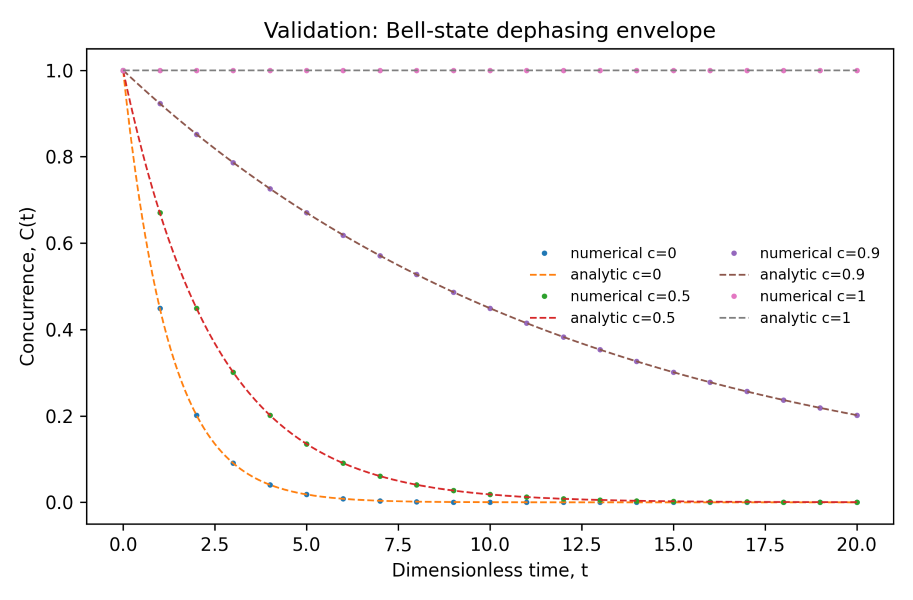
Figure 1: Numerical validation in the pure-dephasing Bell-state limit. Symbols are numerical concurrence values; dashed curves are the exact exponential envelopes for representative correlation coefficients.
RESULTS
Entanglement Generated from an Initially Separable State
The |++> state starts with C(0)=0. The exchange interaction produces transient entanglement, while the dephasing channel gradually reduces it. Figure 2 compares c=0, 0.5, 0.9 and 1 for J=0.7 and γ=0.2. As the positive correlation increases, the peak concurrence also increases: from 0.2834 at c=0 to 0.3352 at c=0.5, 0.3934 at c=0.9 and 0.4095 at c=1. The peak occurs at about t=0.8–1.0 in the dimensionless time units used in the model.
The enhancement does not persist indefinitely. Even at c=1, concurrence falls close to zero by the end of the simulated interval. The main effect is therefore a change in the transient window in which exchange-generated entanglement survives, rather than the formation of a permanently entangled stationary state. This also shows why peak concurrence and a time-integrated measure answer different questions.
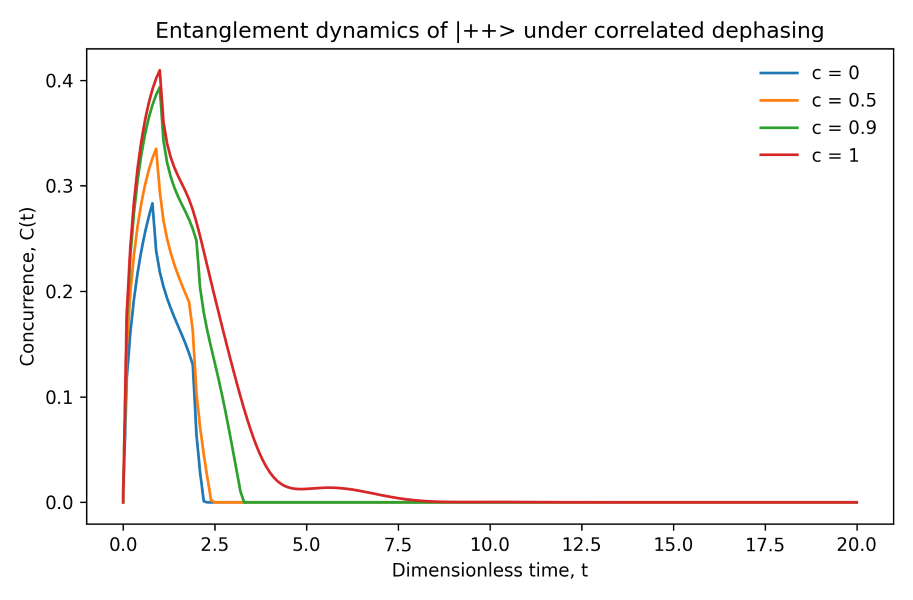
Figure 2: Concurrence versus time for the initially separable |++> state at J=0.7 and γ=0.2. Increasing positive correlation raises the transient concurrence produced by coherent exchange
| c | Cmax | t(Cmax) | Average C | Cl1(20) | Average Cl1 | P(20) |
|---|---|---|---|---|---|---|
| −1.0 | 0.2444 | 2 | 0.0282 | 0.50067 | 0.7656 | 0.375 |
| 0 | 0.2834 | 0.8 | 0.019 | 0.00067 | 0.3125 | 0.25 |
| 0.5 | 0.3352 | 0.9 | 0.0245 | 0.00084 | 0.3333 | 0.25 |
| 0.9 | 0.3934 | 1 | 0.0368 | 0.10162 | 0.5158 | 0.2551 |
| 1 | 0.4095 | 1 | 0.0469 | 0.50067 | 0.7656 | 0.375 |
Table 3: Representative results for |++⟩, J=0.7, ω=1, γ=0.2 and 0≤t≤20
At c=1, the peak concurrence is 44.5% higher than at independent noise, while the time-averaged concurrence is roughly 147% higher. These percentages apply to the parameter set used here and should not be extended to arbitrary Hamiltonians or noise models.
Coherence Dynamics
The coherence signal lasts much longer than the short entanglement pulse. For |++>, C_l1(0)=3. At t=20, the l1 coherence is about 0.00067 for independent dephasing and 0.50067 for perfect positive correlation. Over the full interval, the time-averaged coherence is 0.3125 at c=0 and 0.7656 at c=1. The difference therefore remains visible over a substantial part of the evolution rather than being confined to the early-time entanglement peak.
The correlation sweep also shows why the sign of c matters. For this initial state, the long-time l1 coherence is high near both c=−1 and c=+1 and reaches its lowest values around c=0. This follows from the way the dissipator acts on different coherence sectors, which depends on the differences between their joint σz eigenvalues. A collective environment can therefore weakly suppress one sector while strongly suppressing another. The resulting coherence profile depends on the state and is not simply a monotonic function of the amount of correlation.
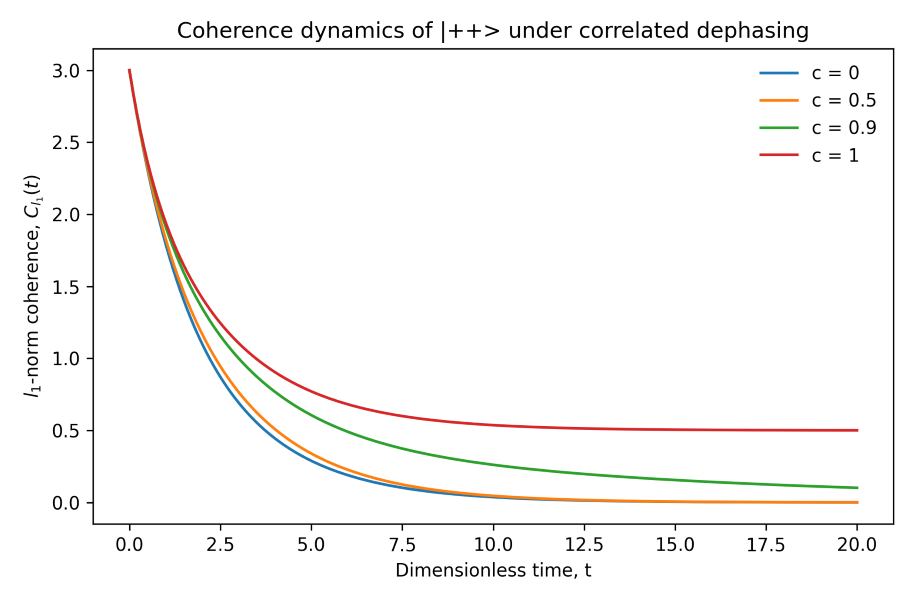
Figure 3: l1-norm coherence versus time for the initial |++> state. The correlation coefficient changes the amount of coherence retained at long times.
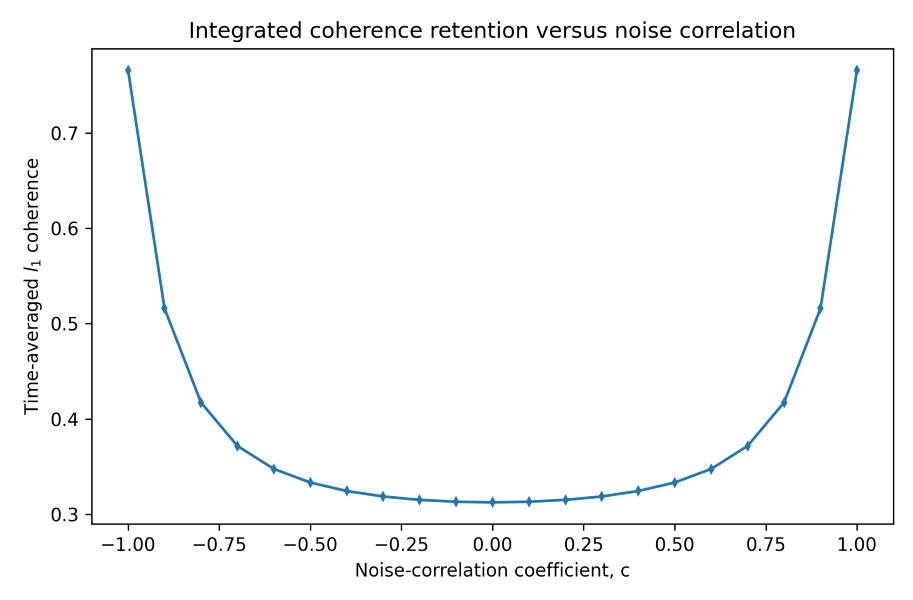
Figure 4: Time-averaged l1-norm coherence versus the noise-correlation coefficient for J=0.7 and γ=0.2.
Continuous Correlation Sweep
Figure 5 provides the main one-parameter view of the calculation. The maximum concurrence increases from the independent-noise point into the positive-correlation regime and reaches 0.4095 at c=1. The time-averaged concurrence shows the same broad increase on the positive side. The negative side is different. At c=−1, the peak concurrence is 0.2444, lower than the value at c=0, but the time-averaged concurrence is 0.0282, higher than the independent value of 0.0190. Peak concurrence and temporal persistence therefore describe different features of the dynamics.
This asymmetry comes from the sign-sensitive cross term in Γ. Replacing c by |c| would remove information that is present in the entanglement dynamics. The result also shows the limitation of using a single summary statistic: a lower peak can occur together with a longer period of nonzero entanglement.
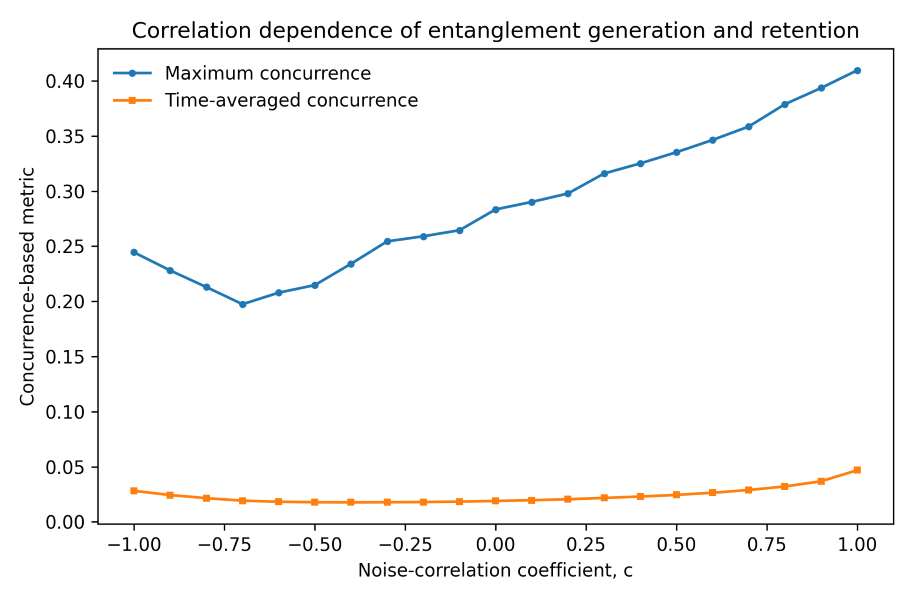
Figure 5: Dependence of maximum and time-averaged concurrence on the correlation coefficient for |++>, J=0.7 and γ=0.2.
Exchange Coupling Versus Correlation
Figure 6 shows the maximum concurrence across the (J,c) plane at γ=0.2. Increasing J strengthens the coherent exchange and, in turn, the entanglement generated from the separable |++> input. Within the scanned region, the largest maximum concurrence is about 0.450 near J=1 and c=1. Weak J gives a broad region of low concurrence.
The map does not show correlation acting as an independent source of appreciable entanglement in this classical Markovian dephasing model. The strongest response occurs when sufficiently strong coherent exchange is combined with positive environmental correlation. The enhancement therefore reflects the interaction between the Hamiltonian dynamics and the structure of the dissipative correlations.
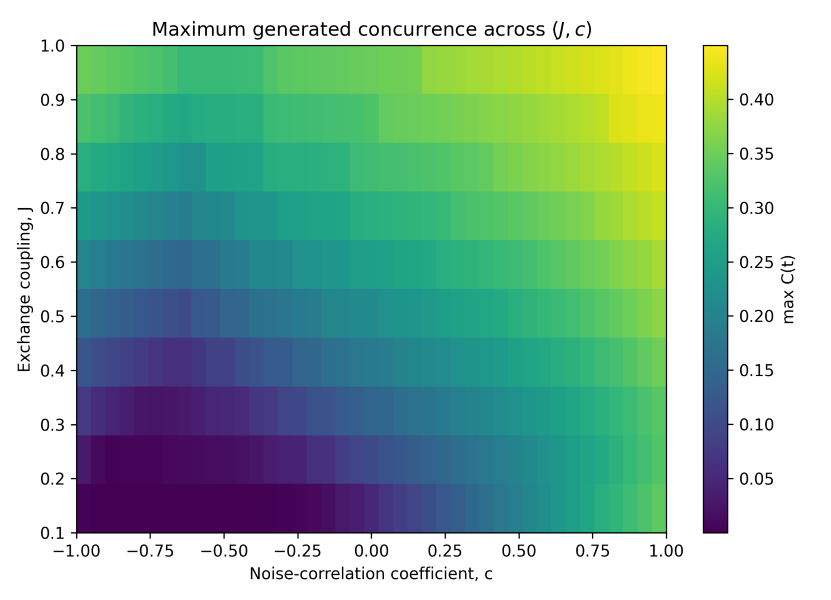
Figure 6: Maximum concurrence across the exchange-coupling/noise-correlation plane at γ=0.2 for the initial |++> state.
Dephasing Strength Versus Correlation
Figure 7 shows the corresponding dependence on γ at fixed J=0.7. As γ increases, the transient concurrence produced by the exchange interaction is suppressed. At γ=0.20, the maximum concurrence changes from 0.2834 at c=0 to 0.4095 at c=1. At γ=0.50, the corresponding values are 0.1327 and 0.3305. The difference between correlated and independent noise is therefore more apparent when dephasing competes more strongly with the coherent exchange process.
The map does not mean that correlation removes decoherence. Concurrence still decreases as the dissipative scale becomes stronger. In this model, the cross-correlation instead redistributes the decay rates of the relevant coherence sectors. That redistribution can partly protect the sectors involved in transient entanglement, but it does not remove the underlying noise scale.
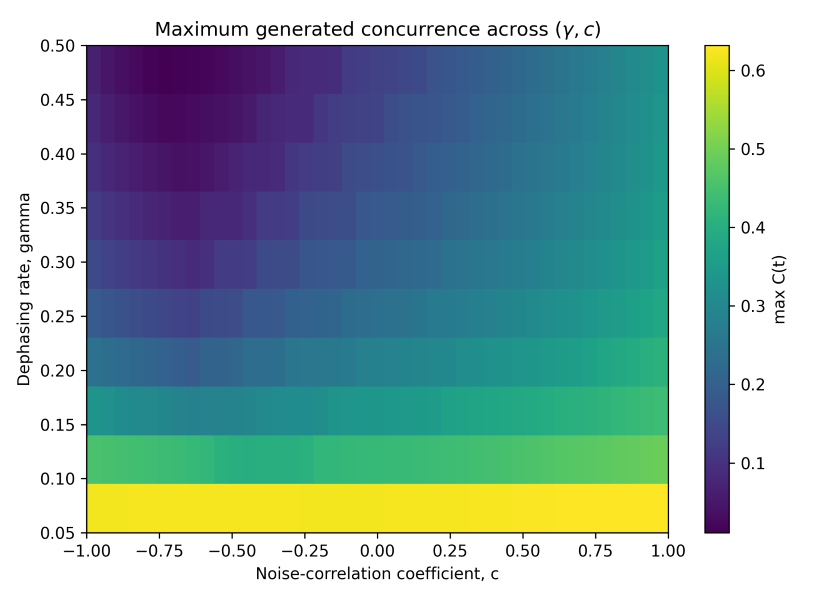
Figure 7: Maximum concurrence across the dephasing-rate/noise-correlation plane at J=0.7 for the initial |++> state.
Initial-State Dependence
The Bell-state calculations are a useful check on the apparent benefit of positive correlation. When J=0 and ω=0, |Ψ+> occupies the |01>↔|10> coherence sector. The two basis components couple with opposite signs to the local σz operators, giving a decay rate of 4γ(1−c). At c=1 this rate vanishes, so |Ψ+> is protected in the ideal pure-dephasing model. The |Φ+> state probes the opposite sector, |00>↔|11>, where the decay rate is 4γ(1+c). Positive correlation therefore increases its dephasing rate, with c=1 giving the strongest decay. The same environmental correlation consequently has opposite effects in the two Bell sectors.
This state dependence is why the main |++> result is not taken as a universal statement about correlated noise. The separable state is used to examine entanglement generation by the exchange Hamiltonian, whereas the Bell states isolate the symmetry of the dissipator. Together, the three initial states show that the effect of correlation depends on how the state is aligned with the collective noise operators.
| Initial state | c | C(20) | Cl1(20) | Average C | Interpretation |
|---|---|---|---|---|---|
| |Ψ+⟩ | 0.0 | 1.125×10⁻⁷ | 1.125×10⁻⁷ | 0.0625 | Independent dephasing. |
| |Ψ+⟩ | 0.5 | 3.355×10⁻⁴ | 3.355×10⁻⁴ | 0.1250 | Partial protection as correlation increases. |
| |Ψ+⟩ | 0.9 | 0.2019 | 0.2019 | 0.4988 | Strong retention. |
| |Ψ+⟩ | 1.0 | 1 | 1 | 1.0000 | Ideal decoherence-free limit. |
| |Φ+⟩ | 0.0 | 1.125×10⁻⁷ | 1.125×10⁻⁷ | 0.0625 | Independent dephasing. |
| |Φ+⟩ | 0.5 | 3.775×10⁻¹¹ | 3.775×10⁻¹¹ | 0.0417 | Positive correlation accelerates decay. |
| |Φ+⟩ | 0.9 | 6.267×10⁻¹⁴ | 6.262×10⁻¹⁴ | 0.0330 | Strong suppression. |
| |Φ+⟩ | 1.0 | 1.266×10⁻¹⁴ | 1.266×10⁻¹⁴ | 0.0313 | Strongest decay in this sector. |
Table 4: State-dependent response at γ=0.2, J=0.5 and ω=1
DISCUSSION
The calculations give a clear physical picture. The exchange term mixes the two-qubit basis states and generates nonseparable states from |++>. The dephasing channel then acts on the phase relations among those components. Because the correlated part of Γ depends on the joint σz structure of a pair of basis states, different off-diagonal elements do not necessarily decay at the same rate. The transient increase in concurrence seen for positive c is therefore connected to the particular coherence sectors populated by the exchange dynamics.
The results also show why coherence and entanglement need to be reported separately. In the main calculation, perfect positive correlation increases the average l1 coherence by about 145% relative to c=0, while average concurrence increases by about 147%. The similarity of these percentages is specific to this parameter set and does not imply a general proportionality. The time traces are more informative on this point: basis coherence can remain measurable after concurrence has become essentially zero. Coherence is therefore not a sufficient measure of bipartite entanglement.
The sign of the correlation coefficient gives another distinction. At J=0.7 and γ=0.2, c=−1 gives a lower peak concurrence than independent noise but a larger time-averaged concurrence. Peak generation and temporal persistence are therefore separate observables. Which quantity is more relevant depends on how the quantum state is intended to be used. This calculation does not select a single operating point; it shows the different trade-offs produced by the same environmental correlation.
Compared with earlier work, the present study is deliberately narrow. Seif et al. [12] established the importance of correlated Markovian dephasing and its relation to dissipative entanglement. Peng, [13] and Awasthi, [14] showed that the response depends strongly on the state and on the construction of the channel. Zou et al. [15] considered spatially correlated classical and quantum noise in a more general driven setting. The present calculation complements these studies by reducing the problem to a transparent two-qubit Liouvillian and following the same correlation coordinate with both transient and integrated resource measures. Its role is as a reproducible benchmark and a controlled starting point for more realistic noise models, rather than a replacement for those broader treatments.
LIMITATIONS
The model has several deliberate restrictions. The dissipator is Markovian and purely dephasing, so energy relaxation, finite-temperature amplitude damping and colored noise are not included. The Hilbert space is limited to two qubits, and the correlation coefficient is phenomenological rather than fitted to a particular device or measured cross-spectrum. The parameter maps are therefore dimensionless model landscapes, not direct predictions for a specific hardware platform. These restrictions help isolate the mechanism being studied, but they also set the limits of the conclusions.
CONCLUSION
This study investigated a two-qubit exchange-coupled open system under continuously tunable correlated Markovian dephasing by propagating its density matrix with a 16×16 Liouvillian. The Kossakowski matrix is positive semidefinite throughout the tested range −1≤c≤1. In the pure-dephasing limit, the numerical results reproduced the analytical Bell-state decay envelopes with maximum absolute errors below 7×10⁻¹⁵. Trace preservation and Hermiticity were maintained to numerical precision, while the smallest eigenvalue in the representative interacting calculation was approximately −1×10⁻¹⁶, consistent with floating-point round-off. These checks support the numerical consistency of the implementation within the assumptions of the model.
For the initially separable state |++> at J=0.7 and γ=0.2, increasing the correlation coefficient from c=0 to c=1 raised the maximum concurrence from 0.2834 to 0.4095 and the time-averaged concurrence from 0.0190 to 0.0469. The time-averaged l₁-norm coherence also increased, from 0.3125 to 0.7656. Thus, for this parameter set, positive noise correlation enhances transient entanglement generated by coherent exchange and preserves more basis coherence over the simulated interval. This enhancement is not permanent: concurrence falls close to zero by t=20, so the result should be interpreted as an improvement in transient generation and retention rather than the creation of a permanently entangled stationary state.
The continuous correlation sweep shows why peak entanglement and its temporal persistence must be reported separately. At c=−1, the peak concurrence is 0.2444, below the independent-noise value of 0.2834, whereas the time-averaged concurrence is 0.0282, above the independent-noise value of 0.0190. The parameter maps further show that the response depends on both coherent exchange and dissipation: at γ=0.2, the largest peak concurrence in the scanned (J,c) region is about 0.450 near J=1 and c=1; at γ=0.50, the reported peak changes from 0.1327 at c=0 to 0.3305 at c=1. Correlation can therefore alter the amplitude and duration of entanglement differently, and stronger dephasing still suppresses the overall transient response.
The Bell-state tests provide an important state-dependent qualification. In the ideal pure-dephasing limit, the Ψ⁺ Bell-state coherence sector decays at rate 4γ(1−c) and is protected at c=1, whereas the Φ⁺ Bell-state coherence sector decays at rate 4γ(1+c), so positive correlation accelerates its dephasing. Correlated noise is therefore neither universally beneficial nor universally harmful; its effect depends on the coherence sector populated by the state and on its interplay with the exchange Hamiltonian. The contribution of this work is not a new master equation, but a compact, validated numerical framework that places transient concurrence, time-averaged concurrence, coherence retention, exchange strength, and dephasing rate on a common correlation-dependent parameter landscape.
The findings should be interpreted within the model's deliberate scope: the environment is Markovian and purely dephasing, the system contains only two qubits, and c is a phenomenological correlation coefficient rather than a parameter fitted to a particular device. The maps are therefore dimensionless model results, not direct predictions for a specific hardware platform. They suggest that noise correlation can be a useful control coordinate to examine when assessing transient quantum resources, but the benefit must be evaluated for the state and observable of interest. Future work should test the robustness of these patterns using frequency-dependent cross-spectra or finite-memory kernels and by adding energy-relaxation channels.
CODE AND DATA AVAILABILITY
The numerical results reported in this manuscript were generated from the model and parameter sets described in Section 3. The accompanying simulation package includes the Python source code, representative CSV outputs, parameter-sweep data and the figures used in the paper. The implementation relies on standard NumPy/SciPy routines and does not require a proprietary quantum-simulation package. The code and data are provided so that the calculations can be reproduced independently.
APPENDIX A. ANALYTICAL VALIDATION IN THE PURE-DEPHASING LIMIT
With J=0 and ω=0, the computational-basis states are simultaneous eigenstates of A₁ and A₂. For two basis states |m> and |n>, let aₘ and aₙ denote their two-component eigenvalue vectors. The off-diagonal element ρₘₙ then decays exponentially at a rate given by the quadratic form (aₘ−aₙ)ᵀΓ(aₘ−aₙ)/2. For |Ψ+>, the coherence between |01> and |10> has eigenvalue difference (2,−2), giving the rate 4γ(1−c). For |Φ+>, the corresponding difference is (2,2), giving 4γ(1+c). These expressions account for the opposite response of the two Bell sectors and provide a direct benchmark for the numerical Liouvillian.
REFERENCES
- Gorini V, Kossakowski A, Sudarshan ECG. Completely positive dynamical semigroups of N-level systems. J Math Phys. 1976;17(5):821-825. [Crossref] [Google Scholar]
- Lindblad G. On the generators of quantum dynamical semigroups. Commun Math Phys. 1976;48(2):119-130. [Crossref] [Google Scholar]
- Zurek WH. Decoherence, einselection, and the quantum origins of the classical. Rev Mod Phys. 2003;75(3):715-775. [Crossref] [Google Scholar]
- Baumgratz T, Cramer M, Plenio MB. Quantifying coherence. Phys Rev Lett. 2014;113(14):140401. [Crossref] [Google Scholar]
- Streltsov A, Adesso G, Plenio MB. Colloquium: Quantum coherence as a resource. Rev Mod Phys. 2017;89(4):041003. [Crossref] [Google Scholar]
- Wootters WK. Entanglement of formation of an arbitrary state of two qubits. Phys Rev Lett. 1998;80(10):2245-2248. [Crossref] [Google Scholar]
- Yu T, Eberly JH. Sudden death of entanglement. Science. 2009;323(5914):598-601. [Crossref] [Google Scholar] [PubMed]
- Lidar DA, Chuang IL, Whaley KB. Decoherence-free subspaces for quantum computation. Phys Rev Lett. 1998;81(12):2594-2597. [Crossref] [Google Scholar]
- Klesse R, Frank S. Quantum error correction in spatially correlated quantum noise. Phys Rev Lett. 2005;95(23):230503. [Crossref] [Google Scholar]
- Wilen CD, Abdullah S, Kurinsky NA, Stanford C, Cardani L, D'Imperio G, et al. Correlated charge noise and relaxation errors in superconducting qubits. Nature. 2021;594(7863):369-373. [Crossref] [Google Scholar] [PubMed]
- Yoneda J, et al. Noise-correlation spectrum for a pair of spin qubits in silicon. Nat Phys. 2023;19:1793-1798. [Crossref] [Google Scholar]
- Seif A, Wang YX, Clerk AA. Distinguishing between quantum and classical Markovian dephasing dissipation. Phys Rev Lett. 2022;128(7):070402. [Crossref] [Google Scholar]
- Peng ZY, Wu FL, Li J, Xue HN, Liu SY, Wang ZY. Analytical method of multiqubit entanglement robustness in correlated quantum channels. Phys Rev A. 2023;107(2):022405. [Crossref] [Google Scholar]
- Awasthi N, Singh A, Kumar Joshi D. Postponing the decay of entanglement and quantum coherence for maximally entangled mixed states under the action of correlated noise channels. Front Quantum Sci Technol. 2023;2:1207793. [Crossref] [Google Scholar]
- Zou J, Bosco S, Loss D. Spatially correlated classical and quantum noise in driven qubits. npj Quantum Inf. 2024;10(1):46. [Crossref] [Google Scholar] [PubMed]