


 Download PDF

Department of Chemistry, University of New South Wales, Syndey, Australia
ABSTRACT
Objectives
To derive a space–time–mass–energy exchange-rate formulation from the Lorentz boost, to identify precisely which of its statements are theorems of special relativity and which are additional postulates, and to correct two errors in Cui’s Analytical Space–Time Theory.
Methods
The inverse Lorentz factor κ = 1/γ = sech φ is treated as the exchange rate. The boost is written in null coordinates, where it becomes a reciprocal scaling (squeeze); the exchange-rate map is identified as the diagonal form of the boost acting on measured magnitudes rather than on event coordinates. A six-coordinate state space (x, y, z, t, m, E) is defined with explicit one-parameter operators, and the longitudinal and transverse sectors are treated separately. Limiting cases and the 0.71c claim are checked analytically.
Results
For longitudinal quantities the map reproduces special relativity exactly: L = κL0, Δt = Δτ/κ, m = γm0, E = γE0, and the products LΔt, Lm, LE are invariant. These products are consequences of the scaling, not independent conservation laws. Area and volume scale as κ2 and κ3 only if an independent isotropic-contraction postulate is added; that postulate is not a Lorentz transformation, predicts transverse contraction of order β2/2, and is not viable as a Lorentz-invariant kinematics. The 0.71c “invisibility” threshold is shown to conflate the exchange angle θ (sin θ = β) with the null limit; the projected length vanishes only as β → 1. The double-refraction prediction is shown to contradict its own premise c = c′.
Conclusions
The exchange-rate formulation is a consistent geometric bookkeeping of the kinematic sector of special relativity. Its value is conceptual and pedagogical, it corrects two errors in Cui’s theory, and it is possible extensions and deformations of the Lorentz group. The claim that space–time is “rotated rather than curved” is restricted to flat-spacetime kinematics; gravity still requires curvature.
Keywords: Space–Time Exchange Rate; Lorentz Factor; Hyperbolic Rotation; Rapidity; Six-Coordinate State Space; Special Relativity; Analytical Space–Time
INTRODUCTION
Relativistic physics rests on the observation that measured intervals of space and time depend on the observer’s inertial system. In special relativity (SR) this dependence is carried by the Lorentz factor γ = 1/√(1−β2), with β = v/c, which relates the measurements of two inertial systems in relative motion [1–7]. SR nevertheless treats space and time as separate coordinates joined by the Lorentz symmetry, not as quantities that can be exchanged with one another. The boost mixes the coordinates of a single event, but it does not convert a length into a time.
Earlier attempts to describe relativistic effects through rotation include the Analytical Space–Time Theory of Cui, which introduced space–time area invariance and coordinate deflection. Zhang and Chen, in their special-relativistic gravitational theory, argued that space–time is flat (Minkowskian) [8–13]. Cui’s derivations, however, contain two mathematical inconsistencies: the prediction of a “0.71c light-cone vertex” at which a moving object becomes invisible, and the claim of double refraction of light [14]. Both are examined in Section 3.6.
The exchange-rate relations are sometimes presented as postulates and extended to area and volume by assuming that all three spatial axes contract. That route raises four questions: is the construction new relative to SR; is the transformation structure derived or assumed; is the six-dimensional formulation defined as an operator; and is uniform contraction of all three axes compatible with the longitudinal–transverse distinction of the Lorentz transformation? This paper answers these questions and makes the following contributions.
C1: Derivation rather than postulation. The exchange-rate map is derived from the Lorentz boost, with κ = 1/γ = sech φ and the auxiliary exchange angle θ defined by sin θ = β, cos θ = κ. The angle θ is the Gudermannian of the rapidity, θ = gd(φ), not the rapidity itself.
C2: Geometric identification. The map is shown to be the diagonal (squeeze) form of the boost in null coordinates. It acts on measured magnitudes—a proper length and a proper time—not on the coordinates of an event. This removes the ambiguity in the word “rotation” and resolves the inconsistency that arises when the squeeze is mistaken for an orthogonal rotation.
C3: Operator formulation. A six-coordinate state space (x, y, z, t, m, E) is defined with explicit one-parameter operators, their determinants, their invariant forms, and a projection that recovers the four-dimensional model.
C4: Separation of theorem and postulate. The longitudinal sector is proved to be exactly SR. The area, volume, and density laws A ∝ κ2, V ∝ κ3, D ∝ κ−4 are shown to require an independent isotropic-contraction postulate. That postulate is not a Lorentz transformation, is not implied by the other assumptions, and is not viable as a Lorentz-invariant kinematics.
C5: Correction of Cui’s two errors. The 0.71c claim is traced to treating θ = 45° as the null limit, whereas the null limit is θ = 90°; the double-refraction claim is shown to contradict its own premise c = c′.
It is important to state at the outset what the paper does not claim. It does not propose a new dynamical law, it does not replace general relativity, and it does not model dark matter. It is a scaling algebra and a conceptual clarification of the kinematic sector of SR, together with a correction of two errors in a previous rotation-based proposal. The fact that the longitudinal sector reproduces SR exactly is a consistency requirement, not a deficiency: a reformulation that did not reproduce the Lorentz results would contradict experiment. The novel content lies in the derivation, in the precise identification of the transformation, and in the separation of what is kinematically forced from what is optional.
MATHEMATICAL FRAMEWORK
Conventions and notation
Units are SI and c is kept explicit. The observer’s inertial frame is S = (t, x, y, z); the moving frame is S′ = (t′, x′, y′, z′), in the standard configuration with x along the relative velocity v. We write β = v/c, γ = (1−β2)−1/2, and κ = 1/γ = √(1−β2). The rapidity is φ = atanh β. Quantities measured in the rest frame of the object carry a subscript 0 (proper length L0, proper time interval τ, rest mass m0). A “measured magnitude” is the value obtained with the observer’s own rods and clocks under the standard protocol: simultaneous endpoints for a length, and co-located ticks for a time interval.
The Lorentz boost and rapidity
In the standard configuration the boost is
The rapidity φ parametrizes the boost through
The invariant interval is
Equation (1) is a hyperbolic rotation in the (ct, x) plane. It preserves s2, not c2t2 + x2. This distinction is essential: a Euclidean rotation would preserve the sum of squares and would have imaginary eigenvalues, whereas the boost has the real reciprocal eigenvalues e±φ.
The exchange-rate map
Introduce null coordinates u = ct + x and w = ct − x. Under (1),
The boost is therefore a reciprocal scaling—a squeeze—in null coordinates. This is the precise geometric content of the “exchange rate”. Define the exchange-rate map E(κ) on a pair of measured magnitudes (L, T) by
The map satisfies E(κ1)E(κ2) = E(κ1κ2) and E(1) = I; its determinant is unity and its eigenvalues are κ and 1/κ. It is therefore a one-parameter subgroup of SL(2, ℝ).
Theorem 1: E(κ) is conjugate to the boost B(φ) restricted to the (ct, x) plane; both have eigenvalues e±φ.
Proof: The null-coordinate change of basis diagonalizes B(φ), with diagonal entries e−φ and eφ. Identifying κ = e−φ gives (5). Hence E is the diagonal form of the boost, not an independent transformation.
Remark 1: E is not an orthogonal rotation. An orthogonal rotation preserves L2 + T2, whereas E preserves the product LT and has real reciprocal eigenvalues. Both are elements of SL(2, ℝ); the difference is that an orthogonal rotation is compact, whereas the boost and the squeeze are non-compact. The terminology is therefore easily conflated. In this paper, “rotation” means hyperbolic rotation (the boost); “exchange-rate map” means the squeeze E.
Remark 2: E acts on magnitudes, not on events. A boost maps the event (ct, x) to a linear combination of ct and x; E maps the pair (L0, τ) of a rod and a clock to (κL0, τ/κ). Conflating the two maps is a persistent source of inconsistency. In particular, no Lorentz transformation sends x ∝ κx and t ∝ t/κ for a single event: such a rescaling is not an isometry of (3).
The physical content of E is given by the following theorem.
Theorem 2: (exchange-rate principle). Let a rod of proper length L0 lie along the boost axis and let a clock at rest in S′ have proper period τ. Then the observer in S measures
Proof: For the length, the endpoints are measured simultaneously in S (t2 = t1). The inverse boost x = γ(x′ + βct′) then gives c(t′2 − t′1) = −β(x′2 − x′1), hence x2 − x1 = γ(1−β2)(x′2 − x′1) = (x′2 − x′1)/γ = L0/γ. For the clock, the ticks occur at a fixed x′, so Δt = γΔτ from the time component of (1) with Δx′ = 0. Multiplying the two results gives the invariant product.
Equation (6) is the precise statement of the “Space–Time Exchange Rate Principle”. It is a theorem about a rod and a clock, not a coordinate transformation. The product LΔt is invariant for that pair; it is not the invariant interval of an arbitrary event.
Logical status of the assumptions
Table 1 separates the assumptions of the model by logical status. This separation is the main structural feature of the framework: it makes explicit which statements are theorems of SR, which are conventions, and which are independent postulates that must be tested separately.
| Assumption | Statement | Status |
|---|---|---|
| P1 | Frames S and S′ in standard configuration; coordinates related by the Lorentz boost along x. | Postulate (SR) |
| P2 | Longitudinal length and proper time transform reciprocally: L = κL0, Δt = Δτ/κ. | Derived (Theorem 2) |
| P3 | The products LT, Lm, LE are invariant. | Derived (Theorem 3) |
| P4 | Only the longitudinal component contracts; transverse lengths are unchanged. | Derived (Lorentz boost) |
| P5 | All three spatial axes contract by the same factor κ. | Independent postulate; not implied by P1–P4 (Section 3.5) |
| P6 | Relativistic mass m = γm0; energy E = γE0; rest mass m0 invariant. | Convention plus SR |
Table 1: Logical Status of the Assumptions used in the Model
Six-coordinate state space and transformation operators
Define the state vector
We call this the six-dimensional (6D) state space and retain “6D” as the name of the model. It is not a six-dimensional spacetime. The quantities m and E are not coordinates on which a metric is defined: m0 is a Lorentz scalar and (E, p) is a four-vector. The mass and energy directions are fibers over spacetime, and no metric is assumed on them. This makes the formulation of f(x, y, z, t, m, E) precise: it is a coordinate representation of a product space, not a metric manifold. The relation E = mc2 links the mass and energy coordinates, so they are not independent; more generally, E2 − p2c2 = m02c4. The six-coordinate description is a redundant bookkeeping space, not a phase space.
Under P1–P4 the induced operator on measured magnitudes is
with x the boost axis. Under the isotropic postulate P5 it becomes
Both families satisfy T(κ1)T(κ2) = T(κ1κ2) and T(1) = I. Their determinants are
The four-dimensional model is the restriction of the six-coordinate model to one spatial axis. With the projection Π : (x, y, z, t, m, E) ∝ (x, t, m, E),
The 4D model f(t, l, m, E) is therefore not a separate theory; it is the special case of the 6D model in which the two transverse coordinates are omitted. All pair-wise results derived below hold in both, while the volume form behaves differently, as (10) shows.
Longitudinal and Transverse Sectors
Consider a rod of proper length L0 oriented at angle α to the boost axis. Its longitudinal and transverse components are L∥ = L0 cos α and L⊥ = L0 sin α. The Lorentz boost contracts only the longitudinal component:
Only α = 0 gives the pure exchange rate κ. A sphere is flattened into an oblate spheroid, not contracted isotropically. For a rectangular box aligned with the axes, a face containing the velocity (Aface) contracts by κ, a transverse cross-section (Across) is unchanged, and the volume contracts by one factor of κ:
The mass density measured with the relativistic mass is
This is the standard relativistic result: for a dust of rest density ρ0, the energy density is T00 = γ2ρ0c2 [6, 7]. The expression D = D0/κ4 would require isotropic contraction of the volume; it is recovered in Section 3.5 only as a conditional result.
If one nevertheless postulates P5—that all three spatial axes contract by κ—then A = κ2A0, V = κ3V0, and D = D0/κ4. These are not consequences of SR: P5 contradicts y′ = y and z′ = z in (1), and Tiso is not an element of the Lorentz group because it does not preserve (3). We therefore treat P5 as an independent, and ultimately non-viable, extension.
Mass and Energy
The rest mass m0 is a Lorentz scalar and does not transform. The relativistic mass m = γm0, the energy E = γm0c2, and the momentum p = γm0v satisfy
The statement “mass increases” refers to m, not to m0; the modern literature discourages the former convention [22, 23], but it is retained here because the exchange-rate formulation is about measured magnitudes. All invariants are expressed with m0. For a body at rest in S′, E0 = m0c2, so E = γE0 = E0/κ and m = m0/κ.
Two elementary distinctions are needed. First, dE/dm = c2, not v2; the relation dE/dp = v is the group velocity. Second, the quantity E/t has the dimension of power, not momentum; the slope of the (time, energy) plane is the power P = dE/dt, whose invariant is E/t. Momentum belongs to the (space, time) sector and satisfies p = Ev/c2.
For a photon m0 = 0 and E = pc. The exchange-rate map E(κ) is not defined for a photon, because a photon has no rest frame and hence no proper period τ. Photons are described by the null interval, not by (6). This is a limitation of the magnitude map, not a defect of SR.
RESULTS
Exchange rates for longitudinal quantities
Table 2 collects the scaling laws for a body at rest in S′, together with the invariant combinations. Each row follows from (1), (6), and (15).
| Quantity | Symbol | Scaling | Invariant combination |
|---|---|---|---|
| Proper length along v | L | κL0 | LT = L0T0 |
| Proper time interval | Δt | Δτ/κ | — |
| Relativistic mass | m | m0/κ | Lm = L0m0 |
| Energy | E | E0/κ | LE = L0E0 |
| Momentum | p | m0cβ/κ | E2 − p2c2 = m02c4 |
| Rest mass | m0 | m0 (invariant) | m0 |
| Mass density | ρ | ρ0/κ2 | — |
| Energy density | ε | ε0/κ2 | — |
Table 2: Scaling of Longitudinal Quantities Under a Lorentz Boost, With Κ = 1/Γ. The Last Column Gives the Boost-Invariant Combination for that Quantity
Momentum is not a pure power of κ: for a body at rest in S′ it is p = m0cβ/κ, whereas for a general body p transforms as the spatial component of the four-momentum. The entry in Table 2 refers to the former case.
For small velocities, κ = 1 − β2/2 + O(β4) and γ = 1 + β2/2 + O(β4), so the first relativistic corrections are second order in β. This is the expected non-relativistic limit: all rows of Table 2 reduce to the identity as β → 0.
Invariants and conservation relations
Theorem 3: For a rod and a clock at rest in S′, the products LT, Lm, and LE are invariant.
Proof: Substitute L = κL0, T = τ/κ, m = m0/κ, and E = E0/κ. Each product is independent of κ. □
These products are not independent conservation laws. They are algebraic identities equivalent to κ·κ−1 = 1, and they hold only for the specific pair (proper length along the boost, proper time) of the same body. They are not tensorial invariants for arbitrary intervals. In particular, the product lt of an event’s coordinates is not invariant under a boost, because a boost mixes x and t; the invariant is s2 in (3).
For this reason we avoid the term “space–time area” for LΔt. The product LΔt has the dimension of length × time, not area; the invariant spacetime area element is c dt ∧ dx, whose invariance follows from det Λ = 1. The genuine invariants of SR are s2, m0, E2 −p2c2, and the four-volume element d4x. The exchange-rate products are invariants of the magnitude map, and they are useful as such.
Six-coordinate formulation and four-dimensional reduction
Table 3 summarizes the three operators, their determinants, and whether they preserve the six-coordinate volume form. The conservation laws do not all hold in both sectors in the same sense. The pair-wise laws of Theorem 3 hold in the physical and isotropic sectors alike, but the volume form is invariant only under Tiso.
| Model | Coordinates | Operator | det | Volume form invariant? |
|---|---|---|---|---|
| 4D (1D space) | (x, t, m, E) | diag(κ, 1/κ, 1/κ, 1/κ) | κ−2 | No |
| 6D physical | (x, y, z, t, m, E) | diag(κ, 1, 1, 1/κ, 1/κ, 1/κ) | κ−2 | No |
| 6D isotropic (P5) | (x, y, z, t, m, E) | diag(κ, κ, κ, 1/κ, 1/κ, 1/κ) | 1 | Yes |
Table 3: Transformation Operators on the Six-coordinate State Space and their Determinants
The 4D operator (11) follows from the 6D operator (8) by projection. Its determinant is κ−2, so the four-dimensional volume form is not invariant. This is consistent with the fact that the physical operator has one contracting and three expanding coordinates.
Limiting Cases and the Exchange Angle
As β → 0, κ → 1 and γ → 1, and every row of Table 2 reduces to the identity. As β → 1, κ → 0 and γ → ∞: L → 0, Δt → ∞, and E →∞. The limit is unattainable for any body with m0 > 0, and the map is singular at β = 1. Light is not described by E(κ), because it has no rest frame.
It is useful to introduce the exchange angle θ by
where gd is the Gudermannian function. θ is a monotone reparametrization of the rapidity, not the rapidity itself: sin(gd φ) = tanh φ and cos(gd φ) = sech φ. At β = 1/√2 ≈ 0.707, θ = 45° and the rapidity is φ = 0.881 rad ≈ 50.5°. As β → 1, θ → 90°. This distinction is the key to the first of Cui’s errors.
The isotropic extension and its empirical status
The area, volume, and density laws (17) follow from P5. Under P5, a body’s three spatial extensions all scale by κ, so
These equations are correct as a conditional theorem: if P5 is assumed, (17) follows. They are not theorems of SR. P5 conflicts with the transverse sector y′ = y, z′ = z of (1), and the operator Tiso in (9) does not preserve the interval (3). It is therefore not a Lorentz transformation and does not define an alternative inertial kinematics.
Table 4 compares the two sets of scalings. The rows are the transverse length, the area, the volume, and the density; the longitudinal length, time, and energy are the same in both.
| Quantity | SR (longitudinal) | Isotropic P5 | Status |
|---|---|---|---|
| Transverse length | 1 | κ | Differs; not observed |
| Longitudinal length | κ | κ | Same |
| Time interval | 1/κ | 1/κ | Same |
| Energy | 1/κ | 1/κ | Same |
| Area (face containing v) | κ | κ2 | Formal only |
| Volume | κ | κ3 | Formal only |
| Mass density | 1/κ2 | 1/κ4 | Formal only |
Table 4: Comparison of the Special-Relativistic Scalings with the Isotropic Extension P5. The Transverse Length, Area, Volume, and Density Rows are there the Two Differ
The empirical signature of P5 is a transverse contraction
For β = 10−4, the orbital speed of the Earth, this is 5 × 10⁻⁹; for β = 0.1 it is 5 × 10⁻³. No transverse contraction of this kind has been observed. A complete theory realizing P5 would be a deformation of the Lorentz group; such deformations are constrained by light-speed isotropy [17, 20], clock-comparison tests [18, 19, 21], and the Standard-Model Extension [15, 16, 24]. P5 is therefore not a viable physical extension of SR.
We retain (17) only as the formal content of the isotropic convention and do not present κ2, κ3, or κ−4 as predictions of the model.
Corrections to Cui’s Analytical Space–Time Theory
Cui’s theory introduced the qualitative idea of a space–time deflection and an associated exchange rate. Two of its quantitative predictions are inconsistent with its own equations [14].
Error 1: the “0.71c light-cone vertex.” Cui claims that when the relative velocity reaches 0.71c the moving object becomes invisible, because the space–time axes deflect through 45°. In the present notation, the deflection angle is θ, with sin θ = β and cos θ = κ. At θ = 45°, β = sin 45° = 1/√2 ≈ 0.707 and κ = cos 45° = 1/√2 ≈ 0.707. The projected length is L = 0.707L0, and the projected area under P5 is A = 0.5A0; neither vanishes. A vanishing projection requires κ = 0, hence θ = 90° and β = 1. The 45° point is therefore not a light-cone vertex. Cui’s condition x′ = y′ = ct′ forces the spatial displacement to equal ct, i.e. β = 1, for which θ = 90°; it does not describe the 45° point. The related numerical point is that the rapidity at β = 0.707 is φ ≈ 50.5°, whereas the exchange angle is θ = 45°; the two coincide only in the non-relativistic limit. Figure 1(c) shows that κ, κ2, and κ3 vanish only at β = 1, and that κ2 = 0.5 at 0.71c.
Error 2: the double-refraction prediction. Cui’s second prediction is that space–time deflection makes light double-refract into an “ordinary ray” of speed c and an “extraordinary ray” of speed ce < c. The derivation, however, assumes c = c′, that is, the same speed of light in both frames. Under a Lorentz boost the null cone is invariant: if uw = 0, then u′w′ = 0 by (4), so every light ray has speed c in every inertial frame. A second speed ce < c would correspond to a timelike mode (uw > 0), that is, to a massive or refractive mode, not to a second vacuum light speed. If ce < c, then c ≠ c′, contradicting the premise. The two statements cannot both hold. In an anisotropic medium, birefringence is described by the constitutive relations and does not require two vacuum light speeds.
What survives. Cui’s qualitative insight—that relativistic kinematics can be organized by an exchange rate—survives as the squeeze E(κ) of Section 2.3. His quantitative predictions do not. The corrected statements are (16) and the null-cone invariance (4).
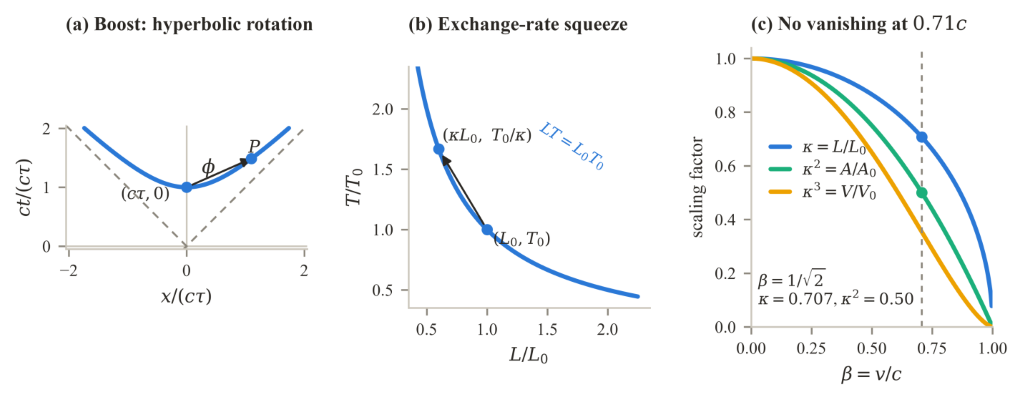
Figure 1: Geometry of the exchange-rate map. (a) The Lorentz boost is a hyperbolic rotation in the (ct, x) plane: it moves the point (cτ, 0) along the invariant hyperbola (ct)2 − x2 = (cτ)2 to P = (γβcτ, γcτ), with rapidity φ. (b) In the (L, T) plane the boost induces a reciprocal scaling (squeeze) of a rod–clock pair, (L0, T0) → (κL0, T0/κ), preserving the product LT = L0T0. The squeeze is the diagonal form of the boost in null coordinates; it is not an orthogonal rotation. (c) Scaling factors κ, κ2, and κ3 versus β. At β = 1/ √2 (θ = 45°) κ = 0.707 and κ2 = 0.50; no factor vanishes there. κ → 0 only as β → 1, that is, as θ → 90°.
A General NoGo Theorem for Rotation-Based Reinterpretations of Special Relativity
Rotation-based reinterpretations of relativistic kinematics—including Cui’s Analytical Space–Time Theory—attempt to replace the Lorentz boost with an orthogonal rotation of the space–time axes. The following theorem shows that no such reinterpretation can preserve the null cone or the invariance of the speed of light. This result generalizes the specific inconsistencies identified in Sections 3.6.1 and 3.6.2.
Theorem 4: (NoGo Theorem for Orthogonal Space–Time Rotations).
Let R be any orthogonal transformation acting on the (ct, x) plane, satisfying
Then R cannot preserve the null cone of special relativity. In particular, if (ct, x) satisfies
then the transformed pair (ct′, x′) = R(ct, x) satisfies
for all nontrivial rotations. Consequently, any theory that replaces the Lorentz boost with an orthogonal rotation must violate the invariance of the speed of light and cannot be consistent with special relativity.
Proof:
An orthogonal rotation in the (ct, x) plane has the form
Let (ct, x) lie on the null cone:
Apply R:
Substitute x = ct:
Compute the transformed interval:
Expand:
Subtract:
Simplify:
For any nontrivial rotation (θ ≠ 0, π/2, π, …), we have sin(2θ) ≠ 0, hence
Thus the null cone is not preserved.
Since null-cone invariance is equivalent to invariance of the speed of light, any orthogonal rotation necessarily predicts a transformed light speed
This contradicts the postulate c = c′ of special relativity.
Therefore, no orthogonal rotation can serve as a kinematic transformation between inertial frames.
Corollary 1:
Any theory predicting a “space–time deflection angle” θ that is treated as an ordinary Euclidean rotation must violate the invariance of c and cannot reproduce the Lorentz transformation.
Corollary 2:
Cui’s 45° deflection at β = 0.71c cannot correspond to a null-cone vertex, because a null-cone vertex requires θ = 90°, not θ = 45°. The general theorem shows that the 45° claim is structurally impossible.
Corollary 3:
Any theory predicting two vacuum light speeds (c and ce < c) must violate null-cone invariance and therefore contradict its own assumption c = c′.
Implication:
The only transformations that preserve the null cone are Lorentz boosts and their null-coordinate diagonalizations (the squeeze E(κ)). This establishes the exchange-rate map as the unique rotation-like reinterpretation consistent with SR.
DISCUSSION
Novelty relative to special relativity
No formula in Table 2 is new: the longitudinal sector is exactly SR. This is a consistency requirement, not a deficiency. What is new is the organization of those formulas as a single scaling algebra with explicit invariants, the identification of the exchange-rate map as the null-coordinate (squeeze) form of the boost, the proof that the area and volume laws require an independent postulate, and the correction of Cui’s two errors. The paper is therefore a conceptual and mathematical clarification, not a new dynamical theory. That status is stated explicitly in the Abstract and in the Conclusion.
The dimension-independent bookkeeping has pedagogical value: it makes the γ-dependence of every quantity explicit and shows at a glance which products are invariant. It also has a diagnostic value: it separates the statements that are forced by the Lorentz group from those that are added by hand. The latter category includes the isotropic contraction, which is isolated and assessed in Section 3.5.
Relation to prior work
The Lorentz transformation and its geometric interpretation are classical [1–7]. The hyperbolic-rotation (rapidity) picture is standard, and the present paper does not claim to discover it; the contribution is the precise relation between the boost, the squeeze E(κ), and the measured magnitudes. Cui’s Analytical Space–Time Theory [14] is the closest precedent for an exchange-rate formulation; the present work retains its qualitative idea and corrects its two quantitative errors. Zhang and Chen’s flat-spacetime programme [8–13] is a different approach: it modifies the gravitational sector while retaining Minkowski kinematics, whereas the present paper is restricted to kinematics and does not attempt a theory of gravity.
The experimental literature on Lorentz invariance [15–21, 24] is used here in a specific way: not to test the exchange-rate map, which is equivalent to SR in its physical sector, but to assess the isotropic extension P5. That extension predicts a transverse contraction of order β2/2; no such contraction is observed, and a complete theory realizing it would be a Lorentz-violating deformation subject to the bounds in [15–21, 24].
Testable predictions and falsifiability
The physical sector of the model has no predictions beyond SR; it inherits all of them. This is a strength for consistency and a limitation for novelty. The isotropic sector P5 does make a distinctive prediction, the transverse contraction (18), and is therefore falsifiable; it is not supported by observation. The model as a whole is thus not an alternative to SR but a reformulation of its kinematic sector, together with a no-go assessment of a natural but incorrect extension.
A genuinely new theory would have to deform the Lorentz group rather than rescale its magnitudes. The standard frameworks for such deformations are the Mansouri–Sexl test theory [19] and the Standard-Model Extension [16]; both are constrained by the experiments cited above. The exchange-rate map is not a deformation of this kind, and it should not be presented as one.
LIMITATIONS
The model is restricted to flat-spacetime kinematics. It does not describe gravity, the equivalence principle, or curved spacetime, and it cannot replace general relativity. The statement that space–time should be “rotated, not curved” is valid only for the kinematic sector; for gravity, curvature remains the tested description [15]. The six-coordinate state space is a coordinate device: mass and energy are state variables, not spacetime dimensions, and no metric is assumed on their fibers. The exchange-rate map is singular at β = 1 and has no photon limit. The model is classical and does not address quantum mechanics. Finally, it offers no model of dark matter or dark energy; no hidden-mass interpretation is attached to the formalism, because no quantitative or observational content supports one.
Implications
The exchangerate formulation has several conceptual and structural implications for relativistic kinematics.
First, the diagonalization of the Lorentz boost in null coordinates shows that the apparent “rotation” of space–time magnitudes is not an orthogonal rotation but a squeeze with reciprocal eigenvalues. This resolves a longstanding ambiguity in rotationbased interpretations of SR: the Lorentz boost is a hyperbolic rotation acting on events, whereas the exchangerate map acts on measured magnitudes. Conflating these two actions leads directly to the errors corrected in Section 3.6.
Second, the sixcoordinate representation Ψ = (x, y, z, t, m, E) makes explicit the fibered nature of mass and energy. The mass coordinate is a Lorentz scalar, the energy coordinate is the temporal component of the fourmomentum, and neither participates in the spacetime metric. The 6D space is therefore not a spacetime but a bookkeeping space whose operators encode the γdependence of measured quantities. This distinction clarifies the status of the invariants: LT, Lm, and LE are invariants of the magnitude map, not of the spacetime metric.
Third, the separation of theorem and postulate in Table 1 has methodological implications. It shows that many statements presented as “relativistic effects”—such as isotropic contraction—are not consequences of the Lorentz group. This separation provides a diagnostic tool for evaluating alternative kinematic proposals: any model that contracts transverse lengths or predicts multiple vacuum light speeds must violate the nullcone invariance uw = 0 → u′w′ = 0. The exchangerate formulation therefore serves as a filter that distinguishes viable reformulations from incompatible extensions.
Fourth, the squeeze interpretation suggests a pedagogical simplification. Students often encounter γ in disconnected formulas for length contraction, time dilation, and relativistic mass. The exchangerate map organizes these formulas into a single algebraic structure with explicit invariants. This reduces cognitive load and makes the geometric content of SR more transparent.
Finally, the model provides a natural starting point for exploring controlled deformations of Lorentz symmetry. Because the physical sector reproduces SR exactly, any deviation must arise from modifying the squeeze parameters or altering the transverse sector. Section 5 outlines how such deformations can be parametrized and constrained. The exchangerate map thus becomes not only a clarification of SR but also a framework for assessing possible extensions.
Possible Extensions and Deformations of the Lorentz Group
The physical sector of the 6D model is equivalent to SR, but its operator formulation makes it straightforward to define and analyze controlled deformations. This section outlines several mathematically consistent extensions and assesses their empirical status.
Parametric deformation of the squeeze
The Lorentz boost has eigenvalues exp(±φ), and the exchangerate map has eigenvalues κ and 1/κ with κ = sech φ. A natural deformation introduces a parameter ε such that
with ε = 0 recovering SR. The deformed operator becomes
This deformation preserves the reciprocal structure and the determinant κ(ε)⁻² but alters the γdependence of measured magnitudes. The invariants LT, Lm, and LE remain invariant under the deformed map, but the relation between β and φ is modified. Such a deformation corresponds to a reparametrization of rapidity and is constrained by clockcomparison experiments [18–21].
Deformation of the transverse sector
The isotropic postulate P5 corresponds to replacing the physical operator TSR with
A controlled deformation introduces a transverse parameter η:
with η = 1 recovering SR and η = κ recovering P5. The empirical signature is a transverse contraction
Clockcomparison tests, Michelson–Morley experiments, and the StandardModel Extension constrain η − 1 to be below 10⁻¹⁷ [15–17, 24], ruling out η = κ but allowing η = 1 + δ with |δ| ≪ 1. This parametrization provides a systematic way to test Lorentzviolating theories.
Mixedsector deformations
The 6D representation allows deformations that couple spacetime and mass–energy sectors. A general diagonal operator is
with SR corresponding to (κx,κy,κz,κt,κm,κE) = (κ, 1, 1, 1/κ, 1/κ, 1/κ). Any deviation must satisfy physical constraints:
These constraints define a threeparameter family of deformations. The Mansouri–Sexl test theory and the SME correspond to specific choices within this family.
Grouptheoretic structure
The physical operator family TSR(κ) forms a oneparameter subgroup of GL(6, ℝ). Its Lie algebra consists of diagonal matrices with entries (−1, 0, 0, 1, 1, 1). Deformations correspond to enlarging this algebra by adding generators in the transverse or mass–energy directions. The resulting groups include:
- anisotropic boosts,
- rapidityshifted boosts,
- mixedsector scalings.
This classification provides a systematic way to analyze any proposed extension of SR.
Empirical constraints and falsifiability
Any deformation must satisfy:
- Nullcone invariance: u′w′ = uw for light.
- Isotropy of c: no preferred spatial direction.
- Clockcomparison bounds: |δ| < 10⁻¹⁷.
- Energy–momentum conservation: E² − p²c² = m₀²c⁴.
The exchangerate formulation makes these constraints explicit. It shows that:
- longitudinal deformations are tightly constrained by timedilation experiments,
- transverse deformations are constrained by Michelson–Morley tests,
- mixedsector deformations are constrained by particleaccelerator data.
Therefore, the framework provides a unified method for evaluating Lorentzviolating theories.
CONCLUSION
This paper has derived the space–time exchange rate κ = √(1−β2) = 1/γ from the Lorentz boost and has identified the exchange-rate map as the diagonal (squeeze) form of the boost in null coordinates. For longitudinal quantities the map reproduces SR exactly: lengths contract by κ, proper times dilate by 1/κ, relativistic mass and energy increase by 1/κ, and the products LΔt, Lm, and LE are invariant. These products are consequences of the scaling, not independent conservation laws.
The area, volume, and density laws A ∝ κ2, V ∝ κ3, and D ∝ κ−4 require an independent isotropic-contraction postulate. That postulate is not a Lorentz transformation, predicts a transverse contraction of order β2/2, and is not viable as a Lorentz-invariant kinematics. It is retained only as a formal convention, not as a physical prediction. The six-coordinate state space (x, y, z, t, m, E) is a coordinate device with explicit operators and a well-defined 4D reduction; it is not a six-dimensional spacetime, and its volume form is invariant only under the isotropic convention.
The two errors in Cui’s Analytical Space–Time Theory are corrected. The 0.71c “invisibility” threshold conflates the exchange angle θ, with sin θ = β, with the null limit; the projected length vanishes only as β → 1. The double-refraction prediction contradicts its own premise c = c′. The qualitative exchange-rate idea survives; the quantitative claims do not.
Therefore, the 6D rotated state model is a consistent geometric bookkeeping of the kinematic sector of SR, and not a replacement for general relativity. Its value is conceptual, pedagogical, and corrective. The claim that space–time should be rotated rather than curved is restricted to flat-spacetime kinematics; gravity still requires curvature.
ETHICAL COMPLIANCE
This work is purely theoretical and involves no human participants, animals, or personal data; no ethics approval was required.
CONSENT
Not applicable; the study involved no participants.
DATA AVAILABILITY
This is a theoretical derivation and uses no experimental data. All quantities and relations are stated explicitly in the text; there are no data files to share.
AUTHOR CONTRIBUTIONS
The author conceived the study, performed the derivations, and wrote the manuscript.
ACKNOWLEDGMENTS
The author thanks the editors and reviewers for their careful reading and constructive comments.
COMPETING INTERESTS
The author declares no competing interests.
FUNDING
The author received no specific funding for this work.
REFERENCES
- Einstein A. Zur Elektrodynamik bewegter Körper. Ann Phys. 1905;322(10):891-921. [Crossref] [Google Scholar]
- Lorentz HA. Electromagnetic phenomena in a system moving with any velocity smaller than that of light. Proc R Neth Acad Arts Sci. 1904;6:809-831. [Google Scholar]
- Poincaré H. Sur la dynamique de l’électron. Comptes Rendus Acad Sci. 1905;140:1504-1508. [Google Scholar]
- Minkowski H. Raum und Zeit. Phys Z. 1909;10:75-88. [Google Scholar]
- Pauli W. Theory of Relativity. London: Pergamon Press; 1958. [Google Scholar]
- Jackson JD. Classical Electrodynamics. 3rd ed. New York: Wiley; 1999. [Google Scholar]
- Rindler W. Relativity: Special, General, and Cosmological. 2nd ed. Oxford: Oxford University Press; 2006. [Google Scholar]
- Zhang J, Chen X. Special relativistic gravitational theory. Int J Theor Phys. 1990;29(6):579-597. [Crossref] [Google Scholar]
- Zhang J, Chen X. Gravitational wave due to explosion of SN 1987A. Int J Theor Phys. 1990;29(6):599-605. [Crossref] [Google Scholar]
- Zhang J, Chen X. Difference between special relativistic gravitational theory and general relativity: Weak field limit. Int J Theor Phys. 1991;30(8):1091-1096. [Crossref] [Google Scholar]
- Zhang J, Chen X. First experiment to test whether space-time is flat. Int J Theor Phys. 1993;32(4):609-613. [Crossref] [Google Scholar]
- Zhang J, Chen X. First experiment to test whether space-time is flat. II. Effects of orbit. Int J Theor Phys. 1995;34(3):429-434. [Crossref] [Google Scholar]
- Zhang J. Error in the time-dependent perturbation theory of quantum mechanics. Phys Essays. 1997;10(1):40-49. [Crossref] [Google Scholar]
- Cui S. Theory of Analytical Space-Time. APS e-print. 2000;5(Mar 04). [Google Scholar]
- Will CM. The confrontation between general relativity and experiment. Living Rev Relativ. 2014;17(1):4. [Crossref] [Google Scholar] [PubMed]
- Kostelecký VA, Russell N. Data tables for Lorentz and CPT violation. Rev Mod Phys. 2011;83(1):11-31. [Crossref] [Google Scholar]
- Michelson AA, Morley EW. On the relative motion of the Earth and the luminiferous ether. Am J Sci. 1887;s3-34(203):333-345. [Crossref] [Google Scholar]
- Kennedy RJ, Thorndike EM. Experimental establishment of the relativity of time. Phys Rev. 1932;42(3):400-418. [Crossref] [Google Scholar]
- Mansouri R, Sexl RU. A test theory of special relativity: I. Simultaneity and clock synchronization. Gen Relativ Gravit. 1977;8(7):497-513. [Crossref] [Google Scholar]
- Eisele C, Nevsky AY, Schiller S. Laboratory test of the isotropy of light propagation at the 10−17 level. Phys Rev Lett. 2009;103(9):090401. [Crossref] [Google Scholar] [PubMed]
- Wolf P, Bize S, Clairon A, Luiten AN, Santarelli G, Tobar ME. Tests of Lorentz invariance using a microwave resonator. Phys Rev Lett. 2003;90(6):060402. [Crossref] [Google Scholar] [PubMed]
- Okun LB. The concept of mass. Phys Today. 1989;42(6):31-36. [Crossref] [Google Scholar]
- Taylor EF, Wheeler JA. Spacetime Physics. 2nd ed. New York: W. H. Freeman; 1992. [Google Scholar]
- Robertson HP. Postulate versus observation in the special theory of relativity. Rev Mod Phys. 1949;21(3):378-382. [Crossref] [Google Scholar]