
Journal of Artificial Intelligence and Digital Health
ISSN:
3139-6267 (Online)
DOI Prefix (Crossref): 10.67238
 Download PDF

Department of Research, Policy and AI Governance, Independent Researcher, Ogbomosho, Nigeria
ABSTRACT
Background
Nanobiotechnology integrates nanoscale materials with biological systems, enabling significant advances in targeted drug delivery, biosensing, molecular diagnostics, regenerative medicine, and environmental monitoring. Despite these advances, the complexity of nano–bio interactions and the multidimensional design space of nanomaterials present substantial challenges to conventional experimental approaches. Artificial intelligence (AI), particularly machine learning and deep learning, has emerged as a powerful tool for modelling, predicting, and optimising nano–bio systems, thereby accelerating innovation and improving decision-making across biomedical and environmental applications.
Objective
This review provides a comprehensive overview of AI-integrated nanobiotechnology, with particular emphasis on AI-assisted nanomaterial design, precision medicine, smart diagnostic technologies, cancer therapeutics, environmental and agricultural applications, and food safety. It also critically examines current ethical, biosafety, regulatory, and commercialisation challenges while identifying emerging research directions.
Methods
I conducted a comprehensive review of peer-reviewed literature published between 2019 and 2026 on the application of artificial intelligence in nanobiotechnology. The review synthesises evidence relating to AI-driven nanomaterial optimisation, intelligent drug delivery systems, nano-biosensors, precision medicine, environmental monitoring, and regulatory developments. Where appropriate, supplementary questionnaire findings are incorporated to provide additional insights into stakeholder perceptions of AI-assisted nanobiotechnology.
Results
The reviewed literature demonstrates that AI has substantially improved the prediction of nano–bio interactions, accelerated nanomaterial design and optimisation, enhanced the performance of intelligent drug delivery systems, and strengthened the analytical capabilities of nano-enabled diagnostic platforms. AI has also expanded opportunities for environmental monitoring, agricultural nanobiotechnology, and pollutant detection through intelligent sensing and predictive modelling. Despite these advances, challenges related to data quality, model interpretability, biosafety assessment, regulatory harmonisation, and ethical governance continue to limit large-scale clinical and industrial implementation.
Conclusion
AI-integrated nanobiotechnology represents a rapidly evolving multidisciplinary field with considerable potential to transform precision medicine, smart diagnostics, environmental sustainability, and advanced healthcare. Continued progress will depend on high-quality data generation, explainable AI models, robust biosafety validation, and internationally harmonised regulatory frameworks that promote safe, transparent, and responsible innovation.
Keywords: Artificial Intelligence; Nanobiotechnology; Machine Learning; Precision Medicine; Smart Diagnostics; Nano-Biosensors; Nanocarriers; Cancer Nanotherapy; Environmental Monitoring; Biosafety
INTRODUCTION
Nanobiotechnology is an interdisciplinary field that integrates nanotechnology with the biological sciences to develop nanoscale materials, devices, and systems capable of interacting with biological environments for medical, industrial, agricultural, and environmental applications. The unique physicochemical properties of nanomaterials, including their high surface-area-to-volume ratio, tunable surface chemistry, and enhanced biological functionality, have enabled significant advances in targeted drug delivery, molecular imaging, biosensing, tissue engineering, regenerative medicine, and environmental remediation. These developments have positioned nanobiotechnology as a key enabling technology for addressing complex challenges in healthcare, food safety, environmental sustainability, and precision agriculture.
Despite these advances, the successful design and translation of nanobiotechnology-based systems remain challenging because nano–bio interactions are governed by highly complex and dynamic biological processes. Factors such as nanoparticle size, morphology, surface charge, composition, protein corona formation, cellular uptake mechanisms, biodistribution, biodegradation, and immunological responses collectively influence the safety and performance of nanomaterials. Conventional experimental approaches for optimising these parameters are often labor-intensive, time-consuming, and costly, particularly when numerous variables must be evaluated simultaneously. Consequently, there is increasing interest in computational approaches capable of accelerating nanomaterial discovery and improving predictive accuracy [1,2].
Artificial intelligence (AI), particularly machine learning, deep learning, reinforcement learning, and generative modelling, has emerged as a transformative technology for addressing these challenges. AI algorithms can analyse large and complex datasets, identify hidden relationships among physicochemical and biological variables, predict nano–bio interactions, optimize nanocarrier formulations, improve biosensor performance, and support data-driven decision-making throughout the nanobiotechnology development pipeline. Recent advances in high-throughput experimentation, multi-omics technologies, cloud computing, and explainable AI have further strengthened the integration of AI into nanobiotechnology, enabling more efficient material design, personalized therapeutic strategies, intelligent diagnostic systems, and environmentally sustainable applications.
The convergence of AI and nanobiotechnology has generated considerable interest across multiple application domains. In precision medicine, AI facilitates patient stratification, optimizes nanocarrier design, predicts therapeutic responses, and supports personalized drug delivery strategies. In smart diagnostics, AI enhances the analytical performance of nano-enabled biosensors through advanced signal processing, image analysis, and real-time clinical decision support. Beyond healthcare, AI-integrated nanobiotechnology is increasingly applied to environmental monitoring, pollutant detection, agricultural nanotechnology, food safety surveillance, and intelligent biosensing systems capable of operating in real-time under diverse conditions. These developments demonstrate the growing role of AI in improving the efficiency, reliability, and scalability of nanobiotechnology applications [3].
Although numerous studies have reported important advances in AI-assisted nanomaterial design and biomedical applications, the available literature remains fragmented across different disciplines, with relatively few reviews providing an integrated perspective that encompasses healthcare, environmental, agricultural, diagnostic, regulatory, ethical, and commercial dimensions. Furthermore, challenges relating to data quality, model interpretability, reproducibility, biosafety evaluation, regulatory compliance, and responsible AI governance continue to influence the successful translation of AI-enabled nanobiotechnology from laboratory research to clinical and industrial practice.
Accordingly, this review provides a comprehensive synthesis of recent advances in AI-integrated nanobiotechnology published between 2019 and 2026. I critically examine the application of AI in nanomaterial design and optimization, precision medicine, smart drug delivery, biosensing technologies, cancer diagnosis and therapy, environmental and agricultural applications, food safety, and emerging intelligent nano-bio systems. I also discuss current biosafety, ethical, regulatory, and commercialization challenges while highlighting key research gaps and future opportunities for the responsible development of AI-enabled nanobiotechnology [4,5].
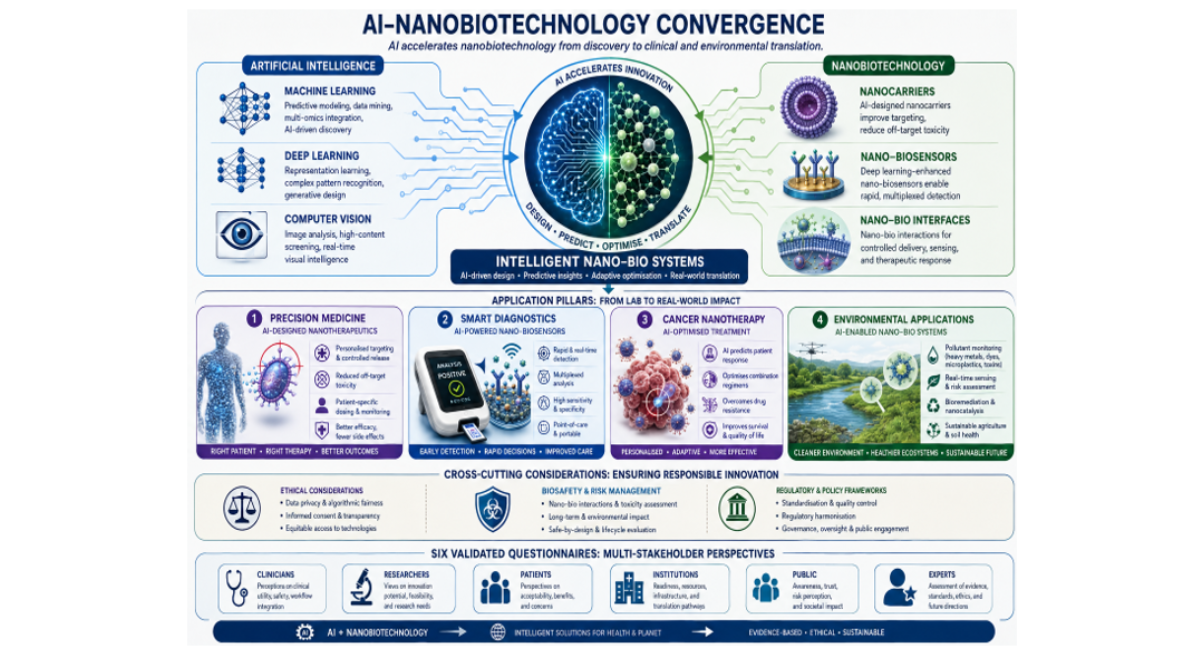
Figure: Graphical Abstract - AI-Nanobiotechnology Convergence
Fundamentals of Nanobiotechnology
Definition and Scope
Nanobiotechnology is an interdisciplinary field that combines the principles of nanotechnology, biology, chemistry, materials science, and medicine to develop nanoscale materials and systems capable of interacting with biological environments. Generally, nanomaterials range from 1 to 100 nm in at least one dimension and possess unique physicochemical properties, including high surface-area-to-volume ratios, tunable surface chemistry, enhanced reactivity, and improved biological functionality. These characteristics enable applications in targeted drug delivery, molecular imaging, biosensing, tissue engineering, regenerative medicine, environmental remediation, agriculture, and food safety.
Unlike nanomedicine, which primarily focuses on disease diagnosis, prevention, and treatment, nanobiotechnology encompasses a broader spectrum of biological applications involving nano–bio interfaces, biomimetic materials, bio-inspired nanostructures, synthetic biological systems, and nano-enabled analytical platforms. The integration of nanotechnology with biological systems has accelerated the development of intelligent nanomaterials capable of responding to physiological and environmental stimuli while improving therapeutic precision, diagnostic accuracy, and environmental sustainability.
Key Nano–Bio Interactions
The performance of nanomaterials is largely determined by their interactions with biological systems following administration or environmental exposure. These nano–bio interactions influence biodistribution, cellular uptake, therapeutic efficacy, toxicity, and long-term biocompatibility.
One of the earliest biological events following nanoparticle exposure is the formation of a protein corona, whereby proteins and other biomolecules rapidly adsorb onto the nanoparticle surface. The composition of this corona modifies the biological identity of the nanoparticle, influencing immune recognition, circulation time, cellular uptake, and tissue distribution. Understanding protein corona formation has therefore become essential for designing nanomaterials with predictable biological behaviour.
Nanoparticles also interact directly with cellular membranes through multiple uptake mechanisms, including clathrin-mediated endocytosis, caveolae-mediated endocytosis, macropinocytosis, and passive membrane penetration. These interactions are influenced by nanoparticle size, shape, surface charge, hydrophobicity, and surface functionalisation. Optimising these physicochemical characteristics improves intracellular delivery while minimising undesirable cytotoxicity [6].
Following internalisation, nanoparticles undergo complex intracellular trafficking pathways involving endosomal transport, lysosomal degradation, cytoplasmic release, organelle targeting, or exocytosis. Successful therapeutic nanocarriers are often designed to promote efficient endosomal escape, thereby increasing intracellular bioavailability of drugs, nucleic acids, proteins, or gene-editing components while reducing premature degradation.
Major Nanocarriers in Nanobiotechnology
Several classes of nanocarriers have been developed to address different biomedical and environmental applications. Their selection depends on therapeutic objectives, payload characteristics, targeting requirements, biodegradability, and safety profiles. Lipid-based nanocarriers remain widely used because of their excellent biocompatibility and clinical success in mRNA vaccine delivery. Polymeric nanoparticles provide controlled drug release and flexible surface modification, whereas inorganic nanomaterials offer unique optical, magnetic, and catalytic properties suitable for imaging, sensing, and photothermal therapy. Biological nanocarriers, including exosomes, viral vectors, and DNA origami structures, have attracted increasing attention because of their intrinsic biocompatibility, low immunogenicity, and high targeting specificity [7-10].
Major Nanocarriers in Nanobiotechnology
|
Class |
Examples |
Typical Size |
Key Feature |
|
Lipid‑based |
Liposomes, solid lipid NPs, nanostructured lipid carriers |
50–200 nm |
High biocompatibility, efficient encapsulation, clinically established |
|
Polymeric |
PLGA, PLA, chitosan, PEGylated nanoparticles |
50–300 nm |
Controlled drug release, surface functionalisation, biodegradability |
|
Inorganic |
Gold nanoparticles, iron oxide nanoparticles, silica nanoparticles, quantum dots |
2–100 nm |
Imaging, biosensing, photothermal therapy, magnetic targeting |
|
Biological |
Exosomes, viral capsids, DNA origami, extracellular vesicles |
10–150 nm |
Natural targeting, low immunogenicity, high biological compatibility |
Overall, advances in nanocarrier engineering have provided the foundation for integrating artificial intelligence into nanobiotechnology. By combining high-quality experimental datasets with machine learning algorithms, researchers can predict nano–bio interactions, optimise nanocarrier design, reduce experimental complexity, and accelerate the translation of innovative nanomaterials into clinical and environmental applications.
Role of Artificial Intelligence in Nanobiotechnology
Artificial Intelligence Techniques Applied in Nanobiotechnology
Artificial intelligence has emerged as a transformative technology for nanobiotechnology by enabling the analysis of complex, high-dimensional datasets that are often beyond the capability of conventional statistical approaches. The integration of machine learning, deep learning, reinforcement learning, and generative artificial intelligence has accelerated nanomaterial discovery, optimized nano–bio interactions, improved predictive modelling, and supported data-driven decision-making throughout the nanobiotechnology development pipeline [11-14].
Machine learning algorithms such as Random Forest (RF), Support Vector Machines (SVM), and Gradient Boosting Machines are widely employed to predict nanoparticle physicochemical properties, protein corona formation, cellular uptake, biodistribution, toxicity, and therapeutic performance. These models effectively identify nonlinear relationships between nanoparticle characteristics and biological responses, thereby reducing reliance on extensive experimental screening.
Deep learning techniques have further expanded the capabilities of nanobiotechnology. Artificial Neural Networks (ANNs) and Deep Neural Networks (DNNs) are increasingly used to predict drug encapsulation efficiency, controlled-release behaviour, nanoparticle stability, and pharmacokinetic performance. Convolutional Neural Networks (CNNs) have demonstrated exceptional performance in analysing microscopy images, histopathology slides, transmission electron microscopy (TEM) images, fluorescence imaging, and nanoparticle morphology, thereby improving diagnostic accuracy and automated image interpretation. Likewise, Recurrent Neural Networks (RNNs) and Long Short-Term Memory (LSTM) networks are particularly valuable for modelling time-dependent biological processes, including drug-release kinetics, disease progression, and continuous biosensor monitoring [15].
More recently, Reinforcement Learning (RL) has been introduced to optimise nanoparticle synthesis, adaptive drug dosing, autonomous laboratory experimentation, and closed-loop manufacturing systems. In parallel, generative artificial intelligence models, including Generative Adversarial Networks (GANs), Variational Autoencoders (VAEs), and diffusion models, have enabled inverse nanomaterial design by generating novel nanocarrier structures with predefined physicochemical and biological properties, substantially reducing experimental development time.
|
AI Technique |
Primary Application in Nanobiotechnology |
|
Random Forest (RF) |
Prediction of protein corona formation, toxicity, and nanoparticle performance |
|
Support Vector Machines (SVM) |
Classification of cellular uptake, toxicity, and diagnostic biomarkers |
|
Artificial Neural Networks (ANN) |
Prediction of nanocarrier properties, drug loading, and release behaviour |
|
Convolutional Neural Networks (CNN) |
Convolutional Neural Networks (CNN) |
|
Recurrent Neural Networks (RNN) / LSTM |
Recurrent Neural Networks (RNN) / LSTM |
|
Reinforcement Learning (RL) |
Reinforcement Learning (RL) |
|
Generative AI (GANs, VAEs, Diffusion Models) |
Generative AI (GANs, VAEs, Diffusion Models) |
Table 1: Summarises The Principal AI Techniques Currently Applied Across Nanobiotechnology Applications
Data Resources Supporting AI-Driven Nanobiotechnology
The successful application of AI depends on the availability of high-quality, standardised, and interoperable datasets. Over the past decade, several publicly accessible databases and ontologies have been developed to support nanobiotechnology research by providing curated information on nanomaterial composition, physicochemical characteristics, biological interactions, toxicity, and clinical applications.
The NanoParticle Ontology (NPO) provides a standardised vocabulary for describing nanomaterials and their biological characteristics, thereby facilitating data integration and interoperability across studies. CaNanoLab serves as a comprehensive repository of nanotechnology data related to cancer research, including nanoparticle formulations, imaging agents, therapeutic systems, and preclinical evaluations. The Nanomaterial Registry compiles physicochemical and toxicological information for a wide range of engineered nanomaterials, supporting environmental health and safety assessments. In addition, PubChem BioAssay contains extensive biological activity and toxicity datasets that are increasingly utilised for AI-based prediction of nano–bio interactions and hazard assessment.
The continued expansion of these repositories is essential for improving model reproducibility, reducing data heterogeneity, and enabling the development of more robust and generalisable AI algorithms.
Workflow for AI-Driven Nanobiotechnology
The development of AI-enabled nanobiotechnology systems typically follows a structured and iterative workflow that combines experimental research with computational modelling. The process begins with data acquisition from high-throughput experiments, published literature, laboratory databases, and publicly available repositories. These datasets are subsequently preprocessed through data cleaning, feature engineering, normalisation, and dimensionality reduction to improve model performance [16-19].
Following preprocessing, AI models are trained using supervised, unsupervised, or reinforcement learning techniques. Model performance is evaluated using internal validation methods, including cross-validation, independent test datasets, and external validation where available. Once validated, the trained models are employed to predict nanoparticle behaviour, optimise formulation parameters, estimate biological responses, and prioritise candidate nanomaterials for experimental investigation.
Predicted outcomes are subsequently verified through in vitro experiments, animal studies, or clinical investigations. Experimental findings are then incorporated into subsequent rounds of model refinement through active learning and continuous feedback, allowing AI systems to improve progressively as additional data become available. This iterative framework substantially reduces experimental cost and development time while improving prediction accuracy and accelerating innovation across nanobiotechnology research.
The integration of AI with high-throughput experimentation, laboratory automation, and autonomous research platforms is expected to further transform nanobiotechnology by enabling self-optimising systems capable of continuously improving nanomaterial discovery and biomedical innovation.
Ai‑Assisted Nanomaterial Design and Optimization
Prediction of Nanomaterial Properties
The rational design of nanomaterials requires accurate prediction of physicochemical properties that directly influence biological performance, therapeutic efficacy, and safety. Conventional optimisation strategies rely heavily on iterative laboratory experimentation, which is often expensive and time-consuming because multiple synthesis parameters must be evaluated simultaneously. Artificial intelligence has significantly improved this process by enabling rapid prediction of nanomaterial characteristics using large experimental datasets.
Machine learning algorithms are increasingly employed to predict nanoparticle size, morphology, polydispersity, surface charge, drug encapsulation efficiency, biodegradation, and colloidal stability based on synthesis conditions such as precursor concentration, reaction temperature, solvent composition, mixing rate, and pH. Regression-based models, Random Forest algorithms, Support Vector Regression, and artificial Neural Networks have demonstrated strong predictive performance for estimating these properties, allowing researchers to identify optimal formulations before laboratory validation.
In addition to physicochemical characterisation, AI models are being applied to predict biological properties including protein corona formation, cellular uptake, biodistribution, circulation half-life, immunogenicity, and nanotoxicity. These predictive capabilities reduce experimental uncertainty and facilitate the development of safer and more effective nanomaterials [20].
AI-Guided Inverse Design of Nanocarriers
Recent advances in generative artificial intelligence have introduced inverse design strategies that fundamentally change nanomaterial development. Rather than experimentally testing thousands of candidate formulations, generative models can propose entirely new nanocarrier structures that satisfy predefined biological and physicochemical objectives.
Generative Adversarial Networks (GANs), Variational Autoencoders (VAEs), diffusion models, and graph neural networks have been successfully applied to design lipid nanoparticles, polymeric nanocarriers, inorganic nanostructures, and hybrid nano-bio systems with improved stability, targeting capability, drug-loading efficiency, and controlled-release behaviour. These approaches enable simultaneous optimisation of multiple design variables while substantially reducing development time and experimental cost.
AI-guided inverse design is particularly valuable for developing lipid nanoparticles for nucleic acid therapeutics, where optimal combinations of ionisable lipids, helper lipids, cholesterol, and polyethylene glycol components can be computationally identified before experimental synthesis.
Optimisation of Nanoparticle Synthesis
Artificial intelligence has also transformed nanoparticle manufacturing by optimising synthesis parameters through continuous learning and adaptive decision-making. Bayesian optimisation algorithms efficiently explore complex experimental design spaces by selecting the most informative experiments while minimising the total number of laboratory trials required.
Reinforcement learning further extends this capability by enabling autonomous control of synthesis processes in microfluidic reactors and automated laboratory systems. These algorithms continuously adjust reaction variables, including flow rate, temperature, precursor concentration, and mixing conditions, to achieve desired nanoparticle characteristics in real time.
The integration of AI with laboratory automation has led to the emergence of self-driving laboratories capable of independently planning experiments, analysing results, updating predictive models, and selecting subsequent experiments with minimal human intervention. Such platforms represent an important step towards autonomous nanomaterial discovery [20-25].
Multi-Objective Optimisation
Nanomaterial development frequently requires the simultaneous optimisation of multiple performance indicators, many of which exhibit competing relationships. For example, increasing drug loading may reduce nanoparticle stability, whereas prolonged circulation time may influence cellular uptake or biodegradability.
Multi-objective optimisation algorithms provide an effective solution by evaluating numerous design variables simultaneously while balancing competing objectives. Evolutionary algorithms, genetic algorithms, particle swarm optimisation, Bayesian optimisation, and Pareto optimisation techniques are increasingly employed to maximise therapeutic efficacy while minimising toxicity, manufacturing complexity, and production cost.
Pareto front analysis enables researchers to visualise trade-offs among competing objectives and identify formulations that offer the best overall balance of safety, efficacy, stability, and manufacturability. These computational approaches substantially reduce experimental workload while improving the efficiency of nanomaterial optimisation [26].
Current Challenges and Future Perspectives
Despite remarkable progress, several challenges continue to limit the widespread application of AI in nanomaterial design. Many predictive models are developed using relatively small, heterogeneous, or laboratory-specific datasets, which limits their generalisability across different experimental settings. Variability in nanomaterial characterisation methods, inconsistent reporting standards, and incomplete metadata further constrain model reproducibility and external validation.
Another important limitation is the limited interpretability of many deep learning models. Although these algorithms often achieve excellent predictive accuracy, their decision-making processes remain difficult to explain, creating challenges for scientific understanding, regulatory acceptance, and clinical translation. Explainable AI approaches are therefore receiving increasing attention as researchers seek to improve transparency while maintaining predictive performance [27].
Future research should focus on integrating multimodal datasets, high-throughput experimentation, digital twins, autonomous laboratories, federated learning, and explainable AI to accelerate nanomaterial discovery. The combination of AI with advanced computational chemistry, molecular simulation, and robotic experimentation is expected to substantially reduce development timelines while improving the safety, reliability, and clinical translation of next-generation nanobiotechnology.
Nanobiotechnology In Precision Medicine
Concept of Precision Nanomedicine
Precision medicine seeks to tailor disease prevention, diagnosis, and treatment according to an individual's genetic profile, molecular biomarkers, physiological characteristics, lifestyle, and environmental exposures. Nanobiotechnology has significantly advanced this paradigm by enabling the development of targeted nanocarriers capable of delivering therapeutic agents selectively to diseased tissues while minimizing systemic toxicity. The incorporation of artificial intelligence has further strengthened precision nanomedicine by integrating complex clinical, imaging, genomic, proteomic, metabolomic, and pharmacological data to support personalised therapeutic decision-making [28].
Unlike conventional therapeutic strategies, AI-assisted precision nanomedicine enables predictive modelling of patient responses, optimisation of nanocarrier formulations, and individualised treatment planning. By combining computational intelligence with nanoscale engineering, researchers can design therapeutic systems that maximise treatment efficacy while reducing adverse effects and improving overall clinical outcomes.
Artificial Intelligence for Patient Stratification
Patient stratification is a critical component of precision medicine because individuals with the same clinical diagnosis often exhibit substantial biological heterogeneity. Artificial intelligence enables the identification of clinically meaningful patient subgroups through the analysis of multidimensional datasets derived from genomics, transcriptomics, proteomics, metabolomics, radiomics, electronic health records, and medical imaging.
Machine learning and deep learning algorithms have demonstrated considerable success in predicting disease progression, therapeutic response, and treatment resistance across numerous disease conditions, particularly cancer. These predictive capabilities facilitate the selection of patients most likely to benefit from specific nano-enabled therapies while reducing unnecessary treatment exposure. AI-driven patient stratification also supports biomarker discovery, companion diagnostics, and adaptive treatment planning, thereby improving the efficiency of precision medicine.
Personalised Nanocarrier Design and Therapeutic Dosing
Artificial intelligence has become an important tool for optimising nanocarrier design and individualising therapeutic dosing. Machine learning models analyse patient-specific variables, including age, body weight, organ function, genetic variations, biomarker profiles, disease stage, and pharmacokinetic parameters, to predict optimal drug dosage and treatment schedules.
In parallel, AI facilitates the design of nanocarriers with tailored physicochemical characteristics that improve drug encapsulation, targeted delivery, controlled release, and biological compatibility. Reinforcement learning and Bayesian optimisation have demonstrated considerable potential for continuously refining treatment strategies based on patient responses, creating adaptive therapeutic systems capable of supporting personalised clinical care.
The integration of AI with pharmacokinetic and pharmacodynamic modelling further enhances dose optimisation by predicting drug distribution, metabolism, clearance, and therapeutic efficacy before treatment is initiated. These approaches have the potential to reduce toxicity while maximising therapeutic benefit.
Prediction of Nano–Bio Interactions
Understanding nano–bio interactions remains fundamental to the safe and effective application of nanomedicine. Artificial intelligence provides advanced predictive capabilities for modelling interactions between nanomaterials and biological systems, including protein corona formation, cellular uptake, immune recognition, intracellular trafficking, biodistribution, biodegradation, and toxicity.
Machine learning algorithms can analyse large experimental datasets to identify the physicochemical characteristics that most strongly influence biological behaviour. Such predictive models assist researchers in selecting nanoparticle formulations with favourable safety profiles and improved therapeutic performance before laboratory or clinical validation. This capability significantly reduces experimental costs while accelerating the development of clinically translatable nanomedicines.
Clinical Applications and Emerging Opportunities
The integration of AI with nanobiotechnology has expanded rapidly across numerous areas of clinical medicine. In oncology, AI-guided nanocarriers facilitate targeted delivery of chemotherapeutic agents, immunotherapies, gene-editing systems, and messenger RNA therapeutics while reducing off-target toxicity. Similar advances are emerging in cardiovascular medicine, neurology, infectious diseases, regenerative medicine, and rare disease therapeutics, where intelligent nanocarriers improve treatment precision and monitoring.
Recent developments in multimodal AI, digital twins, wearable biosensors, and real-time patient monitoring are further extending the capabilities of precision nanomedicine. These technologies enable continuous assessment of therapeutic response and support adaptive treatment strategies that evolve according to changes in patient physiology. As clinical datasets continue to expand, AI-assisted precision nanomedicine is expected to become increasingly predictive, personalised, and clinically accessible.
Although substantial progress has been achieved, challenges remain regarding data interoperability, model transparency, regulatory approval, long-term safety evaluation, and equitable access to AI-enabled healthcare technologies. Addressing these issues will be essential for the successful translation of precision nanomedicine into routine clinical practice.
Smart Drug Delivery Systems and Targeted Therapeutics
Challenges in Conventional Drug Delivery
Conventional drug delivery systems frequently encounter limitations that reduce therapeutic effectiveness and increase the risk of adverse effects. Many therapeutic agents exhibit poor aqueous solubility, limited bioavailability, rapid systemic clearance, and inadequate accumulation at target sites. Consequently, high drug doses are often required to achieve therapeutic efficacy, increasing the likelihood of off-target toxicity and treatment-related complications. Biological barriers such as the blood–brain barrier, tumour microenvironment, immune clearance, and intracellular trafficking further restrict drug delivery to diseased tissues.
Nanobiotechnology has addressed many of these challenges by enabling the development of nanocarriers capable of protecting therapeutic agents, prolonging systemic circulation, enhancing tissue penetration, and providing controlled or stimuli-responsive drug release. Nevertheless, identifying the optimal nanocarrier composition, physicochemical properties, and release profile remains a complex optimisation problem involving numerous interdependent variables.
Artificial Intelligence for Smart Drug Delivery
Artificial intelligence has become an important tool for optimising smart drug delivery systems by analysing large experimental datasets and identifying relationships between nanocarrier characteristics and therapeutic performance. Machine learning algorithms can simultaneously evaluate formulation variables, biological responses, pharmacokinetic behaviour, and treatment outcomes, enabling more efficient optimisation than conventional experimental approaches.
Genetic algorithms, Bayesian optimisation, and evolutionary computing techniques are increasingly employed to optimise nanocarrier composition, particle size, encapsulation efficiency, surface functionalisation, and release kinetics. Deep learning models further enhance predictive capabilities by modelling nonlinear relationships between nanoparticle properties and drug delivery performance, thereby reducing the number of experimental iterations required during formulation development.
Artificial intelligence also facilitates the design of stimuli-responsive nanocarriers capable of releasing therapeutic agents in response to environmental triggers such as pH, temperature, enzymatic activity, oxidative stress, magnetic fields, ultrasound, or light. These intelligent delivery systems improve therapeutic precision while minimising systemic toxicity.
AI-Assisted Targeted Therapeutics
Targeted therapeutics represent one of the most significant applications of AI-integrated nanobiotechnology. By combining predictive modelling with nanoscale engineering, AI enables the identification of optimal targeting ligands, receptor interactions, drug combinations, and nanoparticle surface modifications that maximise selective accumulation within diseased tissues.
Deep learning, graph neural networks, and reinforcement learning algorithms have demonstrated considerable potential for predicting receptor–ligand interactions, nanoparticle internalisation, intracellular trafficking, and therapeutic response. These computational approaches accelerate the development of targeted nanomedicines for cancer, cardiovascular diseases, neurological disorders, inflammatory diseases, and infectious diseases while reducing reliance on extensive laboratory experimentation.
AI also supports combination therapy by identifying synergistic drug combinations and optimising drug-loading ratios within multifunctional nanocarriers. Such approaches improve therapeutic efficacy while reducing drug resistance and treatment-associated toxicity.
Clinical Translation of AI-Enabled Drug Delivery
The translation of AI-assisted nanomedicine from laboratory research to clinical practice has accelerated in recent years. AI-supported formulation optimisation, predictive pharmacokinetic modelling, and digital manufacturing platforms have improved the efficiency of preclinical development while supporting more informed clinical decision-making.
Several lipid nanoparticle systems used for messenger RNA therapeutics have demonstrated the value of computational optimisation during formulation refinement and manufacturing. AI is also increasingly incorporated into model-informed drug development, where predictive algorithms assist dose selection, patient stratification, safety evaluation, and adaptive clinical trial design. These developments contribute to reducing development timelines while improving regulatory confidence in nanomedicine products.
Although clinical adoption continues to expand, widespread implementation remains constrained by limited availability of large, standardised datasets, insufficient external validation of predictive models, and evolving regulatory frameworks governing AI-assisted therapeutics.
Future Perspectives
Future smart drug delivery systems are expected to integrate nanotechnology, artificial intelligence, biosensing, wearable devices, and digital health platforms into intelligent therapeutic ecosystems capable of continuously monitoring patient responses and adapting treatment in real time.
Emerging technologies such as digital twins, autonomous microfluidic synthesis platforms, self-driving laboratories, explainable artificial intelligence, federated learning, and multimodal machine learning are expected to further improve nanocarrier optimisation and personalised therapeutic delivery. These innovations have the potential to transform precision medicine by enabling safer, more effective, and highly individualised treatment strategies while reducing development costs and accelerating clinical translation.
Continued progress will require multidisciplinary collaboration among materials scientists, clinicians, computer scientists, regulatory agencies, and industry partners to establish robust standards for data quality, model validation, biosafety assessment, and responsible implementation of AI-enabled drug delivery technologies.
Ai-Powered Biosensors and Smart Diagnostic Technologies
Nano-Biosensor Technologies
Nano-biosensors combine nanomaterials with biological recognition elements to enable rapid, sensitive, and selective detection of biological and chemical analytes. The incorporation of nanomaterials enhances sensor performance through improved electrical conductivity, optical properties, catalytic activity, and signal amplification. Consequently, nano-biosensors have become indispensable tools for disease diagnosis, environmental monitoring, food safety, and biomedical research.
Several classes of nano-biosensors have been developed for different analytical applications. Electrochemical biosensors utilise carbon nanotubes, graphene, metallic nanoparticles, and conductive polymers to detect biomarkers through changes in electrical signals. Optical biosensors employ gold nanoparticles, quantum dots, surface-enhanced Raman scattering (SERS), fluorescence, and localized surface plasmon resonance (LSPR) to achieve highly sensitive molecular detection. Magnetic biosensors incorporate superparamagnetic nanoparticles for magnetic resonance imaging, immunoassays, and pathogen detection, while mechanical biosensors rely on nanostructured cantilevers and piezoelectric materials to detect minute changes in mass or mechanical force [29,30].
Artificial Intelligence in Biosensor Signal Processing
Although nano-biosensors generate highly sensitive analytical signals, these signals are often affected by background noise, sensor drift, environmental interference, and biological variability. Artificial intelligence has significantly improved biosensor performance by enabling advanced signal processing, feature extraction, and automated pattern recognition.
Machine learning algorithms such as Support Vector Machines, Random Forests, Gradient Boosting Machines, and Artificial Neural Networks are widely employed for signal classification and biomarker identification. Deep learning models, particularly Convolutional Neural Networks (CNNs), have demonstrated exceptional performance in analysing microscopy images, fluorescence images, electrochemical signals, and optical sensor outputs with minimal manual feature engineering.
Long Short-Term Memory (LSTM) networks and other recurrent neural architectures further improve biosensor reliability by modelling temporal changes in sensor responses, compensating for signal drift, and supporting continuous monitoring applications. These computational approaches substantially enhance analytical accuracy while reducing false-positive and false-negative results.
AI-Enabled Point-of-Care Diagnostics
The integration of artificial intelligence with nano-biosensors has accelerated the development of intelligent point-of-care diagnostic systems capable of providing rapid and accurate clinical decision support outside conventional laboratory settings. AI-assisted point-of-care platforms combine portable biosensors with smartphones, cloud computing, edge computing, and wireless communication technologies to facilitate real-time disease detection and remote healthcare delivery.
Deep learning algorithms have improved the interpretation of lateral flow immunoassays, electrochemical biosensors, fluorescence imaging, and smartphone-based diagnostic devices by automatically analysing complex sensor outputs. These systems have demonstrated promising applications in infectious disease diagnosis, cancer screening, cardiovascular risk assessment, metabolic disease monitoring, and antimicrobial resistance detection. The combination of AI and nano-biosensors is particularly valuable in resource-limited settings where access to advanced laboratory infrastructure is limited.
Clinical Applications of AI-Integrated Nano-Biosensors
AI-powered nano-biosensors are increasingly applied across numerous clinical specialties. In oncology, intelligent biosensors facilitate the early detection of circulating tumour cells, extracellular vesicles, nucleic acids, proteins, and other cancer-associated biomarkers, thereby improving early diagnosis and treatment monitoring. In infectious disease management, nano-biosensors enable rapid detection of bacterial, viral, and fungal pathogens with high analytical sensitivity.
Beyond disease diagnosis, AI-enabled biosensors support therapeutic monitoring, personalised medicine, wearable health technologies, and continuous physiological assessment. Integration with the Internet of Medical Things (IoMT) further enables secure transmission of biosensor data for remote patient monitoring and clinical decision-making. These developments are transforming healthcare by enabling faster diagnosis, earlier intervention, and more personalised patient management.
Emerging Trends and Future Perspectives
Recent advances in artificial intelligence, nanotechnology, and digital health are driving the development of next-generation intelligent biosensing platforms. Explainable AI is being incorporated to improve transparency and clinician confidence in automated diagnostic decisions, while federated learning enables collaborative model development without compromising patient privacy.
The convergence of nano-biosensors with wearable technologies, flexible electronics, microfluidics, digital twins, and autonomous healthcare systems is expected to further expand diagnostic capabilities. Future biosensors will likely incorporate multimodal sensing, real-time data analytics, and adaptive learning algorithms capable of continuously improving diagnostic accuracy through ongoing clinical feedback.
Despite these advances, several challenges remain, including limited availability of standardised biosensor datasets, regulatory uncertainty, cybersecurity risks, algorithmic bias, and the need for large-scale clinical validation. Addressing these challenges will be essential for the successful translation of AI-powered biosensors into routine clinical practice and public health applications.
Nanobiotechnology In Cancer Detection and Therapy
AI-Enhanced Nano-Imaging for Cancer Diagnosis
Early and accurate cancer detection remains essential for improving patient survival and therapeutic outcomes. Nanobiotechnology has significantly enhanced medical imaging through the development of nanoparticle-based contrast agents that improve image quality, sensitivity, and tissue specificity. Artificial intelligence further strengthens these imaging technologies by enabling automated image reconstruction, tumour segmentation, lesion classification, and quantitative image analysis.
Machine learning and deep learning algorithms are increasingly integrated with magnetic resonance imaging (MRI), computed tomography (CT), photoacoustic imaging, fluorescence imaging, and positron emission tomography (PET) to improve diagnostic accuracy. Nanoparticle-based contrast agents, including iron oxide nanoparticles, gold nanoparticles, quantum dots, and upconversion nanoparticles, enhance image resolution and facilitate early tumour detection. Convolutional Neural Networks (CNNs), Vision Transformers, and hybrid deep learning models have demonstrated remarkable capability in distinguishing malignant from benign lesions while supporting automated tumour localisation and treatment planning.
AI-Guided Targeted Cancer Nanotherapeutics
Targeted nanotherapeutics represent one of the most successful applications of nanobiotechnology in oncology. Nanocarriers enable selective delivery of chemotherapeutic agents, monoclonal antibodies, nucleic acids, proteins, and gene-editing systems directly to tumour tissues while reducing systemic toxicity and improving therapeutic efficacy.
Artificial intelligence accelerates the development of targeted nanomedicines by predicting nanoparticle behaviour, optimising formulation characteristics, identifying suitable targeting ligands, and modelling tumour-specific drug delivery. Machine learning algorithms analyse physicochemical properties, tumour biology, pharmacokinetics, and treatment outcomes to recommend nanocarrier designs with improved stability, tumour penetration, and controlled drug release.
Recent advances in graph neural networks, reinforcement learning, and generative AI have further enabled computational optimisation of lipid nanoparticles, polymeric nanoparticles, mesoporous silica nanoparticles, and hybrid nanocarriers for precision oncology applications.
Immunotherapy and Precision Oncology
Cancer immunotherapy has transformed oncology by stimulating the immune system to recognise and eliminate malignant cells. Nanobiotechnology enhances immunotherapy by enabling targeted delivery of immune checkpoint inhibitors, cytokines, messenger RNA vaccines, tumour antigens, and immune-modulating agents.
Artificial intelligence contributes to precision oncology by integrating genomic, transcriptomic, proteomic, radiomic, and clinical datasets to predict patient response to immunotherapy and identify optimal therapeutic combinations. AI-assisted biomarker discovery facilitates personalised treatment selection while reducing unnecessary exposure to ineffective therapies.
The integration of nanocarriers with AI-guided patient stratification has also improved the development of personalised cancer vaccines and nano-enabled delivery systems capable of enhancing immune activation while minimising adverse immune reactions.
Overcoming Drug Resistance
Therapeutic resistance remains one of the greatest challenges in cancer management. Tumour heterogeneity, multidrug resistance mechanisms, altered drug transport, and genetic mutations frequently reduce treatment effectiveness and contribute to disease progression.
Artificial intelligence provides valuable tools for identifying resistance mechanisms through the analysis of genomic, transcriptomic, proteomic, and pharmacological datasets. Machine learning models can predict drug resistance, identify synergistic drug combinations, and optimise nanocarrier formulations capable of bypassing resistance pathways.
Nanoparticle-based co-delivery systems have demonstrated considerable potential for simultaneously delivering chemotherapeutic agents, small interfering RNA (siRNA), CRISPR components, immune modulators, and resistance inhibitors. AI-assisted optimisation further improves the selection of drug combinations, dosage ratios, and release profiles, thereby enhancing therapeutic response while reducing toxicity.
Future Directions in AI-Assisted Cancer Nanomedicine
Rapid advances in artificial intelligence, nanotechnology, molecular biology, and precision medicine are driving the emergence of intelligent cancer nanomedicine. Digital twins, explainable AI, multimodal foundation models, autonomous laboratory platforms, and federated learning are expected to accelerate biomarker discovery, therapeutic optimisation, and clinical decision support.
Future research should prioritise the development of transparent and clinically interpretable AI models, large multicentre datasets, standardised validation protocols, and harmonised regulatory frameworks to facilitate clinical translation. Greater collaboration among oncologists, nanotechnologists, data scientists, regulatory authorities, and industry stakeholders will be essential for transforming AI-enabled nanomedicine into routine cancer care.
Although substantial progress has been achieved, continued efforts are required to address challenges relating to biosafety, long-term toxicity, manufacturing scalability, regulatory approval, and equitable access to advanced nanotherapeutic technologies.
Environmental and Agricultural Applications of Nanobiotechnology
AI-Enabled Pollutant Detection
Environmental pollution poses significant risks to human health, biodiversity, and ecosystem stability, necessitating rapid and reliable monitoring technologies. Nanobiotechnology has enabled the development of highly sensitive biosensors capable of detecting heavy metals, pesticides, pharmaceutical residues, industrial chemicals, and pathogenic microorganisms at very low concentrations. The integration of artificial intelligence has further enhanced these sensing platforms by improving signal interpretation, anomaly detection, and predictive environmental analysis.
Machine learning algorithms are increasingly employed to analyse complex datasets generated by electrochemical, optical, fluorescence, and colorimetric nanosensors. Deep learning techniques can distinguish subtle variations in sensor responses that may not be apparent through conventional analytical methods, thereby improving detection accuracy and reducing false-positive results. Smartphone-assisted nano-biosensors combined with AI-based image analysis have also expanded opportunities for rapid field-based environmental monitoring in both urban and remote settings.
Intelligent Nano-Bioremediation
Nanobiotechnology has emerged as an important strategy for environmental remediation through the development of nanomaterials capable of degrading, adsorbing, or transforming environmental contaminants. Artificial intelligence contributes by optimising remediation processes, predicting treatment efficiency, and identifying optimal operational conditions under varying environmental scenarios.
Machine learning models are increasingly used to predict adsorption capacity, catalytic degradation rates, biodegradation efficiency, and environmental fate of engineered nanomaterials. AI also supports the optimisation of enzyme-nanoparticle conjugates, photocatalytic materials, and microbial-nanomaterial hybrid systems designed for the removal of heavy metals, dyes, pesticides, petroleum hydrocarbons, and emerging contaminants from soil and water.
The integration of predictive analytics with sensor networks enables continuous monitoring of remediation performance while supporting adaptive management strategies that improve treatment efficiency and reduce operational costs.
Artificial Intelligence in Agricultural Nanobiotechnology
Agricultural nanobiotechnology has gained considerable attention as a sustainable approach for improving crop productivity, nutrient management, disease control, and environmental conservation. Nanomaterials have been incorporated into nano-fertilisers, nano-pesticides, nano-herbicides, and plant nanosensors to improve resource utilisation while minimising environmental impacts.
Artificial intelligence complements these technologies by analysing soil characteristics, climatic variables, crop health, satellite imagery, and sensor-derived data to optimise agricultural decision-making. Machine learning models support precision fertiliser application, irrigation scheduling, pest prediction, disease surveillance, and crop yield forecasting, thereby improving agricultural productivity and resource efficiency.
AI also assists in designing controlled-release nano-fertilisers and environmentally responsive nano-pesticides capable of delivering active compounds according to crop requirements and environmental conditions. Such intelligent delivery systems contribute to reducing chemical inputs while promoting sustainable agricultural practices.
Environmental Sustainability and Future Perspectives
The convergence of artificial intelligence and nanobiotechnology offers significant opportunities for advancing environmental sustainability. Intelligent nano-enabled monitoring systems, autonomous sensor networks, Internet of Things (IoT) technologies, unmanned aerial systems, and satellite observations are increasingly integrated to provide comprehensive environmental surveillance and early warning capabilities.
Emerging technologies such as digital twins, explainable artificial intelligence, federated learning, and autonomous environmental monitoring platforms are expected to further improve prediction accuracy, resource management, and ecosystem protection. These innovations will enable more effective responses to environmental pollution, climate change, biodiversity loss, and agricultural challenges.
Despite these advances, several issues remain unresolved, including the long-term ecological impacts of engineered nanomaterials, insufficient environmental toxicity data, limited standardisation of monitoring protocols, and evolving regulatory requirements. Future research should prioritise environmentally responsible nanomaterial design, transparent AI models, harmonised risk assessment frameworks, and multidisciplinary collaboration to ensure that AI-enabled nanobiotechnology contributes safely and sustainably to global environmental protection.
Nano-Bio Systems in Food Safety and Pathogen Detection
AI-Assisted Detection of Foodborne Pathogens
Foodborne diseases continue to represent a major global public health challenge, necessitating rapid, accurate, and reliable methods for detecting microbial contaminants throughout the food production chain. Conventional microbiological techniques, although highly accurate, are often labour-intensive and require prolonged incubation periods. Nanobiotechnology has transformed pathogen detection through the development of highly sensitive nano-biosensors capable of identifying bacterial, viral, fungal, and parasitic contaminants within significantly shorter timeframes.
Artificial intelligence further enhances these diagnostic platforms by analysing complex biosensor outputs, recognising subtle signal patterns, and improving automated classification of microbial species. Machine learning algorithms, including Support Vector Machines, Random Forests, and Convolutional Neural
Networks, have demonstrated excellent performance in interpreting electrochemical, optical, fluorescence, and colorimetric biosensor data for the rapid detection of pathogens such as Salmonella, Listeria monocytogenes, Escherichia coli, and Campylobacter species.
The combination of AI with magnetic nanoparticle immunocapture, polymerase chain reaction (PCR), microfluidic platforms, and smartphone-assisted biosensing has substantially improved the speed, sensitivity, and portability of pathogen detection systems.
Detection of Food Allergens and Chemical Contaminants
Beyond microbial contamination, food safety also requires reliable detection of allergens, mycotoxins, pesticide residues, heavy metals, veterinary drug residues, and other hazardous contaminants. Nanomaterials provide enhanced analytical sensitivity through signal amplification, selective molecular recognition, and improved detection limits.
Artificial intelligence supports contaminant detection by processing complex fluorescence spectra, electrochemical responses, hyperspectral images, and optical sensor outputs that would be difficult to interpret using conventional analytical methods. Deep learning models are increasingly employed to quantify aflatoxins, ochratoxins, allergenic proteins, pesticide residues, and heavy metals while improving analytical precision and reducing operator variability.
The integration of intelligent image analysis with lateral flow immunoassays and quantum dot-based biosensors has further enhanced rapid screening capabilities for food quality assessment in laboratory and field environments.
Intelligent Food Supply Chain Monitoring
Artificial intelligence and nanobiotechnology are increasingly integrated into intelligent food supply chains to improve product traceability, quality assurance, and consumer safety. Nano-enabled packaging systems equipped with embedded sensors can continuously monitor environmental conditions including temperature, humidity, oxygen concentration, microbial growth, and volatile spoilage metabolites during food storage and transportation.
Data generated by these sensors are analysed using AI algorithms capable of predicting product deterioration, estimating shelf life, detecting supply chain anomalies, and supporting real-time quality management. Integration with radio-frequency identification (RFID), Internet of Things (IoT) technologies, blockchain platforms, and cloud-based analytics further strengthens food traceability while improving transparency across the entire production and distribution network.
These intelligent monitoring systems contribute to reducing food waste, improving regulatory compliance, and enhancing consumer confidence in food safety.
Future Perspectives
The continued convergence of nanobiotechnology, artificial intelligence, digital sensing, and smart manufacturing is expected to transform global food safety systems. Future developments will likely include autonomous biosensing platforms, wearable food quality sensors, intelligent packaging materials, digital twins for food production systems, and AI-assisted predictive surveillance capable of identifying contamination risks before outbreaks occur.
Despite these advances, several challenges remain, including the need for standardised validation protocols, harmonised regulatory frameworks, cybersecurity protection for connected monitoring systems, and comprehensive assessment of the long-term safety of engineered nanomaterials used in food applications. Future research should focus on developing explainable AI models, environmentally sustainable nanomaterials, and globally interoperable food safety monitoring systems capable of supporting resilient and secure food supply chains.
Recent Advances in AI-Integrated Nanobiotechnology (2022–2026)
Rapid advances in artificial intelligence, nanotechnology, and computational biology between 2022 and 2026 have significantly accelerated innovation in nanobiotechnology. The convergence of machine learning, high-throughput experimentation, laboratory automation, and advanced nanomaterials has transformed the design, optimisation, and translation of nano-enabled technologies across healthcare, environmental science, and industrial biotechnology. Several emerging trends have reshaped the field by improving predictive modelling, reducing experimental complexity, and enabling more efficient development of intelligent nanomaterials.
One of the most important developments has been the emergence of autonomous or self-driving laboratories that combine robotics, high-throughput experimentation, and artificial intelligence to automate nanomaterial synthesis and optimisation. These systems iteratively design experiments, analyse outcomes, and refine predictive models with minimal human intervention, substantially reducing development time while improving reproducibility and experimental efficiency.
Another significant advancement has been the application of graph neural networks and foundation AI models for predicting nano–bio interactions and nanomaterial behaviour. Unlike conventional machine learning approaches, graph-based models effectively capture the structural relationships among atoms, molecules, and nanomaterial components, improving predictions of physicochemical properties, cellular uptake, protein corona formation, toxicity, and therapeutic performance. These models have enhanced the rational design of nanocarriers while reducing reliance on extensive laboratory experimentation.
Generative artificial intelligence has also become increasingly important in nanobiotechnology. Generative Adversarial Networks (GANs), Variational Autoencoders (VAEs), diffusion models, and large language model-assisted design frameworks are now being explored to generate novel lipid nanoparticles, polymeric nanocarriers, biomimetic materials, and multifunctional therapeutic systems with predefined biological and physicochemical characteristics. These approaches have substantially expanded the design space available for next-generation nanomedicine.
In clinical applications, federated learning has emerged as an important strategy for collaborative development of AI models while preserving patient privacy. By allowing multiple healthcare institutions to train predictive models without directly sharing sensitive patient information, federated learning improves model generalisability and supports multicentre development of AI-enabled diagnostic and therapeutic systems. This approach is particularly valuable for cancer diagnosis, rare disease research, and AI-assisted nano-biosensor development.
Explainable artificial intelligence (XAI) has also gained increasing attention during this period. Regulatory agencies and healthcare providers have emphasised the importance of transparent and interpretable AI models capable of explaining the rationale behind automated predictions. The incorporation of XAI techniques into nanobiotechnology improves scientific understanding, facilitates regulatory evaluation, and strengthens clinician confidence in AI-assisted therapeutic decision-making.
Another rapidly evolving area involves the integration of AI with wearable biosensors, Internet of Medical Things (IoMT) platforms, digital twins, and real-time health monitoring systems. These technologies enable continuous collection and analysis of physiological data, supporting adaptive drug delivery, remote patient monitoring, and personalised healthcare. Similar advances are occurring in environmental monitoring, where intelligent sensor networks and autonomous monitoring platforms provide continuous assessment of pollutants, pathogens, and ecosystem health.
Despite these remarkable advances, important challenges remain. Many AI models continue to rely on relatively small or heterogeneous datasets, limiting external validation and clinical translation. Standardisation of nanomaterial datasets, improved interoperability among data repositories, harmonised regulatory frameworks, robust biosafety assessment, and transparent model development remain essential priorities for future research.
Overall, the period from 2022 to 2026 has marked a significant transition from proof-of-concept AI applications towards increasingly autonomous, explainable, and clinically relevant nanobiotechnology systems. Continued integration of artificial intelligence with advanced nanomaterials, robotics, digital health technologies, and systems biology is expected to further accelerate innovation and facilitate the translation of intelligent nanobiotechnology into routine healthcare, environmental management, and industrial practice.
Representative Clinical and Environmental Case Studies
The integration of artificial intelligence (AI) with nanobiotechnology has generated promising outcomes across clinical medicine, environmental monitoring, and agricultural applications. Rather than presenting isolated technological developments, representative case studies illustrate how AI-assisted nanotechnology is being translated into practical solutions for disease diagnosis, targeted therapy, biosensing, and environmental surveillance. These examples demonstrate the potential of intelligent nano-enabled systems to improve analytical performance, operational efficiency, and decision-making while highlighting the importance of rigorous experimental and clinical validation.
AI-Assisted Nanobiotechnology for Early Cancer Detection
Early detection remains one of the most effective strategies for reducing cancer-related mortality. Recent studies have combined nanoparticle-based biosensors with machine learning and deep learning algorithms to improve the sensitivity and specificity of cancer biomarker detection. Gold nanoparticles, quantum dots, magnetic nanoparticles, and graphene-based nanomaterials have been incorporated into biosensing platforms for detecting circulating tumour cells, exosomes, microRNAs, and protein biomarkers associated with breast, pancreatic, lung, and colorectal cancers.
Artificial intelligence enhances these diagnostic platforms by analysing complex imaging, electrochemical, and spectroscopic data that may be difficult to interpret using conventional analytical methods. Deep learning models have demonstrated improved performance in identifying subtle diagnostic patterns while reducing false-positive and false-negative results. These advances suggest that AI-enabled nano-biosensors could support earlier diagnosis, personalised treatment planning, and improved clinical decision-making, although large-scale clinical validation remains necessary before routine implementation.
|
Application |
Nanotechnology Platform |
AI Technique |
Reported Benefit |
|
Liquid biopsy |
Gold nanoparticle biosensors |
Deep learning |
Improved biomarker classification accuracy |
|
Exosome detection |
Magnetic nanoparticles |
Convolutional neural networks |
Enhanced early cancer detection |
|
Histopathology |
Quantum dot imaging |
Deep learning |
Improved tumour classification |
|
Molecular imaging |
Iron oxide nanoparticles |
Machine learning |
Enhanced image reconstruction and diagnostic accuracy |
Table 2: Representative Applications of AI-Assisted Nanobiotechnology for Cancer Detection
Environmental Monitoring and Water Quality Assessment
Environmental monitoring has emerged as another important application of AI-integrated nanobiotechnology. Nanomaterial-based sensors capable of detecting heavy metals, pesticides, pathogenic microorganisms, and industrial pollutants have demonstrated high analytical sensitivity under laboratory and field conditions. Artificial intelligence further enhances these systems by enabling automated signal processing, anomaly detection, predictive modelling, and real-time environmental surveillance.
Several studies have reported successful integration of smartphone-assisted imaging, cloud computing, and machine learning algorithms with nanoparticle-based sensing platforms for rapid water quality assessment. Compared with conventional laboratory-based analytical techniques, these intelligent sensing systems offer shorter analysis times, reduced operational costs, and greater suitability for point-of-use monitoring, particularly in resource-limited settings.
|
Application |
Nanotechnology Platform |
AI Technique |
Reported Benefit |
|
Heavy metal detection |
Gold nanoparticle colorimetric sensors |
Convolutional neural networks |
Automated colour interpretation and rapid analysis |
|
Waterborne pathogen detection |
Magnetic nanoparticle biosensors |
Random forest classifiers |
Improved pathogen identification accuracy |
|
Agricultural monitoring |
Carbon nanotube nanosensors |
Machine learning |
Early detection of plant stress and disease |
|
Environmental surveillance |
Multiplex nanosensor arrays |
Deep learning |
Real-time monitoring of multiple contaminants |
Table 3: Representative Applications Of AI-Assisted Nanobiotechnology for Environmental Monitoring
Lessons from Current Applications
Collectively, these representative case studies demonstrate that AI substantially enhances the analytical capabilities of nanobiotechnology by improving predictive modelling, automating data interpretation, and supporting intelligent optimisation of nano-enabled systems. Nevertheless, many reported applications remain at the experimental or early translational stage. Broader clinical adoption and industrial implementation will depend on the availability of large, high-quality datasets, standardised validation protocols, explainable AI models, robust biosafety assessment, and harmonised international regulatory frameworks. Continued interdisciplinary collaboration among materials scientists, clinicians, engineers, computer scientists, and regulatory agencies will be essential for translating these promising technologies into safe, reliable, and widely accessible real-world applications.
Ethical, Biosafety, And Global Regulatory Challenges
Ethical Considergone astray. ations
The rapid convergence of artificial intelligence and nanobiotechnology has created unprecedented opportunities for improving healthcare, environmental management, and biomedical research. However, these advances also raise important ethical concerns that require careful consideration throughout the innovation lifecycle. The integration of AI into nanomedicine involves the collection and analysis of large volumes of patient information, including genomic, imaging, clinical, and behavioural data, thereby increasing concerns regarding informed consent, data privacy, confidentiality, and cybersecurity. Ethical governance therefore requires transparent data management practices, robust patient protection measures, and compliance with applicable privacy regulations.
Another important ethical issue relates to algorithmic bias and fairness. AI models trained using non-representative datasets may generate predictions that perform unequally across different demographic or clinical populations, potentially contributing to disparities in diagnosis, treatment selection, and health outcomes. Improving dataset diversity, implementing bias detection strategies, and developing explainable
AI models are therefore essential for promoting equitable and trustworthy AI-assisted nanomedicine.
The dual-use nature of nanobiotechnology also presents ethical challenges. Technologies developed for beneficial medical or environmental purposes may be misused if appropriate oversight mechanisms are lacking. Consequently, responsible innovation requires multidisciplinary collaboration among researchers, clinicians, policymakers, regulators, industry, and the public to ensure that scientific advances are translated safely and ethically.
Biosafety Considerations
Although engineered nanomaterials offer substantial therapeutic and technological advantages, uncertainties remain regarding their long-term biological and environmental safety. Nanoparticles may exhibit unique toxicological behaviours because of their small size, high surface reactivity, and ability to cross biological barriers. Factors such as particle size, morphology, chemical composition, surface functionalisation, biodegradability, and dose influence biodistribution, cellular uptake, persistence, and potential toxicity. Comprehensive biosafety assessment therefore remains a prerequisite for clinical and environmental applications.
Artificial intelligence can support biosafety assessment by predicting nanotoxicity, identifying high-risk formulations, modelling environmental exposure pathways, and prioritising experimental validation. Nevertheless, computational predictions cannot fully replace laboratory investigations or long-term in vivo studies. Standardised testing protocols, independent validation, and post-market surveillance remain essential to ensure the safe deployment of AI-enabled nanobiotechnology.
Environmental biosafety also warrants continued attention. The increasing use of nanomaterials in medicine, agriculture, food systems, and industrial processes raises concerns regarding their release into ecosystems and potential impacts on non-target organisms. Future research should therefore prioritise sustainable nanomaterial design, life-cycle assessment, and environmentally responsible manufacturing practices.
Global Regulatory Frameworks
Regulatory oversight of AI-integrated nanobiotechnology remains an evolving area because existing frameworks were largely developed for conventional pharmaceuticals, medical devices, or chemical products rather than intelligent nano-enabled technologies. Regulatory agencies including the United States Food and Drug Administration (FDA), the European Medicines Agency (EMA), the European Chemicals Agency (ECHA), Japan's Pharmaceuticals and Medical Devices Agency (PMDA), and China's National Medical Products Administration (NMPA) have introduced guidance addressing aspects of nanotechnology and artificial intelligence. However, approval pathways remain largely case-specific because of the complexity and diversity of nanomaterials.
Current regulatory priorities include standardisation of nanomaterial characterisation, quality control, manufacturing consistency, validation of AI algorithms, cybersecurity, transparency, and post-market monitoring. International organisations continue to advocate greater harmonisation of regulatory standards to facilitate global collaboration while ensuring patient safety and public confidence. A coordinated international framework that integrates scientific evidence, ethical principles, and risk-based regulation will be essential for accelerating responsible innovation and successful clinical translation of AI-enabled nanobiotechnology.
Commercialization and Industrial Translation of Nanobiotechnology
Clinical Translation and Commercial Landscape
The successful translation of nanobiotechnology from laboratory research to commercial products depends on the integration of scientific innovation, regulatory approval, scalable manufacturing, and market acceptance. Although numerous nanotechnology-based platforms have demonstrated promising preclinical and clinical performance, only a limited number have progressed to widespread clinical implementation.
The emergence of artificial intelligence has accelerated this translational pathway by improving nanocarrier design, formulation optimisation, manufacturing efficiency, and clinical decision support.
Several nano-enabled therapeutics and diagnostic platforms have already entered routine clinical practice, particularly lipid nanoparticle systems for nucleic acid delivery, nanoparticle-based imaging agents, and nano-enabled biosensors. More recently, AI-assisted computational modelling has supported the optimisation of formulation characteristics, quality control, and predictive performance, thereby reducing development costs and shortening product development timelines. These advances demonstrate the growing role of AI in facilitating the commercial adoption of nanobiotechnology across pharmaceutical, biotechnology, and medical device industries.
Manufacturing and Scale-Up Challenges
Despite considerable technological progress, large-scale manufacturing remains one of the principal barriers to commercialising AI-enabled nanobiotechnology. Nanomaterials often exhibit complex physicochemical properties that require precise control of synthesis conditions, particle size distribution, surface functionalisation, and batch-to-batch consistency. Variability during manufacturing may affect product quality, therapeutic performance, and regulatory approval.
Artificial intelligence offers significant opportunities to improve manufacturing through process optimisation, predictive quality control, digital process monitoring, and autonomous production systems. Machine learning algorithms can continuously analyse manufacturing parameters, identify deviations from optimal operating conditions, and recommend real-time process adjustments. Integration of AI with digital manufacturing technologies and Process Analytical Technology (PAT) is expected to enhance production efficiency while supporting compliance with Good Manufacturing Practice (GMP) requirements.
Regulatory, Intellectual Property, and Market Considerations
Commercial success depends not only on scientific innovation but also on appropriate regulatory pathways, intellectual property protection, reimbursement strategies, and market acceptance. The rapid evolution of AI-assisted nanobiotechnology has introduced new regulatory questions regarding software validation, algorithm updates, data governance, explainability, and lifecycle management of intelligent medical products.
Intellectual property also presents emerging challenges, particularly where AI contributes substantially to the design of novel nanomaterials or therapeutic formulations. Questions surrounding inventorship, ownership of AI-generated discoveries, and protection of proprietary algorithms continue to evolve alongside technological development. Furthermore, successful commercialisation requires demonstration of clinical effectiveness, cost-effectiveness, manufacturing reliability, and long-term safety to satisfy healthcare providers, regulatory authorities, and reimbursement agencies.
Future Commercial Opportunities
The commercial outlook for AI-integrated nanobiotechnology remains highly promising. Increasing demand for personalised medicine, precision diagnostics, targeted therapeutics, wearable biosensors, environmental monitoring technologies, and smart agricultural systems continues to drive investment across both public and private sectors. Advances in generative artificial intelligence, digital twins, autonomous laboratories, and intelligent manufacturing are expected to accelerate product development while reducing research and development costs.
Future industrial growth will depend on multidisciplinary collaboration among researchers, healthcare professionals, biotechnology companies, pharmaceutical manufacturers, regulatory agencies, and policymakers. Establishing internationally harmonised regulatory standards, improving manufacturing scalability, strengthening public trust, and generating robust clinical evidence will be essential for achieving widespread adoption of AI-enabled nanobiotechnology. As these challenges are progressively addressed, intelligent nanobiotechnology is expected to become an increasingly important component of modern healthcare, environmental management, and industrial biotechnology.
LIMITATIONS, RESEARCH GAPS, AND FUTURE OPPORTUNITIES
Current Limitations
Despite substantial advances in artificial intelligence-integrated nanobiotechnology, several scientific, technical, and translational challenges continue to limit its widespread adoption. One of the most significant constraints is the limited availability of large, standardised, and high-quality datasets describing nano–bio interactions, physicochemical properties, biological responses, and clinical outcomes. Existing datasets are often generated using different experimental protocols, measurement techniques, and reporting standards, making data integration and model generalisation difficult.
Another important limitation concerns the interpretability of artificial intelligence models. While deep learning algorithms frequently achieve high predictive performance, many operate as "black-box" systems whose decision-making processes are not readily understood by researchers, clinicians, or regulatory authorities. This lack of transparency reduces confidence in AI-assisted decision-making and presents challenges for regulatory approval and clinical implementation.
The translation of computational predictions into real-world applications also remains limited. Although numerous studies have demonstrated promising in silico performance, relatively few AI-designed nanomaterials have undergone comprehensive in vitro, in vivo, and clinical validation. Consequently, additional experimental verification is required before many proposed AI-enabled nanobiotechnology solutions can be routinely implemented in healthcare, environmental management, or industrial practice.
Research Gaps
Several important research gaps remain across the field of AI-integrated nanobiotechnology. First, there is a need for multiscale computational frameworks capable of integrating molecular, cellular, tissue, organ, and patient-level data into unified predictive models. Such approaches would provide a more comprehensive understanding of nano–bio interactions across different biological scales.
Second, long-term prediction of nanomaterial safety remains insufficiently developed. Most existing machine learning models focus primarily on short-term toxicity or laboratory-based experimental outcomes, whereas relatively few studies evaluate chronic exposure, biodegradation, environmental persistence, or long-term clinical safety. Expanding longitudinal datasets will therefore be essential for improving predictive accuracy and supporting regulatory decision-making.
Another major research priority involves the development of explainable artificial intelligence techniques that improve transparency while maintaining predictive performance. Similarly, federated learning, privacy-preserving analytics, and secure data-sharing frameworks require further investigation to enable collaborative research across institutions without compromising data confidentiality.
Finally, greater emphasis should be placed on establishing internationally accepted standards for nanomaterial characterisation, data reporting, model validation, and benchmarking. Such standardisation would improve reproducibility, facilitate comparison among studies, and accelerate regulatory acceptance of AI-assisted nanobiotechnology.
Future Opportunities
The future of AI-integrated nanobiotechnology is expected to be shaped by continued convergence between artificial intelligence, advanced materials science, systems biology, robotics, and digital health technologies. Autonomous laboratories capable of designing, synthesising, and experimentally validating nanomaterials with minimal human intervention are likely to become increasingly important for accelerating scientific discovery and reducing research costs.
Digital twin technologies also represent a promising direction for future research. By integrating patient-specific clinical, molecular, imaging, and physiological information, digital twins may enable simulation of therapeutic responses before treatment is initiated, thereby supporting highly personalised nanomedicine. Coupling these virtual models with AI-assisted nanocarrier optimisation could substantially improve treatment planning and clinical outcomes.
Emerging technologies such as multimodal foundation models, generative artificial intelligence, organ-on-chip platforms, wearable biosensors, and Internet of Medical Things (IoMT) ecosystems are also expected to expand the capabilities of intelligent nanobiotechnology. These innovations will facilitate continuous health monitoring, adaptive drug delivery, precision diagnostics, and real-time environmental surveillance.
Future progress will depend not only on technological innovation but also on responsible governance, interdisciplinary collaboration, regulatory harmonisation, and sustained investment in research infrastructure. Addressing current scientific and regulatory challenges while promoting transparency, reproducibility, and equitable access will be essential for ensuring that AI-enabled nanobiotechnology delivers safe, effective, and socially beneficial solutions across healthcare, environmental sustainability, agriculture, and industrial biotechnology.
Future Trends in Intelligent Nanobiotechnology
The continued convergence of artificial intelligence, nanotechnology, biotechnology, and digital health is expected to redefine the future of intelligent nanobiotechnology. Advances in computational modelling, autonomous experimentation, high-throughput screening, and precision engineering are rapidly transforming the way nanomaterials are designed, validated, and translated into real-world applications. Rather than relying on conventional trial-and-error experimentation, future research will increasingly adopt data-driven and autonomous approaches that accelerate discovery while improving reproducibility and cost-effectiveness.
One of the most promising developments is the emergence of autonomous or self-driving laboratories capable of integrating robotics, artificial intelligence, and microfluidic technologies into fully automated experimental platforms. These systems are expected to design experiments, synthesise nanomaterials, analyse experimental outcomes, and iteratively optimise formulations with minimal human intervention. Such capabilities have the potential to dramatically shorten development timelines while increasing experimental precision and scalability.
Another transformative trend is the growing adoption of explainable artificial intelligence (XAI). As AI becomes more deeply integrated into clinical decision-making, nanomedicine development, and environmental monitoring, there is increasing demand for transparent models that provide interpretable and scientifically justifiable predictions. Explainable AI is expected to improve clinician confidence, facilitate regulatory evaluation, and strengthen public trust in AI-assisted nanobiotechnology.
Digital twin technology is also likely to play an increasingly important role in precision medicine. Virtual patient models integrating genomic, physiological, imaging, and clinical information may enable simulation of therapeutic responses before treatment is administered. Coupled with AI-guided optimisation of nanocarriers, digital twins could support highly personalised treatment planning, minimise adverse effects, and improve therapeutic outcomes.
Future intelligent nanobiotechnology is also expected to benefit from advances in federated learning and privacy-preserving artificial intelligence. These approaches enable collaborative model development across multiple institutions while protecting sensitive patient and research data. By expanding access to diverse datasets without compromising confidentiality, federated learning has the potential to improve model robustness, reduce algorithmic bias, and accelerate multicentre research collaborations.
Emerging technologies such as organ-on-chip platforms, wearable nano-biosensors, Internet of Medical Things (IoMT) ecosystems, edge computing, multimodal foundation models, and generative artificial intelligence are expected to further expand the capabilities of AI-integrated nanobiotechnology. These innovations will support continuous patient monitoring, adaptive drug delivery, intelligent diagnostics, environmental surveillance, and precision agriculture through real-time analysis of complex biological and environmental data.
Despite these exciting opportunities, future progress will depend on addressing several persistent challenges, including data standardisation, model validation, long-term biosafety evaluation, regulatory harmonisation, cybersecurity, and equitable access to advanced technologies. Stronger interdisciplinary collaboration among materials scientists, clinicians, computer scientists, engineers, regulators, industry, and policymakers will be essential for ensuring that technological innovation is accompanied by responsible governance and effective translation into practice.
Overall, intelligent nanobiotechnology is expected to evolve from isolated AI-assisted applications towards fully integrated, adaptive, and autonomous systems capable of supporting personalised healthcare, sustainable environmental management, advanced manufacturing, and global public health. Continued investment in research, infrastructure, regulatory science, and international collaboration will be fundamental to realising the full potential of this rapidly advancing field.
CONCLUSION
Artificial intelligence is transforming nanobiotechnology by enabling more efficient design, optimisation, and application of nanoscale systems across medicine, environmental science, agriculture, and food safety.
As discussed throughout this review, AI has enhanced the prediction of nano–bio interactions, accelerated nanocarrier development, improved biosensor performance, supported precision medicine, and facilitated intelligent environmental monitoring. The integration of machine learning, deep learning, reinforcement learning, and generative artificial intelligence with nanotechnology is shifting the field from conventional trial-and-error experimentation towards data-driven and predictive innovation.
The evidence reviewed demonstrates that AI-assisted nanobiotechnology has significant potential to improve targeted drug delivery, early disease diagnosis, personalised therapeutics, cancer management, pathogen detection, environmental remediation, and sustainable agricultural practices. Recent advances in autonomous laboratories, explainable artificial intelligence, federated learning, digital twins, and intelligent biosensing further illustrate the rapid evolution of the field and its growing relevance to both biomedical and environmental applications.
Despite these advances, several scientific and translational challenges remain. Limited availability of high-quality standardised datasets, incomplete understanding of long-term nano–bio interactions, insufficient external validation of predictive models, concerns regarding model transparency, biosafety assessment, regulatory uncertainty, and ethical governance continue to constrain widespread clinical and industrial implementation. Addressing these issues will require coordinated efforts to establish robust data standards, harmonised regulatory frameworks, explainable AI methodologies, and comprehensive safety evaluation protocols.
Future progress in AI-integrated nanobiotechnology will depend on sustained interdisciplinary collaboration among researchers, clinicians, engineers, data scientists, industry stakeholders, and regulatory authorities. Continued investment in advanced computational methods, autonomous experimentation, intelligent manufacturing, and responsible innovation will be essential for accelerating the translation of research discoveries into safe, effective, and commercially viable technologies.
In conclusion, AI-integrated nanobiotechnology represents one of the most promising frontiers in modern science. By combining computational intelligence with nanoscale engineering, the field offers unprecedented opportunities to advance precision healthcare, environmental sustainability, food security, and industrial biotechnology. As research continues to mature and regulatory frameworks evolve, intelligent nanobiotechnology is expected to become an increasingly important driver of scientific innovation and societal benefit in the coming decades.
REFERENCES
- Blanco E, Shen H, Ferrari M. Principles of nanoparticle design for overcoming biological barriers to drug delivery. Nature biotechnology. 2015;33(9):941-51. [Crossref] [Google Scholar] [PubMed]
- Wilhelm S, Tavares AJ, Dai Q, Ohta S, Audet J, Dvorak HF, Chan WC. Analysis of nanoparticle delivery to tumours. Nature reviews materials. 2016;1(5):16014. [Crossref] [Google Scholar]
- Topol EJ. High-performance medicine: the convergence of human and artificial intelligence. Nature medicine. 2019;25(1):44-56. [Crossref] [Google Scholar] [PubMed]
- Yamankurt G, Berns EJ, Xue A, Lee A, Bagheri N, Mrksich M, Mirkin CA. Exploration of the nanomedicine-design space with high-throughput screening and machine learning. Nature biomedical engineering. 2019;3(4):318-27. [Crossref] [Google Scholar] [PubMed]
- Jumper J, Evans R, Pritzel A, Green T, Figurnov M, Ronneberger O, et al. Highly accurate protein structure prediction with AlphaFold. nature. 2021;596(7873):583-9. [Crossref] [Google Scholar] [PubMed]
- Niemeyer CM, Mirkin CA, editors. Nanobiotechnology: concepts, applications and perspectives. John Wiley & Sons; 2004. [Crossref] [Google Scholar]
- Mazumdar H, Khondakar KR, Das S, Halder A, Kaushik A. Artificial intelligence for personalized nanomedicine; from material selection to patient outcomes. Expert Opinion on Drug Delivery. 2025;22(1):85-108. [Crossref] [Google Scholar] [PubMed]
- Kah M, Beulke S, Tiede K, Hofmann T. Nanopesticides: state of knowledge, environmental fate, and exposure modeling. Critical Reviews in Environmental Science and Technology. 2013;43(16):1823-67. [Crossref] [Google Scholar]
- Shi J, Kantoff PW, Wooster R, Farokhzad OC. Cancer nanomedicine: progress, challenges and opportunities. Nature reviews cancer. 2017;17(1):20-37. [Crossref] [Google Scholar] [PubMed]
- Diaz DO, Manning L, McIntyre L, Randall N, Nayak R. The application of systematic accident analysis tools to investigate food safety incidents. [Crossref] [Google Scholar] [PubMed]
- He X, Deng K, Wang H, Zhong H, Xin A, Chen Yet al. Nanocarrier drug delivery systems: characterization, limitations, future perspectives and implementation of artificial intelligence. Pharmaceutics. 2022;14(4):883. Nano Today. 2023;49:101769. [Crossref] [Google Scholar] [PubMed]
- Ahmadi M, Ayyoubzadeh SM, Ghorbani-Bidkorpeh F. Toxicity prediction of nanoparticles using machine learning approaches. Toxicology. 2024;501:153697. [Crossref] [Google Scholar] [PubMed]
- Sarhan OM, Gebril MI, Elsegaie D. Artificial intelligence-enabled nanomedicine: enhancing drug design and predictive modeling in pharmaceutics. Journal of Pharmacy and Pharmacology. 2026;78(3):rgaf113. [Crossref] [Google Scholar] [PubMed]
- Lee S, Moussa NA, Kang SH. Deep learning-enhanced nanozyme-based biosensors for next-generation medical diagnostics. Biosensors. 2025;15(9):571. [Crossref] [Google Scholar] [PubMed]
- Wang X, Xia L, Cheng H, Li K, Feng W, Dai X, Chen Y. Ultrasound-mediated Cu2+/Cu+ redox cycling activates peroxymonosulfate for oxygen-independent reactive X species (X= O/S) therapy. Nano Today. 2024;55:102180. [Crossref] [Google Scholar]
- Topol EJ. High-performance medicine: the convergence of human and artificial intelligence. Nature medicine. 2019;25(1):44-56. [Crossref] [Google Scholar]
- Food US. Drug Administration Artificial intelligence and machine learning (AI/ML)-enabled medical devices. 2024 [Internet]. 2025. [Google Scholar]
- World Health Organization. Regulatory considerations on artificial intelligence for health. World Health Organization; 2023. [Crossref] [Google Scholar]
- Islam MJ, Al Mamun M, Hashem A. Applications of Nanotechnology in Healthcare. In Biotechnological Advances in Healthomics 2026(pp. 375-409). Singapore: Springer Nature Singapore. [Crossref] [Google Scholar]
- Matheny M, Israni ST, Ahmed M, Whicher D, editors. Artificial intelligence in health care: The hope, the hype, the promise, the peril. [Crossref] [Google Scholar] [PubMed]
- Kim J, Campbell AS, de Ávila BE, Wang J. Wearable biosensors for healthcare monitoring. Nature biotechnology. 2019;37(4):389-406. [Crossref] [Google Scholar] [PubMed]
- Luo S, Yin L, Liu X, Wang X. Advances in Virus Biorecognition and Detection Techniques for the Surveillance and Prevention of Infectious Diseases. Biosensors. 2025;15(3):198. [Crossref] [Google Scholar] [PubMed]
- Mokhtarzadeh A, Eivazzadeh-Keihan R, Pashazadeh P, Hejazi M, Gharaatifar N, Hasanzadeh M, Baradaran B, de la Guardia M. Nanomaterial-based biosensors for detection of pathogenic virus. TrAC Trends in Analytical Chemistry. 2017;97:445-57. [Crossref] [Google Scholar] [PubMed]
- Rai M, Ingle AP, Medici S, Santos CA, Falanga A. Nanobiotechnology for sustainable agriculture and environmental remediation. Environ Res. 2022;214:113826.
- Organisation for Economic Co-operation and Development. Recommendation of the council on artificial intelligence. OECD; 2019. [Google Scholar]
- Pleus R. Nanotechnologies-guidance on physicochemical characterization of engineered nanoscale materials for toxicologic assessment. ISO: Geneva, Switzerland. 2012:33. [Crossref] [Google Scholar]
- Reker D, Schneider G. Active-learning strategies in computer-assisted drug discovery. Drug discovery today. 2015;20(4):458-65. [Crossref] [Google Scholar] [PubMed]
- Fadeel B, Farcal L, Hardy B, Vázquez-Campos S, Hristozov D, Marcomini A, et al. Advanced tools for the safety assessment of nanomaterials. Nature nanotechnology. 2018;13(7):537-43. [Crossref] [Google Scholar] [PubMed]
- Yi W, Xiao P, Liu X, Zhao Z, Sun X, Wang J, Zhou L, Wang G, Cao H, Wang D, Li Y. Recent advances in developing active targeting and multi-functional drug delivery systems via bioorthogonal chemistry. Signal transduction and targeted therapy. 2022;7(1):386. [Crossref] [Google Scholar] [PubMed]
- Li X, Gu Y, Dvornek N, Staib LH, Ventola P, Duncan JS. Multi-site fMRI analysis using privacy-preserving federated learning and domain adaptation: ABIDE results. Medical image analysis. 2020;65:101765. [Crossref] [Google Scholar] [PubMed]

Article Processing Timeline
| 2-5 Days | Initial Quality & Plagiarism Check |
| 25-35 Days |
Peer Review Feedback |
| 45-60 Days | Total article processing time |
Why Publish with us?
Ethics & Policies
Editorial & Management
Useful Links
Journal Highlights
Open Access Journals
Journal Flyer