


Journal of Artificial Intelligence and Digital Health
ISSN:
3139-6267 (Online)
DOI Prefix (Crossref): 10.67238
 Download PDF

Department of Research, Policy and AI Governance, Independent Researcher, Ogbomosho, Nigeria
ABSTRACT
Background
Artificial intelligence (AI) has become a strategic component of digital government, transforming decision-making, public service delivery, regulatory enforcement, taxation, healthcare, procurement, social protection, and judicial administration. As governments increasingly rely on algorithmic systems to perform critical public functions, accountability has emerged as one of the most important challenges in AI governance. Existing AI maturity models primarily assess technological capability, digital transformation, data infrastructure, or organizational readiness but provide limited guidance on evaluating the maturity of institutional accountability mechanisms required for responsible AI implementation.
Objective
This study develops the Artificial Intelligence Accountability Maturity Model (AIAMM), a multidimensional governance framework designed to assess the maturity of accountability systems supporting AI-enabled public administration. The model seeks to establish a structured approach for evaluating institutional readiness, governance capability, transparency, oversight, regulatory compliance, and ethical accountability across the AI lifecycle.
Methods
The study adopts a conceptual theory-building methodology supported by an integrative review of literature covering AI governance, public administration, digital government, organizational maturity models, institutional governance, public accountability, algorithmic transparency, and responsible AI. Existing accountability frameworks and maturity models are critically analysed to identify conceptual limitations and inform the development of the proposed AIAMM.
Results
The study introduces the Artificial Intelligence Accountability Maturity Model (AIAMM), consisting of six progressive maturity levels and nine accountability dimensions: governance leadership, legal and regulatory compliance, algorithmic transparency, human oversight, audit and assurance, data governance, ethical governance, stakeholder participation, and continuous organizational learning. The study further develops the AI Accountability Assessment Matrix (AIAAM), the Accountability Capability Scorecard (ACS), and the AI Accountability Improvement Roadmap (AAIR) as complementary governance instruments for institutional assessment and continuous improvement.
Conclusion
The Artificial Intelligence Accountability Maturity Model extends existing AI governance scholarship by positioning accountability as a measurable organizational capability rather than a general governance principle. The framework contributes to public administration, AI governance, digital government, and institutional governance by providing governments, regulators, supreme audit institutions, and international organizations with a practical instrument for evaluating and strengthening accountability within AI-enabled public administration.
Keywords: Artificial Intelligence; Accountability; AI Governance; Public Administration; Digital Government; Organizational Maturity; Algorithmic Accountability; Responsible AI; Artificial Intelligence Accountability Maturity Model (AIAMM)
INTRODUCTION
Artificial intelligence (AI) is rapidly transforming the operation of governments around the world. Public institutions increasingly deploy AI technologies to improve administrative efficiency, strengthen regulatory enforcement, enhance public service delivery, support policy analysis, optimize resource allocation, detect fraud, and automate routine decision-making [1-2]. AI applications influence areas including taxation, customs administration, healthcare, procurement, policing, immigration, judicial administration, environmental management, and social welfare programmes. As these technologies become embedded within core governmental functions, ensuring that AI systems operate transparently, fairly, and responsibly has become a central objective of contemporary public governance [3-4].
Among the principles underpinning responsible AI, accountability occupies a particularly significant position. Public institutions must be able to explain how AI-supported decisions are made, identify who is responsible for algorithmic outcomes, establish mechanisms for independent oversight, correct errors, respond to citizen complaints, and ensure compliance with applicable legal and ethical standards [3,5,6]. Without effective accountability arrangements, the use of AI in public decision-making may undermine public trust, reduce transparency, weaken democratic legitimacy, and expose governments to legal, financial, and reputational risks [5,7,8].
Although accountability is widely recognized within international AI governance frameworks, it is frequently presented as a normative principle rather than an organizational capability that can be systematically assessed and improved. International guidance emphasizes principles such as transparency, explainability, fairness, human oversight, and accountability, yet comparatively less attention has been devoted to measuring whether public institutions possess the governance structures, institutional capacities, and operational processes necessary to implement these principles in practice [6,9,10,11]. As a result, governments may adopt AI technologies without fully understanding the maturity of the accountability systems required to govern them effectively.
Organizational maturity models have been widely used to evaluate institutional capability across domains such as software engineering, organizational processes, information management, and digital transformation. These models generally provide structured pathways through which organizations progress from fragmented or ad hoc practices toward standardized, measured, and continuously improving capabilities [12-13]. However, existing maturity approaches generally emphasize technological capability, process integration, data management, organizational transformation, or broader institutional capacity rather than the specific accountability requirements associated with AI-enabled public decision-making.
Similarly, AI readiness and digital government assessment frameworks evaluate dimensions such as technological preparedness, institutional capacity, regulatory environments, digital infrastructure, and innovation capability [2,14,15,16]. While these frameworks provide valuable insights into digital transformation and AI adoption, they provide comparatively limited guidance on how to assess the maturity of institutional accountability mechanisms governing AI-enabled decision-making. Consequently, a conceptual gap remains regarding a comprehensive maturity model specifically designed to assess accountability readiness across the governance lifecycle of public-sector AI.
This study addresses this gap by developing the Artificial Intelligence Accountability Maturity Model (AIAMM). The model conceptualizes accountability as a progressive organizational capability encompassing governance leadership, regulatory compliance, algorithmic transparency, human oversight, audit and assurance, data governance, ethical governance, stakeholder participation, and organizational learning. Rather than viewing accountability solely as a static compliance requirement, AIAMM proposes that accountability can be understood as an organizational capability that develops through successive stages of institutional maturity and can therefore be assessed, benchmarked, and continuously strengthened. This conceptualization draws upon established perspectives on accountability, organizational learning, institutional governance, and organizational capability [5,17,18,19].
The study makes four principal contributions. First, it develops the Artificial Intelligence Accountability Maturity Model as a conceptual governance framework for assessing accountability readiness in AI-enabled public administration. Second, it introduces six progressive maturity levels and nine accountability dimensions that provide an architecture for evaluating institutional capability. Third, it develops three complementary governance instruments the AI Accountability Assessment Matrix (AIAAM), the Accountability Capability Scorecard (ACS), and the AI Accountability Improvement Roadmap (AAIR) to support organizational assessment and continuous improvement. Finally, the study establishes a conceptual foundation for future empirical research by proposing constructs that may subsequently be operationalized and validated across different governmental contexts.
The remainder of the paper is organized as follows. The next section reviews the literature on public accountability, AI governance, organizational maturity models, digital government, and responsible AI before identifying the theoretical and practical gaps addressed by the proposed maturity model. Subsequent sections present the theoretical foundations, develop the Artificial Intelligence Accountability Maturity Model, introduce its governance instruments, discuss policy implications, identify limitations, and propose directions for future empirical validation.
Literature Review
Artificial Intelligence in Public Governance
Artificial intelligence (AI) has become an increasingly important component of contemporary public administration, reshaping how governments design policies, allocate resources, regulate activities, and deliver public services [1-2]. AI technologies including machine learning, natural language processing, computer vision, predictive analytics, and generative AI are increasingly applied across areas such as taxation, customs administration, healthcare, procurement, immigration, policing, environmental management, judicial administration, and social welfare. These applications offer opportunities for greater administrative efficiency, improved analytical capacity, faster decision-making, resource optimization, and enhanced public service delivery [1,15].
The transition from traditional digital government to AI-enabled governance represents a significant institutional transformation. Whereas conventional information systems have primarily supported the digitization and automation of administrative processes, AI systems increasingly possess analytical and predictive capabilities that can influence or support governmental decision-making. Digital government scholarship emphasizes that the evolution of digital government involves not merely technological adoption but broader transformations in institutional arrangements, organizational processes, and relationships between government and citizens [15,20]. Consequently, the deployment of AI affects not only operational efficiency but also questions of legal responsibility, institutional legitimacy, citizen rights, and democratic accountability.
While AI creates substantial opportunities for public-sector innovation, it also introduces governance challenges involving transparency, explainability, fairness, privacy, bias, security, and accountability [4,6,7,21]. Among these challenges, accountability is particularly important because governments remain responsible for public decisions and outcomes even when algorithmic systems contribute to or influence those decisions. Effective accountability is therefore essential for maintaining public trust, institutional legitimacy, and responsible AI-enabled governance [3,5].
Accountability in Public Administration
Accountability is a foundational principle of democratic governance and public administration. It generally involves the obligation of actors or institutions to provide information about their conduct, explain and justify decisions, and remain subject to mechanisms of oversight and potential consequences [5]. In public administration, accountability is closely associated with transparency, institutional responsibility, control of public resources, democratic legitimacy, and responsiveness to citizens and other stakeholders [22,23].
Public administration literature recognizes multiple and overlapping forms of accountability, including political, administrative, legal, financial, professional, and social accountability. These mechanisms reflect the institutional and societal relationships through which public organizations are required to justify their actions and remain answerable to relevant authorities and stakeholders [5,22].
Public-sector accountability is therefore not reducible to a single control mechanism but operates through a broader institutional system involving formal rules, organizational structures, professional norms, oversight institutions, and public participation.
The emergence of AI challenges traditional accountability arrangements. Automated and algorithmically supported decision-making can distribute responsibility among software developers, data scientists, public officials, procurement authorities, organizational managers, regulators, and external technology providers. The resulting distribution of decision-making authority can make it more difficult to determine who should explain, justify, monitor, correct, or bear responsibility for an AI-supported outcome [7-8]. This complexity suggests that conventional accountability arrangements require adaptation to address the institutional realities of AI-enabled governance.
AI Governance and Algorithmic Accountability
AI governance has emerged as an interdisciplinary field concerned with ensuring that AI systems operate consistently with legal requirements, ethical principles, democratic values, societal interests, and public-sector objectives. International and scholarly AI governance initiatives identify principles including transparency, explainability, fairness, privacy, safety, human oversight, robustness, and accountability as important components of responsible AI.
Algorithmic accountability extends these governance concerns by requiring organizations to establish mechanisms through which AI-supported decisions and processes can be examined, explained, monitored, challenged, and subjected to responsibility and oversight. Such mechanisms may include documentation, impact assessment, audit, transparency measures, human review, risk management, and opportunities for redress [8-10].
Accountability therefore extends across the AI lifecycle rather than being confined to a single point of compliance.
Current AI governance frameworks have advanced responsible AI practice by promoting risk management, documentation, transparency, human oversight, impact assessment, and accountability mechanisms [10,11,24]. However, many existing frameworks establish principles, requirements, or controls without providing a comprehensive organizational maturity pathway through which public institutions can assess their current level of accountability capability and systematically progress toward more advanced states of institutional maturity. This distinction creates an important conceptual space for an accountability-specific maturity model.
Organizational Maturity Models
Organizational maturity models have long been used to evaluate institutional and process capability across disciplines including software engineering, project management, information management, quality management, and organizational development. A central premise of maturity modelling is that organizational capability can develop through identifiable stages, moving from informal, inconsistent, or ad hoc practices toward standardized, managed, measured, and continuously improving processes [12].
The Capability Maturity Model and Capability Maturity Model Integration (CMMI) are influential examples of this approach, demonstrating how organizations can assess process capability and establish structured pathways for improvement [12]. Related perspectives on organizational learning further emphasize the importance of institutionalizing knowledge, reflection, adaptation, and continuous improvement as organizations develop their capabilities [13-17].
Maturity modelling has subsequently been applied across areas such as information governance, digital transformation, organizational capability, and other domains in which institutions require systematic assessment and improvement. The underlying logic is particularly relevant to governance because it permits organizations to move beyond binary assessments of whether a control exists toward assessments of the degree to which that control is institutionalized, integrated, measured, and continuously improved.
However, existing maturity models generally emphasize technological capability, process performance, organizational development, or digital transformation rather than institutional accountability for AI-enabled decision-making. As governments increasingly rely on algorithmic systems, accountability itself can be conceptualized as an organizational capability requiring structured assessment, institutionalization, and continuous development.
Existing AI Readiness and AI Maturity Frameworks
Several international organizations have developed AI readiness and digital government assessment frameworks to evaluate countries' preparedness for digital and AI-enabled transformation. Such frameworks commonly consider dimensions including digital infrastructure, human capital, data capabilities, innovation capacity, institutional arrangements, regulatory environments, and government digital maturity [2,15,16].
AI maturity models developed by governments, consulting organizations, and technology-oriented institutions similarly tend to focus on areas such as AI strategy, data capability, analytics maturity, technological adoption, workforce readiness, organizational governance, and digital transformation. These approaches provide useful mechanisms for assessing an organization's capacity to adopt and deploy AI. However, technological or organizational readiness does not necessarily demonstrate that an institution possesses mature accountability mechanisms. An organization may have sophisticated data infrastructure, advanced analytical capability, and extensive AI deployment while lacking clearly assigned accountability responsibilities, effective human oversight, independent assurance, transparent decision processes, or adequate mechanisms for redress. Consequently, technological readiness and accountability readiness should be treated as related but conceptually distinguishable constructs.
Dimensions of Accountability in AI Governance
Recent AI governance scholarship and international frameworks conceptualize accountability as a multidimensional construct involving institutional responsibility, transparency, explainability, auditability, human oversight, risk management, ethical governance, stakeholder engagement, and regulatory compliance [3,5,6,10,11].
Effective AI accountability requires organizations to establish clear governance responsibilities, maintain appropriate documentation, monitor system performance, identify and manage risks, conduct appropriate assurance or audit activities, provide mechanisms for review and redress, protect data, manage security risks, and maintain compliance with applicable legal and ethical requirements. Data governance is also important because trustworthy AI depends partly on the quality, stewardship, accessibility, and responsible management of data throughout the AI lifecycle [25].
Accountability therefore extends beyond technical system design to encompass institutional leadership, organizational culture, governance structures, regulatory capacity, oversight mechanisms, and stakeholder participation. Institutional theory further suggests that organizational practices are shaped by formal rules, norms, expectations, and institutional environments, making accountability an institutional rather than purely technical phenomenon [18,26,27].
Despite broad agreement concerning these accountability dimensions, the literature provides comparatively limited guidance on how public organizations progress from basic accountability arrangements toward more advanced and institutionalized accountability capabilities. The absence of structured maturity pathways can constrain governments' ability to benchmark institutional performance, prioritize governance reforms, and monitor continuous improvement.
Research Gap
The literature demonstrates substantial progress across AI governance, public accountability, digital government, responsible AI, and organizational maturity modelling. Existing accountability scholarship provides important theoretical foundations for understanding institutional answerability and oversight, while AI governance literature provides extensive guidance concerning transparency, fairness, explainability, human oversight, ethical principles, risk management, and regulatory governance [3,5,6,9].
Similarly, organizational maturity models demonstrate considerable value in evaluating institutional and process capability and establishing structured pathways for organizational improvement [12,17]. Digital government frameworks additionally demonstrate how technological capability, institutional capacity, data infrastructure, and organizational transformation can be assessed within public-sector contexts [14,16].
However, these bodies of knowledge remain insufficiently integrated around the specific problem of AI accountability maturity. Existing AI readiness and maturity approaches primarily evaluate technological preparedness, digital capability, data capacity, organizational transformation, or AI adoption, whereas accountability frameworks generally establish principles, responsibilities, or governance requirements without providing a structured maturity architecture for assessing the degree to which those accountability capabilities are institutionalized. Consequently, governments lack a dedicated conceptual framework for evaluating whether their accountability systems have developed sufficiently to support responsible AI implementation.
This gap is increasingly important as AI adoption expands across high-impact public functions involving legal rights, financial decisions, public safety, healthcare, taxation, procurement, and social welfare.
Technological capability alone cannot ensure responsible AI governance. Institutions must also develop accountability mechanisms capable of supporting transparency, oversight, auditability, ethical
decision-making, stakeholder participation, legal compliance, and continuous organizational learning [3,5].
The present study addresses this conceptual and practical gap through the development of the Artificial Intelligence Accountability Maturity Model (AIAMM). The proposed model conceptualizes accountability as a progressive organizational capability comprising nine interrelated dimensions that evolve across six maturity levels. In doing so, the study provides a conceptual framework through which governments, regulators, supreme audit institutions, and researchers may assess accountability readiness, benchmark institutional capability, and guide continuous governance improvement in AI-enabled public administration.
THEORETICAL FOUNDATIONS
Rationale for Developing a New Accountability Maturity Model
The rapid integration of artificial intelligence into public governance has transformed the institutional context within which accountability is exercised. Traditional public-sector accountability arrangements were largely developed around administrative systems in which identifiable human officials exercised primary decision-making authority and could be required to explain and justify their actions [5,22]. In contrast, AI-enabled governance can distribute decision-making and operational responsibility across algorithms, datasets, software developers, technology vendors, public managers, regulators, auditors, and political institutions [7,8].
Accountability therefore increasingly requires organizational arrangements that extend beyond the responsibility of individual officials. Such arrangements must connect technological systems with institutional responsibilities, oversight mechanisms, legal requirements, audit processes, and mechanisms for explanation and redress [5,10].
Existing theories explain important dimensions of accountability, organizational governance, institutional development, and capability building. However, their individual explanatory scope does not by itself provide a comprehensive account of how public institutions progressively develop accountability capability as AI systems become increasingly embedded in governmental operations. Similarly, established organizational maturity models provide structured approaches for evaluating capability development but were not specifically designed to explain the maturity of accountability systems governing AI-enabled public decision-making [12].
The Artificial Intelligence Accountability Maturity Model (AIAMM) addresses this conceptual gap by integrating insights from Accountability Theory, Institutional Theory, Organizational Learning Theory, Dynamic Capabilities Theory, the Resource-Based View (RBV), and Socio-Technical Systems Theory into a comprehensive maturity framework. Rather than viewing accountability solely as a static compliance obligation, AIAMM conceptualizes accountability as an organizational capability that can develop through successive stages of institutionalization, learning, adaptation, and governance improvement.
Accountability Theory
Accountability Theory provides the primary conceptual foundation of AIAMM. Accountability involves relationships in which an actor or institution is required to provide information about conduct, explain and justify decisions, and remain subject to mechanisms of oversight and potential consequences [5]. In public administration, accountability contributes to transparency, institutional legitimacy, responsible administration, and democratic control [22-23].
Within AI-enabled public administration, accountability extends beyond individual decision-makers to encompass algorithmic systems, data governance processes, software development practices, procurement decisions, technology providers, and organizational oversight structures. Public institutions must therefore establish mechanisms capable of identifying responsibility for decisions that are influenced or supported by artificial intelligence [7,8].
AIAMM extends the application of Accountability Theory by conceptualizing accountability not only as a normative governance relationship but also as an organizational capability whose institutionalization can vary in degree. Public institutions may differ in the sophistication of their governance arrangements, oversight mechanisms, audit capacity, transparency practices, responsibility structures, and accountability cultures. A maturity perspective therefore provides a means of conceptualizing these differences systematically.
Institutional Theory
Institutional Theory explains organizational behaviour in terms of formal rules, governance structures, professional norms, social expectations, and pressures for institutional legitimacy [18,26,27]. Organizations may adopt governance practices not only because such practices improve operational performance but also because conformity with institutional expectations contributes to legitimacy and organizational acceptance.
The increasing adoption of AI has generated new institutional expectations concerning transparency, explainability, ethical governance, regulatory compliance, human oversight, and responsible use of algorithmic systems [2,3,24]. Governments are consequently confronted with evolving regulatory, professional, and societal expectations regarding how AI should be governed.
Within AIAMM, Institutional Theory explains why public organizations may progressively strengthen accountability arrangements as laws, regulatory requirements, professional standards, stakeholder expectations, and governance norms evolve. It therefore provides a theoretical explanation for the institutionalization of accountability practices and for variation in accountability maturity across public organizations.
Organizational Learning Theory
Organizational Learning Theory emphasizes the capacity of organizations to acquire knowledge, reflect on experience, modify practices, and embed learning within organizational routines [17]. Related perspectives on learning organizations emphasize continuous reflection, knowledge development, adaptation, and improvement as characteristics of mature organizations [13].
AI governance requires continuous organizational learning because AI technologies, regulatory environments, ethical expectations, operational risks, and governance practices evolve over time. Public institutions must therefore evaluate AI performance, identify governance failures, learn from incidents, update accountability mechanisms, and revise policies and procedures as new evidence and risks emerge [10-11].
AIAMM incorporates Organizational Learning Theory by recognizing that advanced accountability maturity should involve continuous monitoring, institutional learning, adaptive governance, knowledge sharing, and evidence-based improvement. The theory therefore provides a foundation for treating the highest levels of accountability maturity as dynamic states characterized by continuous organizational learning rather than as fixed compliance conditions.
Dynamic Capabilities Theory
Dynamic Capabilities Theory emphasizes an organization's capacity to sense changes in its environment, seize emerging opportunities, and reconfigure resources and capabilities in response to changing conditions [19,28].
Artificial intelligence represents a rapidly evolving technological and institutional environment for contemporary public administration. Governments must continually adapt governance structures, regulatory approaches, accountability mechanisms, audit methodologies, human capabilities, and organizational processes in response to technological developments and emerging risks.
Within AIAMM, Dynamic Capabilities Theory explains how accountability systems may evolve from reactive compliance toward proactive governance characterized by environmental sensing, institutional adaptation, strategic foresight, and continuous capability development [19]. This perspective is particularly relevant to the model's emphasis on continuous improvement and organizational adaptability.
Resource-Based View (RBV)
The Resource-Based View argues that organizational performance depends partly on the development and effective deployment of valuable organizational resources and capabilities [29-30]. In public-sector contexts, the logic can be adapted from competitive advantage toward sustained organizational and governance effectiveness.
In AI-enabled governance, accountability depends upon complementary organizational resources and capabilities, including skilled personnel, governance structures, regulatory expertise, auditing capacity, ethical leadership, data governance systems, institutional knowledge, and organizational routines.
Technology alone cannot guarantee accountable governance without the organizational capabilities required to manage and oversee it.
AIAMM therefore extends the application of the Resource-Based View to AI governance by conceptualizing accountability capability as a strategic institutional capability that can contribute to governance quality, institutional resilience, public trust, and responsible AI implementation. The framework does not treat accountability as a technological asset; rather, it emphasizes the organizational resources and capabilities required to institutionalize accountable AI governance.
Socio-Technical Systems Theory
Socio-Technical Systems Theory emphasizes that organizational performance emerges through interactions between technological systems and social, organizational, and institutional arrangements rather than from either component operating independently. Effective organizational design therefore requires attention to both technological and human dimensions.
This perspective is particularly relevant to AI governance because accountability failures may arise through interactions among software systems, datasets, organizational processes, institutional leadership, legal frameworks, ethical standards, technology providers, and public oversight rather than from algorithms alone [7-8].
Within AIAMM, the socio-technical perspective provides an overarching systems lens for understanding accountability maturity as the coordinated development of technological, organizational, legal, institutional, and human governance capabilities. It consequently complements the more specific explanatory contributions of Accountability Theory, Institutional Theory, Organizational Learning Theory, Dynamic Capabilities Theory, and the Resource-Based View.
Integrated Theoretical Foundation of the Artificial Intelligence Accountability Maturity Model
The Artificial Intelligence Accountability Maturity Model synthesizes the complementary contributions of six theoretical perspectives into a unified conceptual foundation for explaining accountability capability in AI-enabled public governance.
Accountability Theory establishes the normative and institutional requirement that public institutions remain answerable for AI-supported decisions and actions [5]. Institutional Theory explains how accountability structures are shaped by formal rules, regulatory pressures, professional norms, and societal expectations [18,26,27]. Organizational Learning Theory explains how accountability capabilities can improve through reflection, knowledge development, adaptation, and institutional learning [13,17]. Dynamic Capabilities Theory explains the capacity of institutions to adapt accountability arrangements in response to changing technological and institutional environments [19]. The Resource-Based View highlights the organizational resources and capabilities necessary to sustain effective accountability, while Socio-Technical Systems Theory integrates technological, organizational, human, and institutional dimensions into a systems-level perspective.
The integration of these perspectives provides the theoretical rationale for treating AI accountability as a multidimensional organizational capability rather than solely as a normative administrative principle. Public institutions may differ systematically in their ability to govern AI responsibly because they possess different levels of governance institutionalization, organizational learning, adaptive capacity, resources, oversight capability, and socio-technical integration.
Accordingly, this study defines AI Accountability Maturity as:
The progressive organizational capability of public institutions to establish, implement, evaluate, and continuously improve governance structures, oversight mechanisms, transparency practices, regulatory compliance, ethical safeguards, and institutional learning that support accountable artificial intelligence throughout its lifecycle.
This definition positions accountability maturity as an evolving institutional capability that develops through successive stages of governance institutionalization, organizational learning, capability development, and continuous improvement rather than as a binary state of compliance or non-compliance.
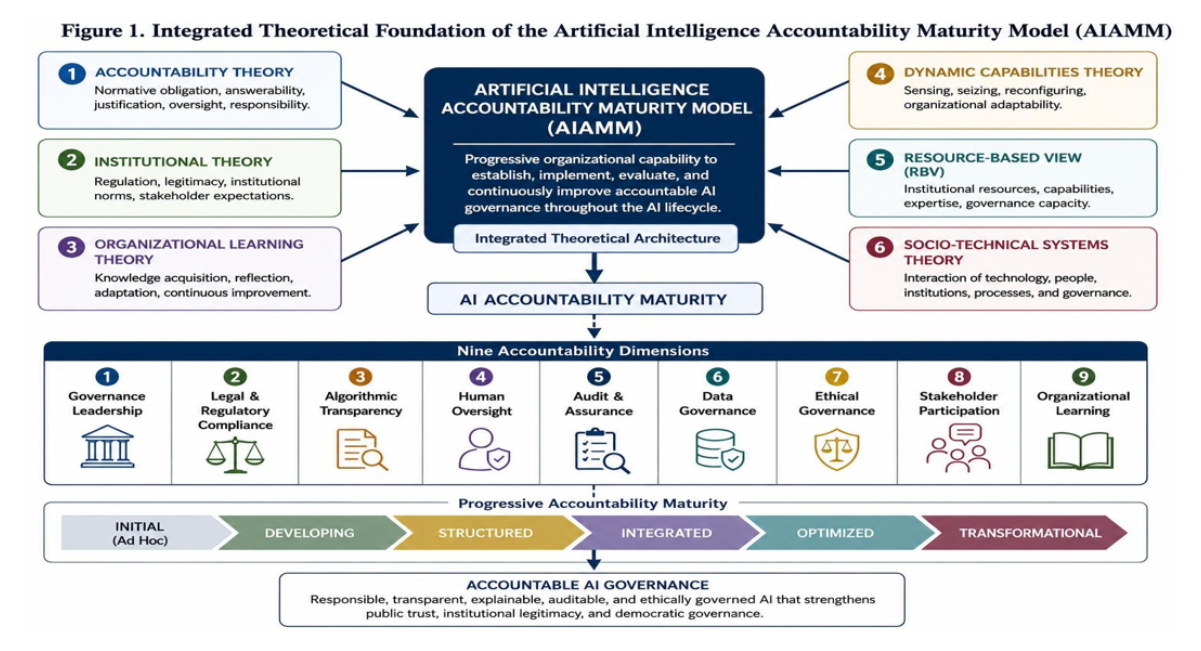
Figure 1: Integrated Theoretical Foundation of AIAMM
Scholarly Contribution of the Theoretical Foundation
The integrated theoretical foundation establishes AIAMM as a theory-informed conceptual framework rather than merely another AI governance checklist or technological maturity model. Its principal theoretical contribution lies in integrating accountability, institutional development, organizational learning, adaptive capability, organizational resources, and socio-technical governance into a unified explanation of how accountability capability may develop within AI-enabled public institutions.
Accordingly, AIAMM proposes a theoretical perspective in which accountability maturity is conceptualized as a progressive organizational capability that can vary across institutions and develop through successive stages of institutionalization, capability building, learning, adaptation, and continuous governance improvement. This theoretical proposition provides the foundation for the maturity levels and accountability dimensions developed in subsequent sections and establishes a basis for future empirical operationalization and validation.
Development of The Artificial Intelligence Accountability Maturity Model (AIAMM)
Conceptualizing AI Accountability Maturity
Artificial intelligence accountability extends beyond compliance with legal and ethical requirements. It represents an organizational capability through which public institutions establish governance structures, assign responsibility, ensure transparency, maintain oversight, monitor performance, and continuously improve AI governance throughout the technology lifecycle [3,5,10,11].
Unlike traditional accountability frameworks that primarily emphasize institutional obligations and answerability, AIAMM conceptualizes accountability as a progressive organizational capability that develops through successive stages of institutional maturity. Institutions may therefore differ not only in whether accountability mechanisms exist but also in the extent to which those mechanisms are institutionalized, integrated, monitored, evaluated, and continuously improved. This conceptualization draws on accountability theory, organizational learning, institutional theory, and maturity-model approaches [5,12,17,18].
Accordingly, this study defines AI Accountability Maturity as:
The progressive institutional capability to design, implement, monitor, evaluate, and continuously improve governance systems that support responsible, transparent, explainable, auditable, and legally compliant artificial intelligence throughout its lifecycle.
This definition recognizes accountability as an evolving organizational capability rather than a static governance requirement and provides the conceptual basis for the maturity levels and dimensions developed below.
Core Principles of AIAMM
The Artificial Intelligence Accountability Maturity Model is guided by six foundational principles derived from the theoretical foundations and responsible AI literature.
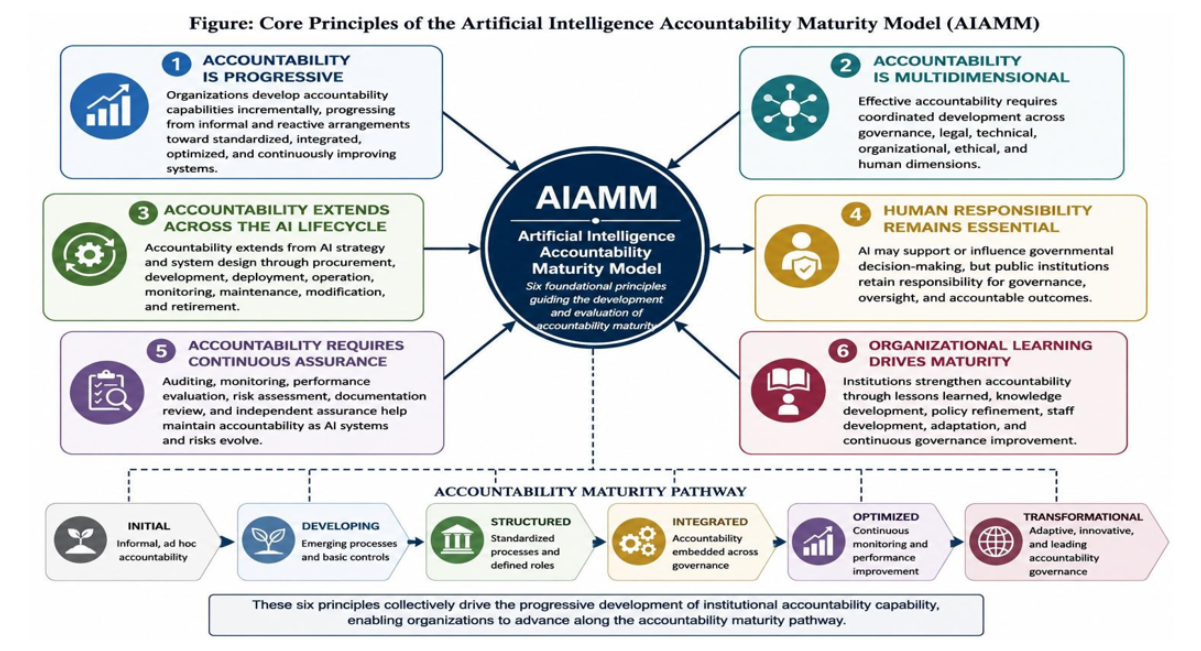
Higher levels of accountability maturity require organizations to learn from experience, governance incidents, stakeholder feedback, audit findings, and changes in the technological and regulatory environment. Continuous learning therefore provides an important mechanism through which accountability capabilities can be strengthened over time [13,17,19].
The Six AI Accountability Maturity Levels
Drawing on the logic of organizational maturity models and the theoretical foundations established in Section 3, AIAMM proposes six progressive levels of organizational accountability capability. The levels should be understood as conceptual stages rather than empirically validated developmental laws. They provide a structured basis for assessing the extent to which accountability practices are institutionalized and integrated.
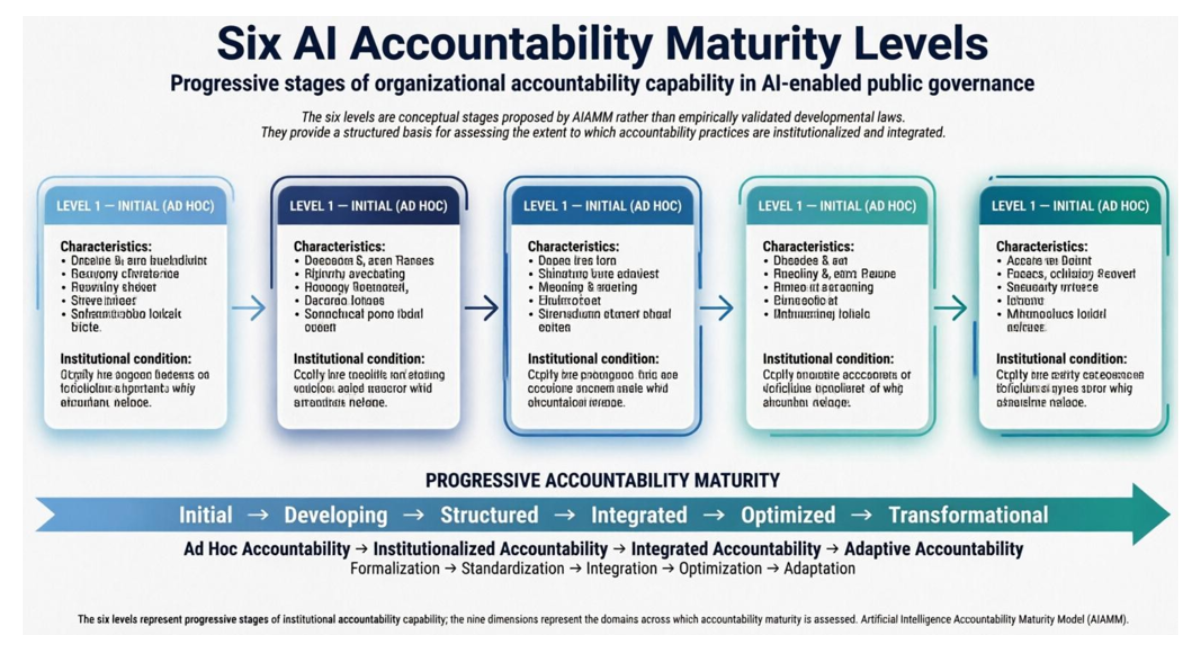
At this conceptual level, accountability is deeply institutionalized and continuously adapted in response to technological, regulatory, organizational, and societal change.
Importantly, the designation of Level 6 as “Transformational” does not imply that an institution automatically becomes an international or global leader. Such a claim would require empirical benchmarking. Instead, the level represents the highest conceptual state within the proposed AIAMM maturity architecture.
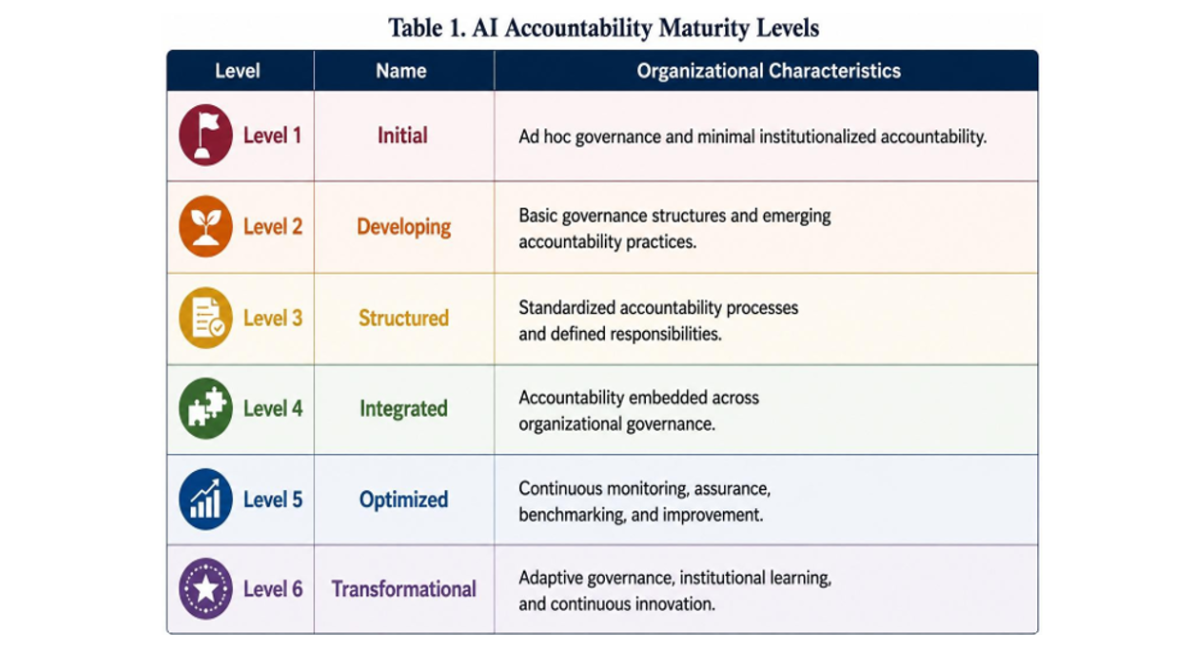
Table 1: AI Accountability Maturity Levels
The Nine Accountability Dimensions
Based on the integrated theoretical foundation and the responsible AI, accountability, institutional governance, and organizational capability literature, AIAMM proposes nine complementary accountability dimensions. These dimensions are conceptual constructs of the proposed model and require future empirical validation and operational testing.
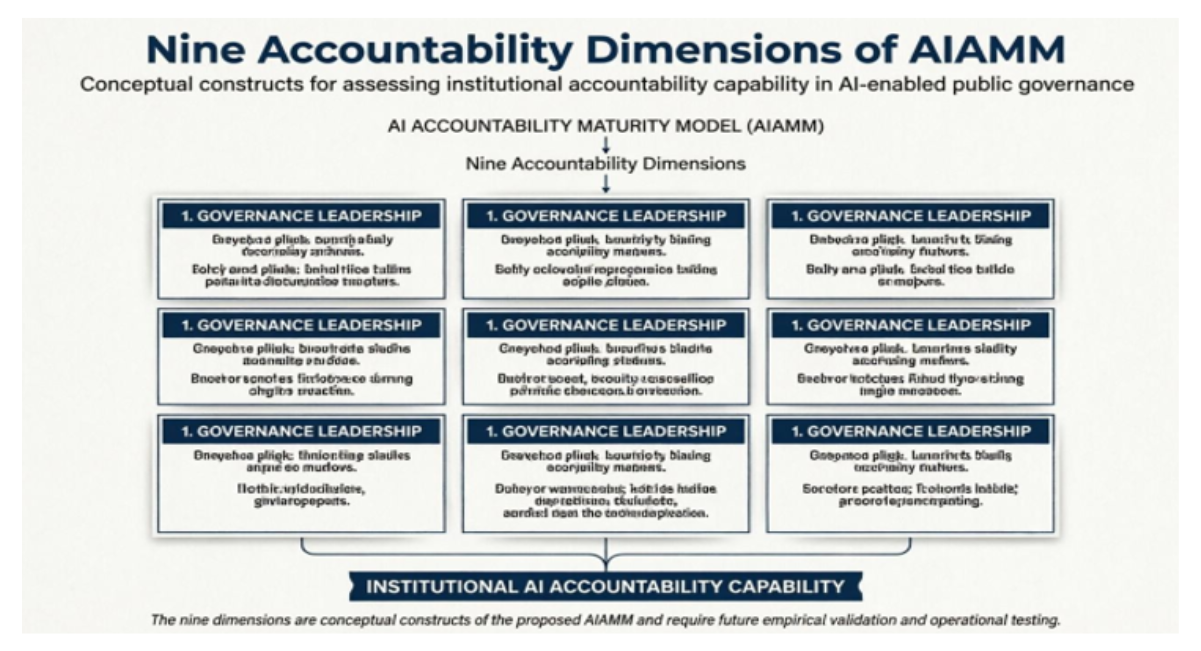
AI Accountability Assessment Matrix (AIAAM)
The AI Accountability Assessment Matrix (AIAAM) is proposed as an assessment instrument through which organizations can examine their accountability maturity across the nine AIAMM dimensions.
The matrix translates the conceptual dimensions into assessment questions and observable indicators. It is intended as a conceptual assessment architecture, rather than as a statistically validated measurement instrument at this stage.
Accountability Dimension | Assessment Question | Example Indicators |
|---|---|---|
Governance Leadership | Is AI accountability led and overseen at executive level? | Governance committee; executive sponsorship |
Governance Leadership | Is there a governance committee responsible for AI accountability? | Governance committee; AI governance leadership |
Governance Leadership | Are governance responsibilities clearly assigned? | Defined governance roles; accountability ownership |
Governance Leadership | Are governance processes reviewed and updated regularly? | Governance committee; executive sponsorship |
Governance Leadership | Is AI accountability integrated into organizational leadership? | Governance committee; AI governance sponsorship |
Governance Leadership | Is accountability monitored at the executive level? | Executive oversight; governance reporting |
Governance Leadership | Are accountability responsibilities communicated across the organization? | Governance policies; executive communication |
Governance Leadership | Does the governance committee oversee AI accountability? | Governance committee; AI governance oversight |
Governance Leadership | Are governance arrangements regularly assessed for effectiveness? | Governance reviews; executive-level accountability |
Table 2: AI Accountability Assessment Matrix
Accountability Capability Scorecard (ACS)
To operationalize the conceptual logic of AIAMM, the Accountability Capability Scorecard (ACS) assigns each accountability dimension a score using the proposed six-level maturity scale.
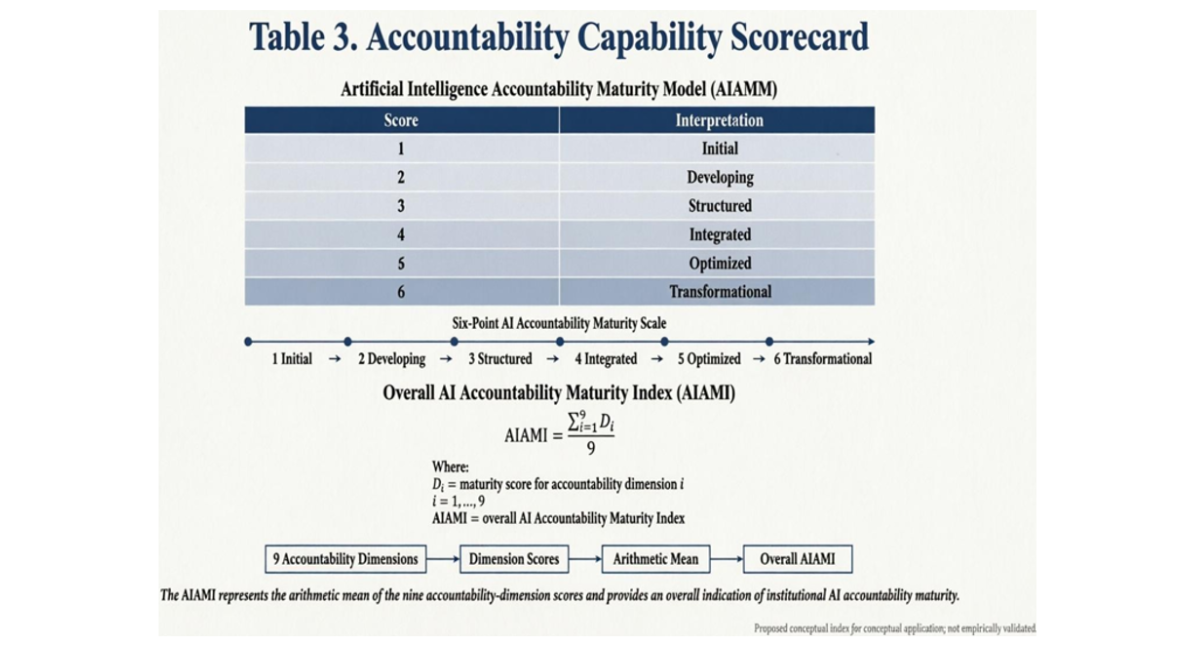
Table 3: Accountability Capability Scorecard
The index provides an aggregate representation of institutional accountability maturity while retaining the individual dimension scores necessary to identify strengths, weaknesses, and areas requiring improvement. Because the model is currently conceptual, the equal-weighting assumption should be understood as a proposed baseline scoring rule rather than an empirically established weighting scheme. Future empirical research may test whether dimensions should receive equal or differential weights.
AI Accountability Improvement Roadmap (AAIR)
The AI Accountability Improvement Roadmap (AAIR) is proposed as a governance instrument for guiding institutions from their assessed maturity level toward higher levels of accountability capability.
Current Level | Improvement Priority | Expected Outcome |
|---|---|---|
Initial | Establish governance structures, responsibilities, and basic documentation. | Basic institutional accountability |
Developing | Standardize policies, responsibilities, and oversight procedures. | Consistent governance |
Structured | Integrate oversight, assurance, documentation, and risk management. | Institutionalized accountability |
Integrated | Implement continuous monitoring, performance evaluation, and cross-functional governance. | Proactive governance |
Optimized | Strengthen advanced analytics, benchmarking, assurance, and adaptive risk management. | Adaptive accountability |
Transformational | Institutionalize continuous learning, innovation, and knowledge sharing. | Continuous governance improvement |
Table 4: AI Accountability Improvement Roadmap
Progression: Initial → Developing → Structured → Integrated → Optimized → Transformational
The roadmap is intended to complement the ACS by translating assessment results into potential governance-improvement priorities. It does not prescribe a universal sequence of reforms because institutional circumstances, regulatory environments, organizational resources, and AI use cases differ across public-sector contexts.
Conceptual Representation of AIAMM
The Artificial Intelligence Accountability Maturity Model can be represented conceptually as:
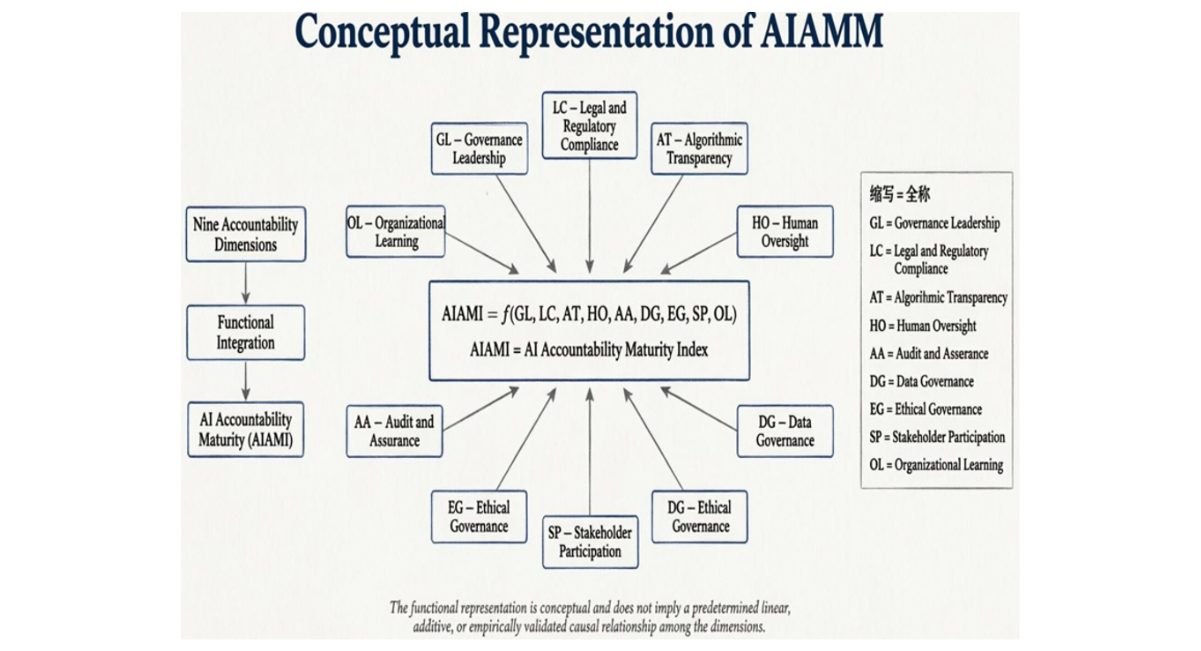
The model proposes that overall accountability maturity is associated with the development and coordination of these nine dimensions. The formulation emphasizes that strong performance in one dimension should not automatically compensate for severe deficiencies in another. For example, sophisticated technical infrastructure cannot by itself compensate for inadequate human oversight, weak accountability assignment, or ineffective mechanisms for redress.
The functional representation should therefore be interpreted as a conceptual model specification rather than an empirically estimated mathematical function. Future empirical research will be required to determine the statistical relationships among the dimensions and their relative contribution to overall accountability maturity.
Theoretical Contribution
The Artificial Intelligence Accountability Maturity Model advances the literature by proposing a governance maturity framework that reconceptualizes accountability as a measurable organizational capability rather than solely as a normative governance principle. Unlike general AI readiness or digital transformation models, AIAMM focuses specifically on the institutional capabilities required to support accountable AI governance.
The model integrates six theoretical perspectives—Accountability Theory, Institutional Theory, Organizational Learning Theory, Dynamic Capabilities Theory, the Resource-Based View, and Socio-Technical Systems Theory—with nine proposed accountability dimensions and six conceptual maturity levels. The resulting architecture provides a structured basis for assessment, benchmarking, organizational learning, and continuous governance improvement.
However, the theoretical contribution should be understood appropriately. AIAMM is a proposed conceptual model, not yet an empirically validated maturity instrument. Its theoretical contribution therefore lies in the integration and specification of constructs, maturity levels, assessment dimensions, and proposed relationships that can subsequently be subjected to expert validation, case-study research, survey development, comparative assessment, and statistical testing.
The model consequently provides a foundation for future empirical research examining whether the proposed dimensions adequately capture AI accountability capability, whether the six maturity levels can be reliably distinguished, whether the nine dimensions are empirically separable, and whether higher accountability maturity is associated with improved governance outcomes in AI-enabled public administration improvement.
Conceptual Propositions and Research Model
Purpose of the Conceptual Model
The Artificial Intelligence Accountability Maturity Model (AIAMM) proposes that accountability in AI-enabled public governance is not achieved solely through legal compliance, technological sophistication, or the adoption of ethical principles. Rather, accountability develops through the progressive institutionalization and integration of governance leadership, regulatory capability, algorithmic transparency, human oversight, audit and assurance, data governance, ethical governance, stakeholder participation, and organizational learning [3,5,10,11]
The conceptual model translates the theoretical foundations developed in Section 3 and the maturity architecture presented in Section 4 into a set of conceptual propositions concerning the development of AI accountability capability. The propositions specify the expected relationships among the proposed accountability dimensions and overall AI accountability maturity and provide a theoretical basis for future empirical examination.
The propositions are intentionally presented as theoretical propositions rather than empirically validated hypotheses, because AIAMM is currently a conceptual model. Future empirical studies may operationalize these propositions as testable hypotheses using survey, case-study, comparative, or mixed-method research designs.
Overall Research Model
The AIAMM conceptual research model consists of four interrelated governance domains that collectively contribute to institutional accountability maturity:
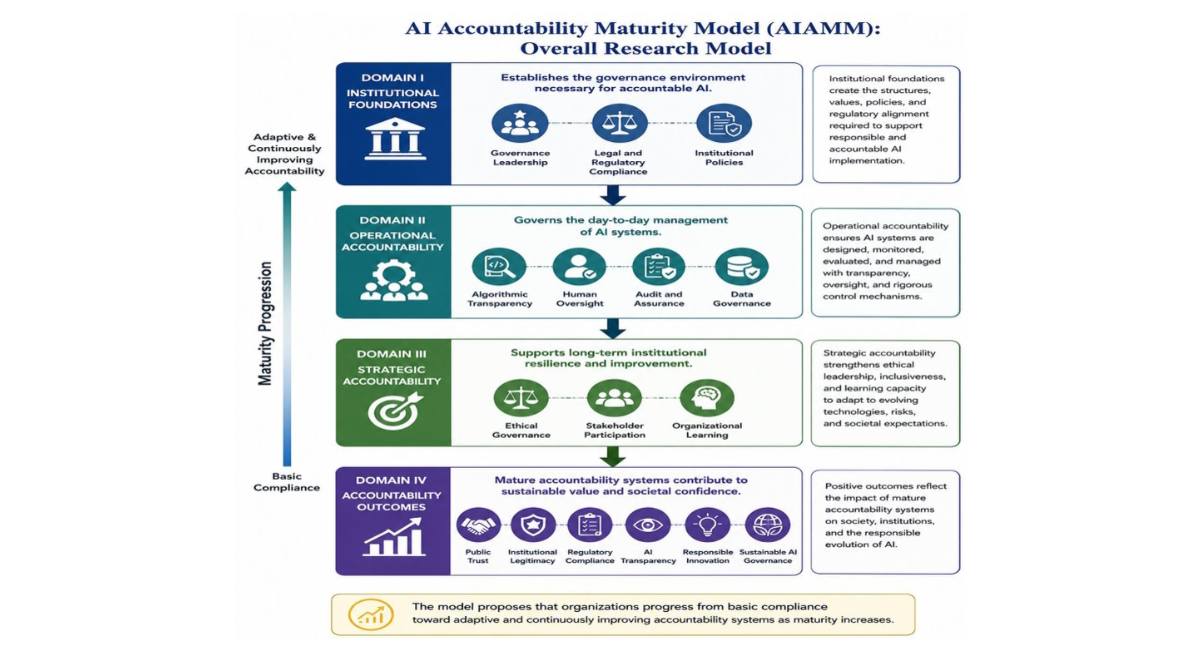
- Institutional Governance Capability – governance leadership and legal and regulatory compliance;
- Transparency and Control Capability – algorithmic transparency, human oversight, and audit and assurance;
- Responsible AI Governance Capability – data governance, ethical governance, and stakeholder participation; and
- Organizational Learning Capability – continuous learning, adaptation, knowledge development, and governance improvement.
These domains are not intended to replace the nine accountability dimensions presented in Section 4. Rather, they provide a higher-order conceptual organization of those dimensions for theory-building purposes.
The model proposes that the nine dimensions operate in an interconnected manner and collectively contribute to overall AI accountability maturity. Institutional governance establishes the organizational foundation for accountability; transparency and control mechanisms enable monitoring and oversight; responsible AI governance incorporates ethical, data, and stakeholder considerations; and organizational learning enables institutions to adapt and continuously improve their accountability arrangements.
Accordingly, the model conceptualizes AI accountability maturity as the dependent or outcome construct, while the nine accountability dimensions represent the principal capability domains through which maturity is developed.
The conceptual model may therefore be represented as: AIAMI= f (GL,LC,AT,HO,AA,DG,EG,SP,OL)
Figure 22: Conceptual Research Model
The model does not assume that these relationships have equal empirical strength. Rather, the formulation identifies the proposed dimensions that collectively constitute AI accountability maturity and establishes a basis for future empirical investigation.
Conceptual Propositions
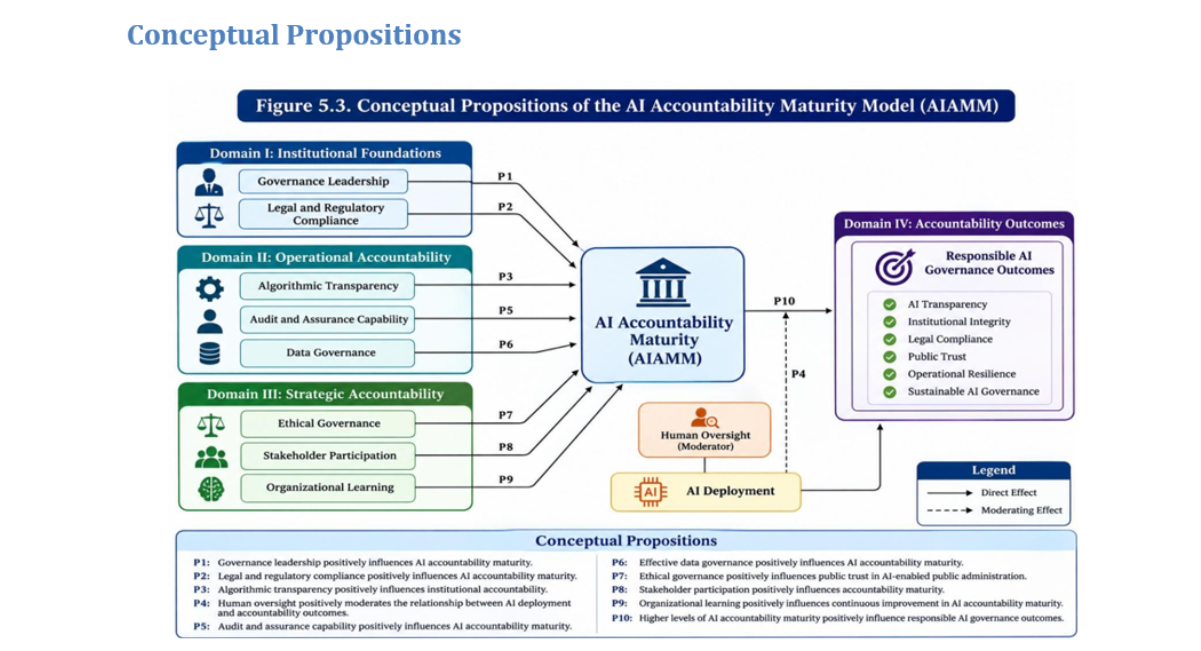
However, this proposition represents a theoretical expectation requiring empirical validation. The present study does not claim that higher AIAMM scores have already been demonstrated to cause improved governance outcomes.
Integrated Conceptual Explanation
The propositions collectively conceptualize AI accountability maturity as a cumulative and interconnected organizational capability. The nine dimensions are expected to reinforce one another rather than operate as completely independent governance mechanisms.
Governance leadership provides strategic direction and institutional responsibility; legal and regulatory compliance establishes formal obligations; algorithmic transparency enables explanation and traceability; human oversight maintains meaningful institutional control; audit and assurance provide verification and monitoring; data governance supports the integrity and responsible management of AI-related data; ethical governance addresses fairness and broader societal considerations; stakeholder participation strengthens external accountability and redress; and organizational learning enables continuous adaptation.
The model therefore distinguishes between the existence of accountability mechanisms and the maturity of those mechanisms. An institution may possess policies, committees, audits, or transparency procedures while still operating at a relatively low level of maturity if those mechanisms remain fragmented, inconsistently implemented, weakly coordinated, or predominantly reactive.
AIAMM consequently proposes that maturity develops progressively from informal and reactive accountability arrangements toward structured, integrated, optimized, and adaptive governance systems.
This developmental logic is consistent with organizational maturity and learning perspectives [12,17].
The model further proposes that technological sophistication alone does not guarantee accountability maturity. An institution may possess advanced AI infrastructure while simultaneously exhibiting weak accountability if responsibility is unclear, oversight is ineffective, documentation is inadequate, or stakeholders lack mechanisms for review and redress. AI accountability maturity therefore represents a distinct institutional capability that must be developed alongside technological capability
Accountability Development Pathways
AIAMM conceptualizes institutional accountability development as a progression through six maturity levels:
Initial → Developing → Structured → Integrated → Optimized → Transformational
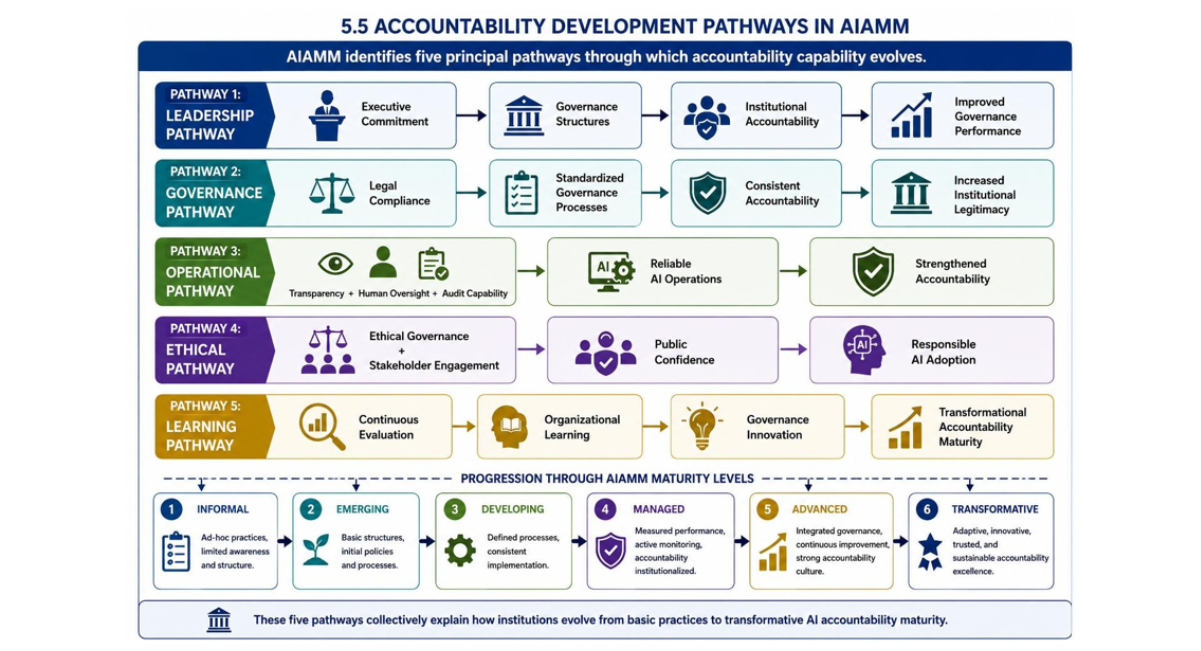
Importantly, the pathway represents a conceptual maturity progression, not a deterministic sequence. Different institutions may exhibit different maturity profiles across the nine dimensions. For example, an institution may demonstrate relatively advanced data governance while remaining at an early stage of stakeholder participation or human oversight.
This possibility of uneven development reinforces the importance of assessing both the overall AIAMI score and the individual dimension scores.
Strategy for Empirical Validation
Because AIAMM is developed as a theoretical framework, empirical validation represents an important direction for subsequent research.
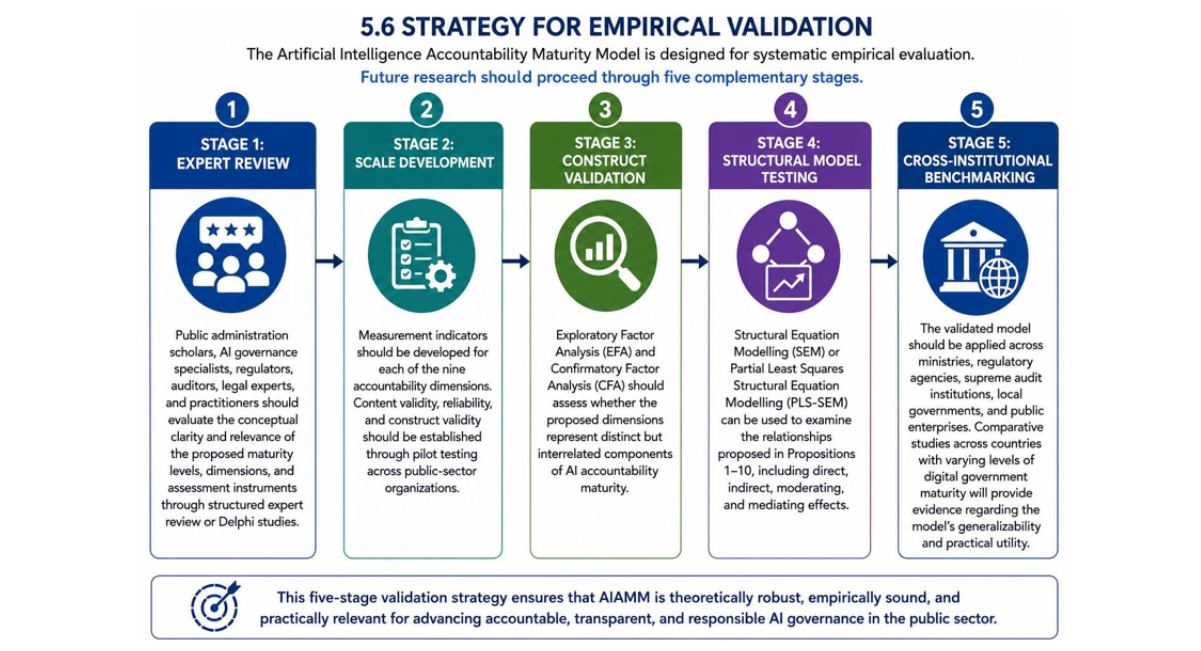
The empirical validation process should also examine whether the proposed six-level maturity structure is sufficiently discriminating and whether the equal-weighting assumption used in the preliminary AIAMI calculation is empirically justified. Alternative weighting approaches may be evaluated if empirical evidence indicates that particular dimensions have greater explanatory importance.
Accordingly, the current study presents AIAMM as a theory-building framework whose empirical validity remains to be established.
Expected Contributions to Theory and Practice
The conceptual propositions transform AIAMM from a descriptive maturity architecture into a theoretically specified and potentially testable governance model. The propositions establish explicit relationships between the nine accountability dimensions and overall AI accountability maturity while identifying the expected role of integrated organizational capability in supporting responsible AI governance.
For theory, AIAMM contributes by conceptualizing AI accountability as a progressive institutional capability rather than solely as a normative principle or compliance obligation. It integrates accountability theory, institutional theory, organizational learning, dynamic capabilities, resource-based perspectives, and socio-technical systems thinking into a unified theoretical architecture.
For empirical research, the model provides proposed constructs and relationships that can be operationalized and tested through qualitative, quantitative, comparative, and longitudinal research designs.
For public-sector practice, AIAMM provides a conceptual basis for diagnosing institutional accountability strengths and weaknesses, prioritizing governance improvements, benchmarking organizational capability, and monitoring progress toward more mature AI governance.
POLICY AND PRACTICAL IMPLICATIONS
Implications for National AI Governance
As governments accelerate the adoption of artificial intelligence across public administration, accountability should be treated as a central component of national AI governance. International AI governance frameworks increasingly emphasize transparency, accountability, human oversight, safety, fairness, and responsible institutional governance (OECD, 2019; National Institute of Standards and Technology, 2023; European Commission, 2024).
However, the existence of national AI principles or strategies does not necessarily demonstrate that public institutions possess the organizational capabilities required to implement those principles effectively. The AIAMM therefore proposes that national AI strategies incorporate institutional accountability maturity assessments as part of governance planning for high-impact AI applications.
AIAMM can be applied to public-sector AI initiatives in areas such as taxation, healthcare, policing, immigration, judicial administration, procurement, and social protection. The purpose is not to impose a universal threshold for all AI applications but to enable governments to assess whether the governance capability of an institution is proportionate to the risks associated with the AI systems it operates.
By incorporating accountability maturity into national AI governance, governments may be better positioned to identify institutional weaknesses, prioritize governance reforms, and strengthen accountability throughout the AI lifecycle.
Implications for Regulatory Authorities
Regulatory authorities require practical mechanisms for evaluating whether organizations possess adequate governance capability to manage AI-related risks. Contemporary AI governance approaches increasingly emphasize risk management, accountability, transparency, human oversight, and organizational controls (OECD, 2019; National Institute of Standards and Technology, 2023; European Commission, 2024).
AIAMM provides a proposed framework through which regulators can assess institutional capability across nine accountability dimensions and six maturity levels.
Regulatory authorities could use the framework to:
- Benchmark Accountability Capability Across Public Institutions; Identify Governance Deficiencies Requiring Corrective Action;
- Prioritize Supervisory Attention According To Institutional Risk And Maturity; Monitor Improvements In Accountability Capability Over Time; And Inform Risk-Based Regulatory Supervision Of High-Impact Ai Applications.
These applications are proposed uses of AIAMM rather than empirically validated regulatory procedures. Future research should therefore examine whether maturity-based regulatory supervision produces measurable improvements in governance performance.
Implications for Public Sector Organizations
Public institutions implementing AI require governance arrangements capable of supporting transparency, responsibility, oversight, risk management, and continuous improvement. Existing public-sector digital transformation research demonstrates that technological transformation involves organizational and institutional change rather than technology adoption alone (Janowski, 2015; Mergel et al., 2019).
AIAMM provides institutional leaders with a structured framework for examining accountability capability across the AI lifecycle.
Organizations can apply the model to assess potential weaknesses in:
- Governance leadership; regulatory compliance; algorithmic transparency; human oversight;
- Audit and assurance; data governance; ethical governance;
- Stakeholder participation; and organizational learning.
The resulting maturity profile can then be used to establish improvement priorities and monitor institutional progress. The proposed approach is consistent with the broader logic of organizational maturity models, which emphasize progression from informal practices toward standardized, integrated, and continuously improving organizational capabilities (Chrissis et al., 2011).
Implications for Supreme Audit Institutions
Supreme Audit Institutions (SAIs) play an important role in strengthening accountability, transparency, and the effective use of public resources. As AI becomes increasingly integrated into public administration, traditional approaches to public-sector auditing may need to address algorithmic systems, data governance, automated decision-making, and associated institutional controls.
The AIAMM framework can therefore be considered as a complementary assessment structure for performance audits, compliance audits, information-technology audits, and governance reviews.
Auditors could examine whether public institutions have: clearly assigned accountability responsibilities; established effective human and institutional oversight; documented AI-supported decision processes; implemented appropriate assurance arrangements; maintained adequate data governance controls; and established mechanisms for learning from audit findings and governance failures.
The proposed application extends the accountability logic of auditing into AI-enabled governance. However, the suitability of AIAMM for formal audit methodology requires further professional and empirical evaluation.
Implications for Public Financial Management
Artificial intelligence is increasingly relevant to public financial management, including revenue administration, budgeting, procurement, expenditure management, fraud detection, and public-service delivery. The effectiveness of these applications depends not only on technological capability but also on institutional governance and accountability.
The AIAMM framework therefore proposes that accountability capability be considered when governments evaluate major public-sector AI investments. Ministries of Finance and other central financial authorities could incorporate governance maturity considerations into the assessment of significant AI projects.
Such assessments could consider:
Institutional governance capacity; regulatory and compliance readiness; audit and assurance capability;
Data governance; human oversight; and mechanisms for monitoring and continuous improvement.
This approach is consistent with the broader public-sector emphasis on effective institutions, transparency, and responsible use of public resources (World Bank, 2020; OECD, 2017).
Implications for Public Procurement
AI procurement presents distinctive governance challenges because public institutions may depend on external vendors for algorithmic systems, technical expertise, data infrastructure, system maintenance, and model updates. These relationships can create accountability challenges where contractual responsibilities, data ownership, system documentation, audit rights, and transparency requirements are inadequately defined.
The AIAMM framework therefore recommends that procurement authorities incorporate accountability requirements into the procurement lifecycle for high-impact AI systems.
Such requirements may include:
Accountability governance plans; algorithm and system documentation; contractual audit rights;
Clear data ownership and governance provisions; appropriate explainability requirements;
Vendor transparency obligations; and continuing accountability and performance reporting.
These requirements represent proposed policy applications of AIAMM, rather than findings empirically established by the present study. Future research should investigate how accountability maturity requirements can be incorporated into public procurement regulations and contracts without creating disproportionate administrative burdens.
Implications for Capacity Development
Effective AI accountability requires multidisciplinary institutional capabilities. Responsible AI governance involves technological, legal, ethical, organizational, auditing, data, cybersecurity, procurement, and policy considerations (Dignum, 2019; Stahl, 2021).
Public organizations should therefore develop capacity-building programmes that bring together professionals from public administration, computer science, law, auditing, ethics, procurement, cybersecurity, data governance, and policy analysis.
Universities, professional institutions, civil-service training organizations, and international development organizations can contribute to the development of specialized programmes focused on AI accountability, algorithmic auditing, AI risk management, responsible AI, and public-sector governance.
From the AIAMM perspective, capacity development is particularly important because higher maturity levels require institutions to move beyond basic compliance toward continuous learning, adaptive governance, and institutional innovation.
Implications for International Organizations
International organizations increasingly support digital government, institutional reform, technological development, and public-sector modernization. Existing international assessments frequently examine digital government development, technological capacity, institutional capability, and broader governance conditions.
AIAMM provides a complementary conceptual framework for examining AI accountability readiness as a distinct institutional capability.
International organizations could potentially use the framework to:
- Assess accountability readiness in AI-related development projects; benchmark institutional maturity across jurisdictions;
- Support public-sector governance reform;
- Develop comparative accountability indicators; and
- Encourage greater consistency in responsible AI governance practices.
These applications should be understood as potential uses of the proposed framework rather than validated applications. Comparative research is required to determine whether AIAMM produces reliable and meaningful cross-country or cross-institutional assessments.
Governance Roadmap for Implementing AIAMM
The practical application of AIAMM follows a staged implementation process that enables organizations to strengthen accountability capability progressively.
Implementation Stage | Key Activities | Lead Institutions | Expected Outcomes |
|---|---|---|---|
Stage 1: Baseline Assessment | Evaluate accountability maturity across the nine dimensions. | Public organizations, regulators, audit institutions | Institutional accountability profile |
Stage 2: Governance Design | Develop accountability policies, governance structures, and oversight mechanisms. | Executive leadership, governance committees | Standardized accountability framework |
Stage 3: Operational Integration | Embed accountability into AI procurement, deployment, and operations. | Ministries, agencies, IT departments | Accountable AI operations |
Stage 4: Assurance and Monitoring | Conduct audits, monitor performance, and evaluate governance effectiveness. | Internal audit, Supreme Audit Institutions, regulators | Continuous accountability assurance |
Stage 5: Organizational Learning | Capture lessons learned, update governance practices, and benchmark performance. | Leadership teams, training institutions | Continuous maturity improvement |
Stage 6: Transformational Leadership | Promote innovation, international benchmarking, and governance excellence. | National governments, international organizations | Global leadership in accountable AI governance |
Table 5: Governance Roadmap for AI Accountability Maturity
Important: This roadmap is a proposed application of AIAMM, not an empirically validated implementation sequence. Its effectiveness should be tested through future case studies and longitudinal research.
Practical Benefits of AIAMM
The proposed implementation of AIAMM may provide several potential benefits for governments and public institutions.
Institutional Benefits
Strengthening executive accountability for AI-enabled decisions; improving coordination across governance functions; standardizing accountability practices;
identifying institutional capability gaps; and supporting evidence-based governance improvement.
Operational Benefits
improving transparency and explainability; strengthening AI auditability;
improving data governance and regulatory compliance; strengthening human oversight; and identifying accountability weaknesses before they become significant governance failures.
Strategic Benefits
supporting public confidence in AI-enabled government; strengthening institutional legitimacy;
supporting responsible digital transformation; and aligning AI implementation with principles of accountable and democratic governance.
These should be understood as potential benefits of the framework, not outcomes empirically demonstrated by the present conceptual study.
Contribution to Public Governance
The Artificial Intelligence Accountability Maturity Model extends the conceptual discussion of public administration and AI governance by reconceptualizing accountability as a progressive institutional capability rather than solely as a static legal or normative obligation.
The framework integrates governance leadership, regulatory compliance, algorithmic transparency, human oversight, audit and assurance, data governance, ethical governance, stakeholder participation, and organizational learning into a unified maturity architecture.
AIAMM therefore provides a conceptual bridge between normative AI governance principles and operational institutional capability. Instead of asking only whether an organization recognizes accountability as a governance principle, the model proposes a structured approach for examining the extent to which accountability mechanisms have been institutionalized, integrated, monitored, and continuously improved. Nevertheless, the contribution should be interpreted within the limitations of a theory-building study.
AIAMM has not yet been empirically validated across public institutions, countries, or AI application domains. The proposed maturity levels, dimensions, assessment instruments, and implementation roadmap therefore constitute theoretical and conceptual contributions requiring subsequent empirical validation.
Future research should determine whether AIAMM demonstrates adequate construct validity, reliability, discriminant validity, predictive value, and applicability across different institutional and regulatory environments. Such validation would determine whether the proposed model can progress from a theoretically grounded framework into a robust instrument for assessing AI accountability in practice.
LIMITATIONS
The Artificial Intelligence Accountability Maturity Model (AIAMM) represents a conceptual and theory-building contribution to the emerging literature on AI governance and public administration. While the model provides a structured framework for conceptualizing institutional accountability in AI-enabled governance, several limitations should be acknowledged.
First, AIAMM has not yet undergone empirical validation. The proposed six maturity levels, nine accountability dimensions, and associated governance instruments were developed through an integrative synthesis of literature concerning public accountability, AI governance, organizational maturity, institutional governance, and digital government. Although conceptual synthesis is appropriate for theory development, empirical research is required to establish the reliability, construct validity, discriminant validity, and practical applicability of the proposed model.
Second, AIAMM is primarily designed for public-sector organizations. Although many of its accountability principles may be relevant to private enterprises, non-governmental organizations, and international institutions, accountability relationships, regulatory obligations, governance structures, and institutional mandates differ substantially across organizational settings. Consequently, direct application of AIAMM outside the public sector may require contextual adaptation.
Third, the proposed maturity architecture assumes that accountability capability can develop through progressively higher levels of institutional maturity. However, organizational development may not follow a strictly linear or uniform trajectory. Institutions may demonstrate relatively advanced capability in some accountability dimensions while remaining less developed in others. The model should therefore be interpreted as a multidimensional maturity framework rather than a deterministic linear progression.
Fourth, AI governance operates within rapidly evolving technological, regulatory, and institutional environments. Developments involving generative AI, autonomous AI agents, foundation models, emerging computational technologies, and evolving regulatory frameworks may introduce accountability challenges that are not fully captured by the present model. AIAMM should therefore be treated as an adaptive theoretical framework subject to periodic refinement as AI governance develops.
Finally, the current model does not empirically establish the relative importance or weighting of the nine accountability dimensions. The preliminary AI Accountability Maturity Index (AIAMI) presented in Section 4 uses an equal-weighting approach for conceptual simplicity. However, different governmental contexts may assign different levels of importance to individual dimensions depending on institutional mandates, regulatory requirements, AI application risks, and sector-specific conditions. Future empirical research should therefore examine whether equal weighting is theoretically and statistically justified.
FUTURE RESEARCH
The Artificial Intelligence Accountability Maturity Model establishes a broad research agenda for scholars working in AI governance, public administration, digital government, information systems, auditing, public policy, and institutional governance.
First, future research should focus on instrument development and validation. The nine accountability dimensions should be operationalized into observable indicators and standardized assessment items. Exploratory Factor Analysis (EFA), Confirmatory Factor Analysis (CFA), reliability analysis, and other appropriate validation procedures can be used to examine the underlying structure and measurement properties of the proposed constructs.
Second, future studies should empirically examine the relationships proposed in the conceptual model. Structural Equation Modelling (SEM), Partial Least Squares Structural Equation Modelling (PLS-SEM), and other appropriate quantitative approaches could be used to examine whether governance leadership, regulatory compliance, transparency, human oversight, audit and assurance, data governance, ethical governance, stakeholder participation, and organizational learning are significantly associated with AI accountability maturity and relevant governance outcomes.
Importantly, such studies should test the propositions rather than assume that the relationships are causal. Establishing causality would require appropriate research designs, including longitudinal, quasi-experimental, or other designs capable of supporting causal inference.
Third, comparative international studies should investigate AI accountability maturity across countries with different levels of digital government development, regulatory capacity, administrative traditions, and institutional characteristics. Such studies could provide evidence concerning the contextual applicability and generalizability of AIAMM.
Fourth, future research should develop sector-specific maturity profiles. Accountability requirements may differ considerably across healthcare, taxation, customs administration, policing, immigration, education, procurement, environmental regulation, social protection, and judicial administration. Sector-specific indicators may therefore improve the contextual sensitivity and practical usefulness of AIAMM.
Fifth, longitudinal research should examine how accountability maturity changes over time. Repeated institutional assessments could provide evidence regarding whether governance reforms, regulatory interventions, organizational learning, training programmes, and institutional investments contribute to measurable changes in accountability capability.
Sixth, future research should examine the relationship between AIAMM and complementary organizational constructs, including AI readiness, digital maturity, cybersecurity maturity, organizational resilience, institutional trust, risk management maturity, and public-sector innovation capability. Such research could investigate whether these constructs operate as antecedents, mediators, moderators, or related dimensions of AI accountability maturity.
Finally, future studies should investigate the potential application of AIAMM within emerging AI governance mechanisms, including AI assurance frameworks, regulatory sandboxes, digital public infrastructure programmes, and public-sector AI certification or assessment schemes. Such research could strengthen the model's contribution to international AI governance and facilitate comparative assessment of institutional accountability capability.
CONCLUSION
Artificial intelligence is increasingly transforming public administration by influencing how governments make decisions, deliver services, regulate activities, allocate resources, and interact with citizens. As AI systems assume increasingly significant roles within public governance, accountability becomes an important institutional requirement for supporting transparency, oversight, legitimacy, responsible decision-making, and public trust. Existing AI governance scholarship and international frameworks recognize accountability as an important principle, but there remains a need for conceptual approaches that explain how accountability capability can be systematically assessed and progressively developed.
This study addressed this conceptual gap through the development of the Artificial Intelligence Accountability Maturity Model (AIAMM). The model reconceptualizes AI accountability as a progressive organizational capability rather than solely as a static compliance obligation. Drawing on Accountability Theory, Institutional Theory, Organizational Learning Theory, Dynamic Capabilities Theory, the
Resource-Based View, and Socio-Technical Systems Theory, the study establishes an integrated theoretical foundation for explaining how public institutions may develop increasingly sophisticated accountability capabilities as AI becomes embedded within public governance.
The study makes several principal theoretical contributions. First, it introduces AI Accountability Maturity as a conceptual construct representing the institutional capability to establish, implement, evaluate, and continuously improve accountability throughout the AI lifecycle. Second, it develops a six-level maturity architecture through which accountability capability is conceptualized as progressing from Initial and Developing arrangements toward Structured, Integrated, Optimized, and Transformational governance.
Third, it identifies nine accountability dimensions governance leadership, legal and regulatory compliance, algorithmic transparency, human oversight, audit and assurance, data governance, ethical governance, stakeholder participation, and organizational learning as the principal components of the proposed capability.
Fourth, the study introduces three complementary governance instruments the AI Accountability Assessment Matrix (AIAAM), Accountability Capability Scorecard (ACS), and AI Accountability Improvement Roadmap (AAIR) to translate the theoretical framework into proposed mechanisms for institutional assessment and improvement. Fifth, the study develops ten conceptual propositions that specify theoretically expected relationships among the accountability dimensions and overall AI accountability maturity. These propositions provide a foundation for future empirical testing rather than representing empirically established relationships.
From a practical perspective, AIAMM provides a proposed framework through which governments, regulators, public organizations, Supreme Audit Institutions, and international development organizations may assess accountability readiness, identify governance capability gaps, benchmark institutional performance, and prioritize improvement initiatives. The framework complements existing AI readiness and digital transformation approaches by placing greater analytical emphasis on the institutional accountability capabilities required to govern AI responsibly, rather than focusing exclusively on technological readiness. The study nevertheless recognizes that AIAMM remains a theory-building contribution rather than an empirically validated assessment instrument. The proposed maturity levels, dimensions, propositions, scoring approach, and governance instruments require systematic empirical investigation across different institutional, regulatory, sectoral, and national contexts. Future research should therefore establish the measurement properties of the model, examine the relationships proposed within the conceptual framework, evaluate alternative weighting approaches, and investigate whether higher levels of accountability maturity are associated with improved AI governance outcomes.
Overall, AIAMM provides a theoretically grounded framework for advancing the study of accountability at the intersection of artificial intelligence and public governance. Its central proposition is that responsible AI governance requires more than technological capability or formal compliance: it requires institutional capability to establish responsibility, maintain transparency, exercise oversight, provide assurance, engage stakeholders, and continuously learn and improve. The model therefore offers a foundation for future empirical research into how public institutions can progressively develop the accountability capabilities necessary to govern increasingly consequential AI systems.
REFERENCES
- Wirtz BW, Weyerer JC, Geyer C. Artificial Intelligence and the Public Sector—Applications and Challenges. Int J Public Adm. 2019;42(7):596-615. [Crossref] [Google Scholar]
- United Nations. United Nations E-Government Survey 2024. New York: United Nations; 2024. [Google Scholar]
- Organisation for Economic Co-operation and Development. OECD Principles on Artificial Intelligence. Paris: OECD; 2019. [Google Scholar]
- Dignum V. Responsible Artificial Intelligence: How to Develop and Use AI in a Responsible Way. Cham: Springer; 2019. [Crossref] [Google Scholar]
- Bovens M. Analysing and Assessing Accountability: A Conceptual Framework. Eur Law J. 2007;13(4):447-468. [Crossref] [Google Scholar]
- Jobin A, Ienca M, Vayena E. The global landscape of AI ethics guidelines. Nat Mach Intell. 2019;1(9):389-399. [Crossref] [Google Scholar]
- Mittelstadt BD. Principles alone cannot guarantee ethical AI. Nat Mach Intell. 2019;1(11):501-507. [Crossref] [Google Scholar]
- Pasquale F. The Black Box Society: The Secret Algorithms That Control Money and Information. Cambridge (MA): Harvard University Press; 2015. [Google Scholar]
- Floridi L, Cowls J. A Unified Framework of Five Principles for AI in Society. Harv Data Sci Rev. 2019;1(1). [Crossref] [Google Scholar]
- Tabassi E. Artificial Intelligence Risk Management Framework (AI RMF 1.0). Gaithersburg (MD): National Institute of Standards and Technology; 2023. NIST AI 100-1. [Crossref] [Google Scholar]
- International Organization for Standardization. ISO/IEC 42001:2023 Information technology — Artificial intelligence — Management system. Geneva: ISO; 2023. [Google Scholar]
- Chrissis MB, Konrad M, Shrum S. CMMI for Development: Guidelines for Process Integration and Product Improvement. 3rd ed. Boston: Addison-Wesley Professional; 2011. [Google Scholar]
- Senge PM. The Fifth Discipline: The Art and Practice of the Learning Organization. Rev ed. New York: Doubleday; 2006. [Google Scholar]
- Janowski T. Digital government evolution: From transformation to contextualization. Gov Inf Q. 2015;32(3):221-236. [Crossref] [Google Scholar]
- Organisation for Economic Co-operation and Development. The OECD Digital Government Policy Framework: Six Dimensions of a Digital Government. OECD Public Governance Policy Papers, No. 2. Paris: OECD Publishing; 2020. [Crossref] [Google Scholar]
- World Bank. GovTech Maturity Index, 2022 Update: Trends in Public Sector Digital Transformation. Washington (DC): World Bank; 2022. [Google Scholar]
- Argyris C, Schön DA. Organizational Learning II: Theory, Method, and Practice. Reading (MA): Addison-Wesley; 1996. [Google Scholar]
- Scott WR. Institutions and Organizations: Ideas, Interests, and Identities. 4th ed. Los Angeles: SAGE; 2014. [Google Scholar]
- Teece DJ. Explicating dynamic capabilities: the nature and microfoundations of (sustainable) enterprise performance. Strategic Manage J. 2007;28(13):1319-1350. [Crossref] [Google Scholar]
- Mergel I, Edelmann N, Haug N. Defining digital transformation: Results from expert interviews. Gov Inf Q. 2019;36(4):101385. [Crossref] [Google Scholar]
- Cath C. Governing artificial intelligence: ethical, legal and technical opportunities and challenges. Philos Trans A Math Phys Eng Sci. 2018;376(2133):20180080. [Crossref] [Google Scholar] [PubMed]
- Behn RD. Rethinking Democratic Accountability. Washington (DC): Brookings Institution Press; 2001. [Google Scholar]
- Denhardt JV, Denhardt RB. The New Public Service: Serving, Not Steering. 5th ed. Routledge; 2022. [Edition/year not independently verified against the publisher record.] [Google Scholar]
- European Union. Regulation (EU) 2024/1689 (Artificial Intelligence Act). Off J Eur Union. 2024. [Google Scholar]
- Janssen M, Brous P, Estevez E, Barbosa LS, Janowski T. Data governance: Organizing data for trustworthy Artificial Intelligence. Gov Inf Q. 2020;37(3):101493. [Crossref] [Google Scholar]
- Meyer JW, Rowan B. Institutionalized Organizations: Formal Structure as Myth and Ceremony. Am J Sociol. 1977;83(2):340-363. [Crossref] [Google Scholar]
- DiMaggio PJ, Powell WW. The Iron Cage Revisited: Institutional Isomorphism and Collective Rationality in Organizational Fields. Am Sociol Rev. 1983;48(2):147-160. [Crossref] [Google Scholar]
- Teece DJ, Pisano G, Shuen A. Dynamic capabilities and strategic management. Strategic Manage J. 1997;18(7):509-533. [Crossref] [Google Scholar]
- Grant RM. The Resource-Based Theory of Competitive Advantage: Implications for Strategy Formulation. Calif Manage Rev. 1991;33(3):114-135. [Crossref] [Google Scholar]
- Peteraf MA. The cornerstones of competitive advantage: A resource-based view. Strategic Manage J. 1993;14(3):179-191. [Crossref] [Google Scholar]