


Journal of Cardiology and Heart Failure
ISSN:
3139-6429 (Online)
DOI Prefix (Crossref): 10.67238
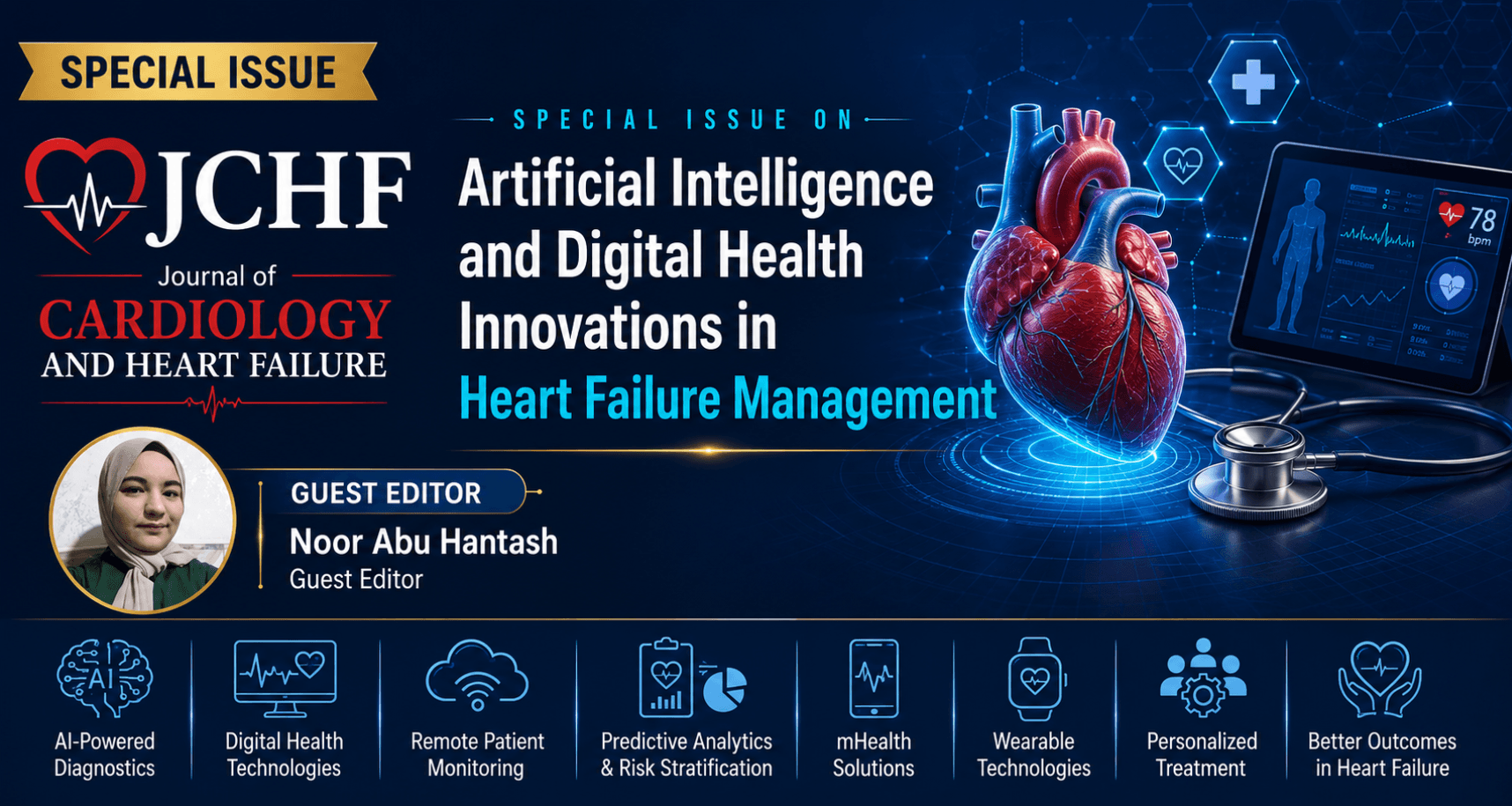
Guest Editor




Noor Abu Hantash is a medical researcher and medical student at the School of Medicine, University of Jordan, Amman, Jordan. Her research focuses on cardiology, cardiothoracic surgery, cardiovascular medicine, vascular surgery, and clinical outcomes research. She has authored and co-authored numerous peer-reviewed publications, including systematic reviews, meta-analyses, case reports, and observational studies published in international medical journals. Her academic interests include aortic diseases, coronary artery disease, cardiac surgery, heart failure, and evidence-based medicine. In addition to her research activities, she actively participates in collaborative clinical research initiatives and promotes medical education through student-led academic organizations and international research collaborations. She is committed to advancing cardiovascular science and improving patient care through high-quality clinical research and interdisciplinary cooperation.
Submit Special Issue Manuscript
Why Publish in a Special Issue?
Rigorous Peer Review
Independent scientific evaluation.
Open Access
Maximum visibility worldwide.
Crossref DOI
Permanent citation and discoverability.
Rapid Publication
Efficient editorial workflow.
Global Visibility
International readership.
Editorial Excellence
Experienced Editorial Board and Guest Editors.
Propose a Special Issue
Become a Guest Editor
Researchers interested in leading a Special Issue are invited to submit a proposal. Proposal should include:
- Proposed title
- Scope
- Objectives
- Potential contributors
- Guest Editor CV
- Tentative timeline
For proposal submissions, editorial collaborations, or Special Issue inquiries, please contact:
Editorial Office: editorial@confmeets.com
General Support: support@confmeets.com
- Define the scientific scope.
- Promote the Call for Papers.
- Encourage high-quality submissions.
- Recommend qualified reviewers.
- Support editorial assessment.
- Maintain publication ethics.
- Collaborate with the Editorial Office.
Final publication decisions remain the responsibility of the Editor-in-Chief or a formally delegated independent editor authorized by the journal.
The Editorial Board provides independent oversight throughout the publication process.
Editorial Board Members assist by:
- Reviewing Special Issue proposals
- Ensuring editorial quality
- Supporting reviewer selection
- Monitoring publication ethics
- Resolving editorial concerns
- Providing independent editorial oversight and recommendations where formally assigned.
Frequently Asked Questions
- 1. Who can propose a Special Issue?
Researchers, university faculty, scientific societies, academic institutions, conference organizers, and experienced scholars are welcome to submit proposals. - 2. Can multiple Guest Editors manage one Special Issue?
Collaborative editorial teams are encouraged, particularly for interdisciplinary topics. - 3. Are Special Issue papers peer reviewed?
Every scholarly manuscript receives the same editorial and peer-review standards as regular submissions, including at least two independent external reviewers. The Editor-in-Chief retains scholarly oversight. See the Special Issue peer-review requirements for conflicts, confidentiality and independent handling. - 4. Is there a submission deadline?
Each Special Issue has its own submission schedule, which will be announced on the respective Special Issue page. - 5. Are Article Processing Charges applicable?
Any applicable publication fees follow the policies of the respective journal. Authors are encouraged to review the journal's APC information before submission. - 6. Can a Guest Editor submit a manuscript to their own Special Issue?
Guest Editors may submit their own manuscripts. To maintain editorial independence and avoid conflicts of interest, their submissions are handled entirely by an independent member of the journal's standing editorial team and undergo the same rigorous peer-review process as all other manuscripts. Guest Editors have no involvement in the editorial handling or decision-making process for their own submissions. - 7. Is there an Article Processing Charge (APC) for Special Issue publications?
An Article Processing Charge (APC) applies only after a manuscript has successfully completed editorial assessment, peer review, and has been formally accepted for publication. - 8. Are Special Issue articles indexed together?
Accepted articles are published individually within the journal and are also grouped under a dedicated Special Issue collection page, making the thematic collection easily discoverable by readers and indexing services. - 9. Who should I contact regarding a Special Issue?
For proposal submissions, Guest Editor Inquiries, manuscript-related questions, or editorial assistance, please contact the Confmeets Publishing Editorial Office.
Email: editorial@confmeets.com; support@confmeets.com