


 Download PDF
ABSTRACT
We revisit a deterministic χI - F model of Codeco that is linked to endemics and epidemics in order to achieve this. A stochastic differential equation SDE for the number of infectious people I(t) that are impacted by the aquatic environment is then produced by extending this model to a stochastic jump diffusion model. The existence and uniqueness of the solution to the SDE was shown. The basic reproduction number R0 and some qualitative properties (positivity and invariant region) were found for the deterministic model. Also, the stability and the biological meaning of the end points of the endemic and disease-free equilibria were investigated.The stochastic jump diffusion model was numerically simulated by the method of Euler Maruyama to obtain sample paths of I(t). The results showed that the stochastic jump diffusion trajectories fluctuate around the deterministic trajectory of the χI - F model and are continuously differentiable, but not continuously differentiable. Moreover, it is theoretically relevant and easy to understand that the proposed stochastic jump diffusion model is applicable.
Keywords: Cholera; Stochastic; Jump Diffusion; Stability Analysis; Reproduction Number R0; Endemic Equilibrium
INTRODUCTION
The battle against cholera is far from victory yet and hence investigations both theoretically and numerically to assess cholera transmission become more and more significant. Research that could be used to enhance the control, prediction or prevention of severe cholera outbreaks is of significant importance especially because mortality is so high in these out-breaks. Mathematical models are useful tools for understanding how diseases are spread and for assessing the effectiveness of interventions in various epidemiological situations.
Cholera is an acute infection of the gut which causes severe diarrhea and vomiting due to the ingestion of the bacterium Vibrio cholerae spread by ingesting contaminated water or food. It has a short incubation period (1-5 days). After infection, Vibrio cholerae is able to produce an enterotoxin that hastens the dehydration process and renders the organisms incapable of absorbing fluids, ultimately producing death if treatment does not occur within a few hours after infection [1]. Crooks and Atesmachew report that access to potable drinking water and good environment sanitation is still a major problem in many affected areas of Africa and Asia and the incidence of cholera is still on the increase [2].
Cholera is one of the most ancient diseases to impact both children and adults, and, despite its long control, it is still causing epidemic and pandemic outbreaks. Cholera is a disease that has many causes that are environmental. Changes in the hydrological cycle can signif-icantly affect pathogen levels in water bodies as Vibrio cholerae persists and proliferates in water. The rainfall pattern and intensity can either increase or decrease the transmission with droughts or floods [3]. These environmental disruptions are usually sudden and er-ratic and result in unforeseen contamination of water sources, displacement of people, and disruption of sanitation and can lead to unexpected cases of cholera.
After onset of symptoms, the person suffering from cholera has watery diarrhea without pain, profuse vomiting, irregular heart rate and low blood pressure [4]. Many infected peo-ple do not experience any symptoms or have only mild symptoms, but continue to excrete the pathogen in their stool for 7-14 days after infection making water sources and susceptible people vulnerable to contamination [5]. About ten percent of those infected get seriously ill, with the potential for dehydration and death to become very rapid without treatment. There are both direct and indirect routes of transmission for cholera [6]. Direct transmission is defined as close contact with infected persons and indirect transmission is through inges-tion of food or water contaminated with Vibrio cholerae [7]. The environmental reservoir is thus an important factor in the perpetuation of transmission and in the occurrence of recurrent outbreaks.
Cholera epidemics have been a growing health challenge all over the world, and much re-search effort has been focused on elucidating the epidemiological dynamics of cholera. The interaction of Vibrio cholerae, humans, and the aquatic environment have demonstrated that cholera is a much more complex process of transmission than first thought [3]. This fact has led to the development of many mathematical models to study the epidemiology and endemism of cholera. One of the first deterministic models to investigate the 1973 outbreak of cholera in the Mediterranean was developed by Capasso and Paveri Fontana [8]. For this purpose, Codeco developed an extension of this model, explicitly including the aquatic environmental reservoir in the transmission. Hntsa and Kahsay studied a fractional order cholera model, and Opoku and Afriyie analyzed the effect of environmental factors and health care interventions towards the control of cholera. The work of Mukandavire was extended by Wang and Modnak to incorporate treatment, vaccination and sanitation interventions in a cholera model. Other contributions are from Mark, Ochoche, Fatima, Togbenon and Moyo, Posny and Wang, Nyabadza, and Lemospaiaao, along with others [3,4,7,9-22].
Deterministic models have made a large improvement in the understanding of cholera dynamics, but most of them assume that environmental conditions are continuously varying with time. In fact, there are random fluctuations in the environment many of which affect cholera transmission, and sudden catastrophic events like floods, heavy rainfall, failure of water supply systems, sewage overflow, population displacement and contamination episodes. While jump processes are useful for modelling abrupt and unpredictable events, continuous random fluctuations can be represented by Brownian motion. SDEs with jump diffusion processes integrate these two types of uncertainty, both Wiener process and jumps driven by a Poisson process, into a single equation, hence the name, giving a more realistic representation of an epidemic system with environmental shocks. In a cholera context, a jump diffusion could be a dramatic spike or drop in the density of pathogens, a sudden shift in transmission rates, or a sudden outbreak as a result of unforeseen events like a natural disaster.
Liang, have reported mathematical models for the analysis and prediction of dynamic behavior in the biological systems are successful [23]. Inspired by the necessity to capture the continuous variation in the environment as well as outbreak triggering events, this study extends the deterministic model proposed by Codeco to a stochastic jump-diffusion model of cholera transmission [3]. First the deterministic system is analyzed, with the derivation of the basic reproduction number (R0), positivity and invariant regions of the solutions and analysis of stability of the disease-free and endemic equilibria. The model is then modified to be a stochastic jump-diffusion model by adding Gaussian white noise and Poisson jump perturbations, so that the dynamics can include sudden events in the environment that influence cholera transmission. A resulting stochastic model is shown to have unique and existing positive solutions. Lastly, numerical simulations are carried out with the Euler-Maruyama scheme and with Poisson jump simulation methods, and implemented in python. The numerical results show the effects of the intensity of the jumps and jump size on the trajectories of the infectious individuals and the concentration of the environmental pathogen; this indicates that the representation of the jumps by the jump-diffusion formulation yields a more realistic representation of cholera outbreaks with sudden disturbances in the environment and irregular surges in the number of infected individuals.
LITERATURE REVIEW
Cholera transmission dynamics and factors that influence the persistence and control of the disease have been increasingly explored through mathematical modelling. Mathematical models which include both human populations and aquatic pathogen reservoirs have been a focus of interest as cholera is strongly associated with contaminated water and environmental conditions. Later deterministic models built on the basis of early models. Later deterministic models followed on the basis of the early models. In 1973, there was an epidemic of cholera in the European Mediterranean area, which was described mathematically by Capasso and Paveri-Fontana (1979). Their work proved the value of mathematical modelling in represent-ing the transmission and the behaviour of cholera epidemics. This early contribution was important, laying the groundwork for more recent models that added environmental factors to cholera transmission.
The addition of the aquatic reservoir of Vibrio cholerae in the transmission process was a new approach in cholera modelling introduced by Code¸co (2001). The importance of the role of environmental bacteria in sustaining the endemic and epidemic dynamics of cholera were highlighted in the model. This environmental-reservoir perspective is of particular impor-tance since the density of toxigenic Vibrio cholerae in water may affect human infection and the presence of toxigenic Vibrio cholerae in water can also play a role in the survival of the disease. Later works in this series extended deterministic cholera models by including control measures and other epidemiological dynamics. Wang and Modnak (2011) studied cholera dynamics with control measures and Fatima et al. (2014) formulated a mathematical model for controlling cholera in Nigeria. The dynamics and control strategy of cholera epidemic phenomena were also investigated by Fakai (2014) with a deterministic mathematical approach. These studies showed that mathematical models can be helpful for assessing the interventions and finding mechanisms that have an impact on the spread of disease.
Several researchers have also further extended cholera models to include other control mechanisms, limited resources, periodic environments, and environmental effects. Hntsa and Kahsay (2020) explored mathematical modelling approaches to cholera epidemic control and Opoku and Afriyie (2020) explored roles of control measures and the environment in the transmission of cholera. The reproductive number is important in determining transmis-sion potential of diseases and in estimating the reproductive numbers for cholera outbreaks in Zimbabwe was shown by Mukandavire. Mark, analyzed the potential of using a bacterial virus (bacteriophage) to control the spread of cholera, and Posny and Wang examined cholera transmission in a non-continuous environment. Togbenon and Moyo added the vaccination phenomenon in cholera dynamics and Nyabadza, accounted for the effect of limited resources in cholera transmission. Lemos-Pai˜ao, investigated optimal control treatment for cholera, further demon-strating the importance of control-oriented modelling. Deterministic models have given us important insights into cholera transmission, but typically have assumed that model pa-rameters and environmental conditions are constant or can be assumed to vary according to pre-determined functions. In fact, environmental and demographic changes can impact transmission of cholera, and can add randomness to the dynamics of the disease. For this reason, the inclusion of uncertainty and random environmental changes into epidemiological systems can be designed using stochastic mathematical models.
Stochastic differential equation models have thus become an increasingly popular way to model the impact of continuous environmental stochasticity on the spread of infectious dis-eases. In these models, a typical example of continuous random fluctuations is Brownian motion. This can be very helpful with cholera as the water quality and concentration of bacteria may change continuously over time. But, in some cases, sudden environmental or epidemiological events may not be adequately captured by continued stochastic perturba-tions. Another way of modelling sudden changes in a dynamical system is to use jump processes. A jump-diffusion model is a model with continuous random fluctuation (Brown-ian motion) and discontinuous fluctuation (Poisson jump process). This framework can be used for cholera modelling where both gradual environmental variation and sudden events are deemed to be important. In this current paper, the infected human population is con-tinuously and stochastically perturbed, and also subjected to jump events, which results in the nonlinear stochastic jump-diffusion cholera model.
Scopes
The focus of this study is on the mathematical modeling and investigation of cholera transmission via contact between human and aquatic populations. The model has three main state variables: the susceptible human population χ(t), the infected human population I(t) and the amount of toxic Vibrio cholerae bacteria in the aquatic environment (F(t)). Infection occurs through contact with contaminated water and susceptible individuals are drawn into the community. Infected people excrete germs which contaminates the aquatic environment and recovers at a set rate.
This study extends the deterministic model for cholera to include two stochastic components to account for environmental uncertainty. The Poisson jump process models the abrupt and unpredictable environmental disruptions, while the continuous environmental changes are modeled by a Brownian motion. These disruptions can be triggered by an event such as floods, heavy rains, sewage overflow, pollution events or sudden changes in the environment. A deterministic cholera model is developed, the fundamental reproduction number R0 is derived, positive and invariant regions are analyzed and the stability of the endemic and disease-free equilibria is investigated.
The model is then extended to a stochastic jump-diffusion model to explore the impacts of sudden environmental shocks and continuous environmental fluctuations on cholera trans-mission. Existence and uniqueness of positive solutions are also discussed.
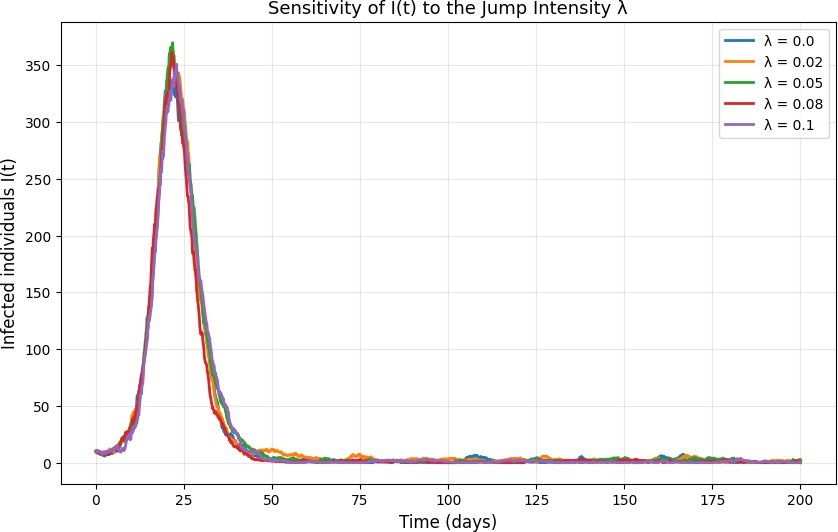
Finally, we conduct numerical simulations to investigate the influence of Brownian fluc-tuations, the leap size and the jump intensity on the trajectories of infected individuals and the abundance of ambient pathogens. The numerical analysis uses the Euler-Maruayama technique and Poisson jump simulation which enables the model to give several possible epidemic paths instead of one deterministic trajectory.
Model Formulation
The cholera model in adopts a classic SIR framework to explain the relationship between the human population and the aquatic environment by including the concentration of Vibrio cholerae bacteria in water F. In this paper, the random environmental fluctuations are simulated with the help of the Brownian motion (Wiener process) which leads to the stochastic extension of the deterministic model [20]. The model is composed of three compartments: bacterial concentration in water F, susceptible individuals χ and infected individuals I. The recruitment of susceptible people is at rate n. The contact of polluted water causes infection at rate .
The bacteria in the aquatic reservoir grow at rate b, infected individuals shed bacteria to the environment at rate e and recover at rate r.
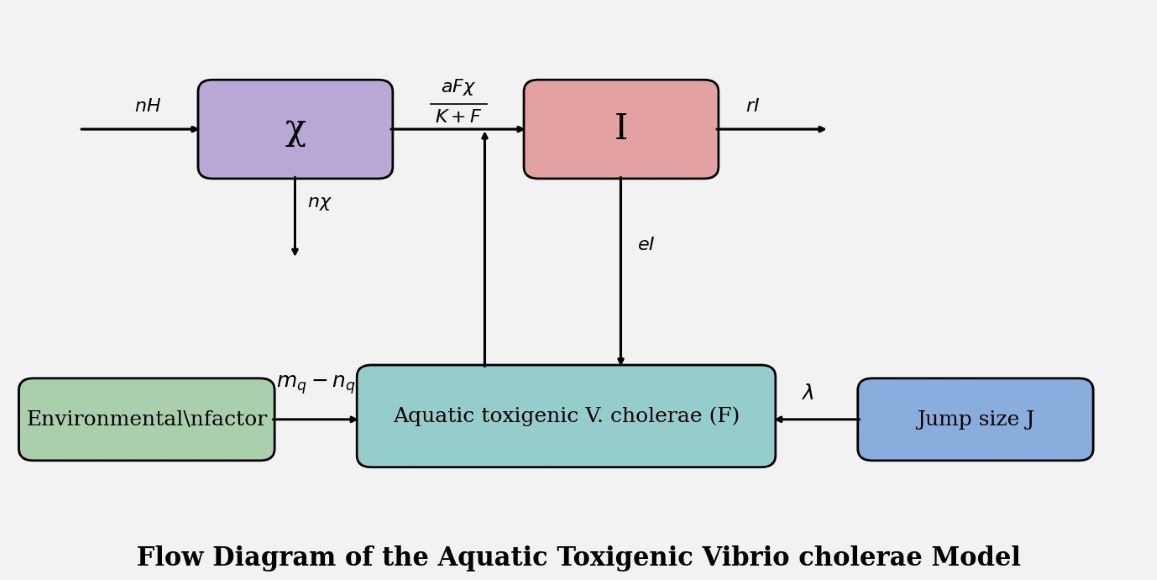
Flow Diagram of the Aquatic Toxigenic Vibrio cholerae Model
Deterministic Model
The Deterministic Model Equations. In this model, the deterministic compartmental human population and a Vibrio cholera bacteria population. The total human population is divided into three classes which are the susceptible population χ, the cholera infectious population I and a Vibrio cholerae bacteria population F. Susceptible are recruited with the rate of n through birth, susceptible can BE infected at the rate of , the contact rate with untreated water and is the probability of an individual to catch cholera.
Infected individuals also contribute to the enhancement of the Vibrio cholera bacteria population through excretion at the rate of e. The infected individual may recover at the rate of r. In the aquatic environment, the bacteria population also grows at a rate determined by environmental factors, and b is the size of bacteria in the aquatic environment. A susceptible individual dies naturally at a to extend the deterministic model in to a stochastic jump diffusion, we reformulate the basic model as follows. The above assumptions of the model lead to the system of ordinary differential equations shown below as in.
| Variable | Definition |
|---|---|
| χ | Number of susceptible individuals. |
| I | Number of infected individuals. |
| F | Toxigenic concentration of Vibrio cholerae in aquatic. |
| Parameters | Definition |
|---|---|
| H | Human population |
| a | Exposure rate of individuals to contaminated water per day |
| n | Birth and death rates of humans per day |
| r | Recovery rate per day |
| K | Vibrio cholerae concentration in water reservoir per day |
| nq - mq | Growth and death difference rate |
| e | Infected rate of individuals contributing to the bacteria population in water |
Table 1: Model parameters and their definitions
Theorem 1
Positivity
In order to get a realistic model, our solution must be non-negative for all t. Therefore if the initial values of the parameters , then the solution set is nonnegative for all .
Proof
Let . Since χ(t), I(t)andF(t) are continuous, then we . If , the positivity holds however if ,
Consider the model equation
We can wrte the above model equation as
Where .
The integrating factor is
Multiplying the differential equation by the integrating factor,
Hence,
Integrating both sides from 0 to t*,
Therefore,
That is,
where .
. Hence, the solution .
Implies that .
Also,
where .
Multiplying both sides of the above equation by the integrating factor,
Where .
, implies that the solution , hence The model equation,
To find the integrating factor of the above differential equation,
Multiplying through by the integrating factor,
Integrating both sides from 0 to t,
Hence,
Multiplying by .
The equation becomes
Let .
Therefore
By definition t* is not finite, which implies that . Therefore the model solution of the system (1) is always positive
Theorem 2
Invariant Region for the Deterministic Model
In this section, we obtain the invariant region of the model Equation (1). The model solution are in the region
Consider the total human population
Let , .
Therefore we have
To find the integrating factor of the above first order DE
Hence the feasible solution set of the system of equation (1) is in the region . Therefore the model is well posed and have biological sense.
Existence and Stability of disease-Free equilibrium
The model's disease free equilibrium is obtained by equating the susceptible χ, infected I and the disease compartment F.
This implies that,
Hence, the equilibrium equations are
This implies that there exists no infection at the disease-free equilibrium; Thus,
By substituting into equation (4), we have, it follows that .
Provided that .
Also, substituting into equation (2), we obtain . Since , .
Therefore, the disease-free equilibrium is .
Hence, the model is well-posed and biologically meaningful, as the jump size alters F.
Disease-Free Equilibrium Stability
To analyze the disease-free equilibrium stability, let us consider taking the Jacobian of the model equations (2) and (4) to prove that they are locally asymptotically stable around the equilibrium point as in [3]. When it comes to disease spread, local asymptotic stability means that if a small change or perturbation is introduced into the system, the system will still return to the disease-free equilibrium.
Basic Reproduction Number for the Deterministic Model
The basic reproduction number R0 is calculated from the disease compartment as follows:
- Fi: rate of appearance of new infections,
- Vi-: transfer rate out of the disease compartment,
- Vi+: transfer rate into the disease compartment by other means.
, the Jacobian of F with respect to the disease compartment (χi) evaluated at the disease-free equilibrium.
The model disease-free equilibrium point is obtained by setting
Therefore
From the equation above, and provided that . By putting in to , we have .
Therefore,
The Jacobian matrix of is
where and . Thus,
At the disease-free equilibrium . Hence
Also, , which is the Jacobian matrix of Vi with respect to the disease compartments χi, evaluated at the disease-free equilibrium (D.F.E).
Therefore,
The eigenvalues satisfy
Clearly λ1 is the dominant eigenvalue and therefore becomes the basic reproduction number R0 of the model:
Theorem 3
The disease-free equilibrium point of the system is asymptotically stable if and only if .
proof
Also, at the disease-free equilibrium point, . We have
The equilibrium point is asymptotically stable if the following condition (Routh–Hurwitz) holds for the characteristic polynomial and its determinant
It is observed that the Jacobian matrix characteristic equation has three roots. Now we write the equation of characteristic as
where
Hence the eigenvalues that correspond to the equilibrium E0 are
We have and according to the Routh-Hurwitz criterion, all the characteristic equation roots have negative real part when and . Hence, the disease-free equilibrium is stable, given that .
Existence and stability of endemic equilibrium
In the endemic equilibrium state , we use equations: 2, 3, 4 to find the endemic equilibrium state.
This implies,
Substituting the value of χ in equation (7)
Since .
We obtain
Or equivalently,
Suppose . Then , which implies since
We observed that from the analysis, if and , there exist a positive endemic equilibrium state.
Theorem 4
The endemic equilibrium state E* is locally asymptotically stable if .
Proof
Let . The Jacobian matrix evaluated at the endemic equilibrium is
Therefore,
From the Routh–Hurwitz criterion, the equilibrium is locally asymptotically stable provided
Which implies that the endemic equilibrium state is locally asymptotically stable. That is all the roots of the characteristic polynomial have negative real parts.
Clearly, since and . Similarly, since and .
And if and only if and . Now, we need to show that .
Therefore, for , the model system (1) has a unique endemic equilibrium E* and it is stable if
Transition Probabilities
Consider the stochastic differential equation with jumps
where f(X, t) is the deterministic (drift) part, g(X(t), t) is the diffusion part and h(X(t), t) is the jump-size part.
The drift coefficient is given by
The diffusion coefficient is
The jump-size coefficient is .
Since time is a continuous variable, the state variables χ(t) and I(t) are continuous random variables. Let and . These increments are approximately normally distributed,
For small time intervals Δt, assume where X1 and X2 correspond to the number of individuals χ(t) and I(t), respectively, with and F(t) denotes the concentration of Vibrio cholerae bacteria.
According to Allen [?], . Hence,
Where , and
Substituting the expressions for γ, ρ, ψ
Expanding,
Similarly ,
The stochastic differential equations are
Differentiating the equations,
Hence,
According to Greenhalgh et al. [? ], the martingale above in terms of filtration is as follows.
Therefore we can write the above Martingale equation as
Hence
Similarly,
We also can write the above Martingale equation as
For that,
Existence and uniqueness of the stochastic differential equations
Therefore the 2×2 matrix with entries gij (x, t) satisfy the following Lipschitz and growth conditions
in the equations below for some K, L and ∀ t ∈ R and x, y ∈ R² as in Ogunlaran et al (26)
Therefore the constant M > 0 exists such that
This implies that the diffusion matrix is continuously differentiable
where
Since both f and g are continuously differentiable, hence the functions satisfies Lipschitz condition and the norm is bounded hence it satisfy conditions for uniqueness and existence of the solution criteria
Dynamic Analysis of the Non-Linear Jump-Diffusion Cholera Endemic Model
Consider the system of the equation
To reduce equation (10) to linear form,
Condition for the reducible non-linear jump-diffusion of cholera endemic model.
The conditions for reducing non-linear stochastic cholera endemic model, using Kloeden and Platen (2010) in [31] , for S.D.E without jumps. The non-linear SDE with jumps above can be reduced to a linear stochastic cholera model with jumps in the form
If f(t) = g(t, I(t)) then ∂g(t,I)/∂I ≠ 0
Therefore, the solution of (10) has the form I(t) = V(t, f(t))
where f = g(t, V(t,I))
Applying Lemma to g(t, Iₜ), we get
where g(t, I(t-)) is the population size just before the arrival of a jump due to infection.
Let
Also let
From equation (19),
Differentiating the above w.r.t. I,
Similarly,
Taking the derivative of equation (22),
Therefore,
Now from equations (20) and (21),
and
Hence,
From equation (22),
Therefore,
Substituting equation (28) into equation (26),
Using
we obtain
Since κ′(t) is independent of I, then
Therefore equation 29 satisfies the condition for the reducing of the non linear stochastic cholera model
Basic reproduction number of the cholera jump diffusion model
At D.F.E, for S = S*, E = I,
Applying Ito's lemma to the above equation,
Since
i.e.,
And
Therefore, the continuous part becomes
For the jump JI I dN(t),
When jump occurs, dN(t) = 1,
Hence, the change in ln(I) by jump is
Therefore,
and
The jump diffusion growth rate threshold
If the growth rate is expressed per unit time,
where E(α) is the expected value of α. Also, for
the jump-diffusion reproduction number (Rjp) for cholera is obtained as
The threshold occurs when the infection has zero average growth,
Dividing by r,
Parameter values table for model simulation
| Parameter | Value | Unit |
|---|---|---|
| n | 0.0001 | day-1 |
| a | 0.5 | day-1 |
| K | 106 | cell/ml |
| r | 0.2 | day-1 |
| mq-nq | 0.33 | day-1 |
| e | 10 | cell/ml day-1 person-1 |
| λ | 0.05 | day-1 |
Table 2: Effect of continuous environmental randomness on the jump-diffusion reproductionnumber
| ηI | Reduction from R0 |
|---|---|
| 0 | 0 |
| 0.1 | 0.025 |
| 0.2 | 0.100 |
| 0.3 | 0.225 |
| 0.4 | 0.400 |
| 0.5 |
NUMERICAL RESULTS AND DISCUSSION
Numerical simulations of the suggested stochastic cholera model with jump perturbation were considered for the dynamic behavior of the model. The susceptible human population (t), the infected human population I(t), and the concentration of toxic Vibrio cholerae bacteria F(t) in the aquatic environment are the three interacting state variables that make up the model. The stochastic part of the model incorporates diffusion in situations of en-vironmental uncertainty and abrupt environmental perturbations (Poisson jump processes), whereas the deterministic part of the model predicts the spread of cholera through polluted water. This means that the model can incorporate both large scale contamination events and gradual environmental changes that may impact the transmission of cholera.
The following parameter values were chosen for the numerical experiments: n = 0.0001 per day, a = 0.5 per day, K = 106 cell/ml, r = 0.2 per day, mq - nq = 0.33 per day, e = 10 cell/ml per day per person and λ = 0.05 per day. In this instance n is the recruitment rate for susceptible individuals, n is the recruitment rate for contaminated water, K is the half-saturation constant related to the concentration of the bacteria, r is the recovery rate, mq - nq is the net removal rate of bacteria, e is the infected individual that contributes bacteria to the aquatic environment, and λ is the intensity of the Poisson jump process.
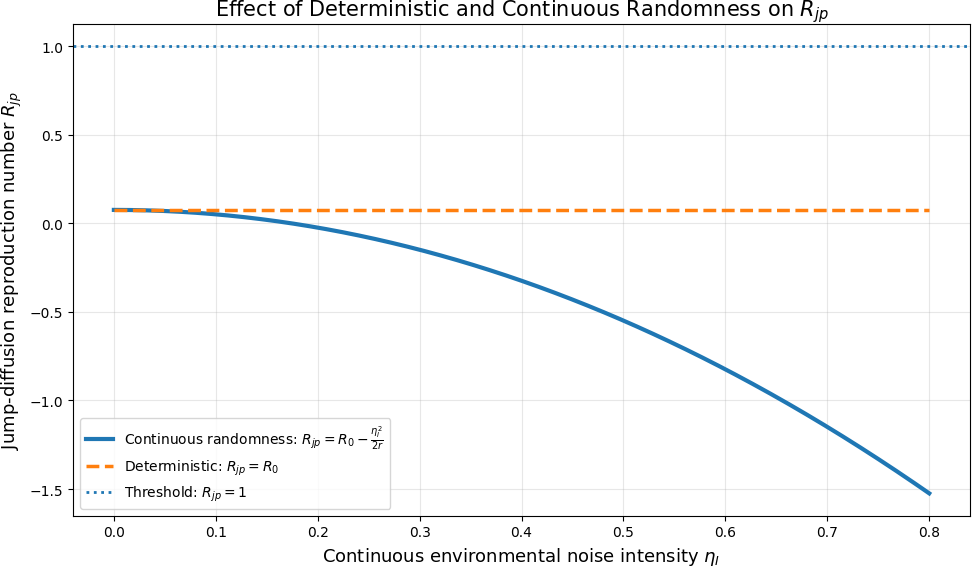
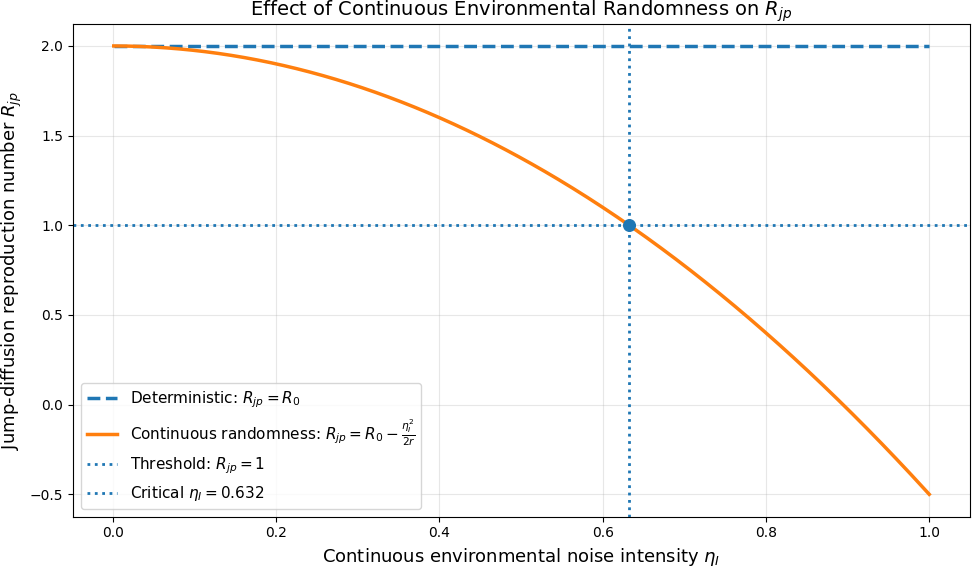
The estimated jump diffusion reproduction number Rjp shows that in addition to the deterministic reproduction number R0, ongoing environmental changes and abrupt epidemic disruptions also have an impact on the dynamics of typhoid disease transmission. In particular, the contribution by the diffusion component includes a negative correction factor -ηI2/2R
which implies that environmental stochasticity can reduce the potential for the infection to be effective in reproduction. On the contrary, if the size of the jump is positive JI , then the contribution is positive, The term λj l n(1+JI )
indicates that if there are significant, or frequent spikes in the number of infections, then disease may be spread. Thus, Rjp < 1 represents a tendency to extinction of the disease, and Rjp > 1 represents a potential for disease persistence. The jump-diffusion formulation accounts for the random fluctuations in the infected population, along with dramatic changes in that population, and as such provides a more realistic epidemic threshold. Poisson jump simulation and the Euler-Maruyama method for the stochastic compo-nent were used in the numerical computations. This numerical approach is suitable for the stochastic differential formulation as it allows the discontinuous nature of the disturbances generated by the Poisson process to be incorporated into the numerical trajectories as well as the continuous random fluctuations generated by the Wiener process. The consequence is that the stochastic formulation can give several possible epidemic paths, rather than a single deterministic path. The development of the model in particular aims to represent fast environmental events which can lead to abrupt changes in the concentration of pathogens and thus influence the spread of cholera.
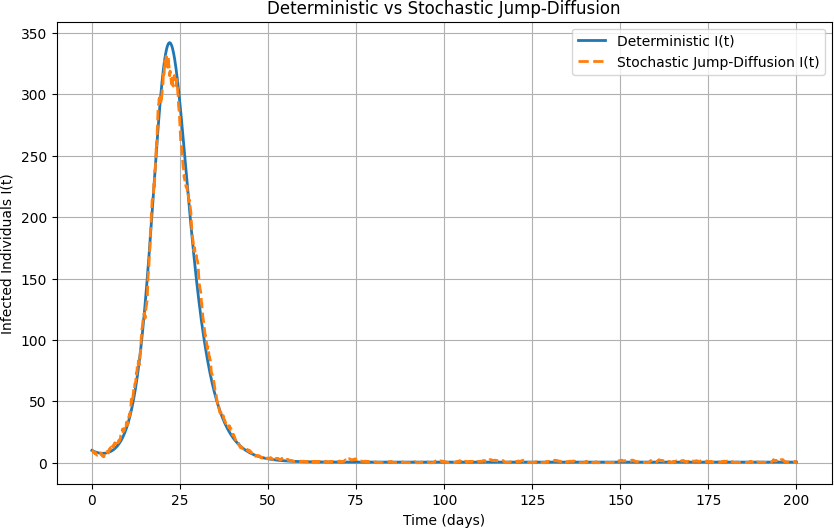
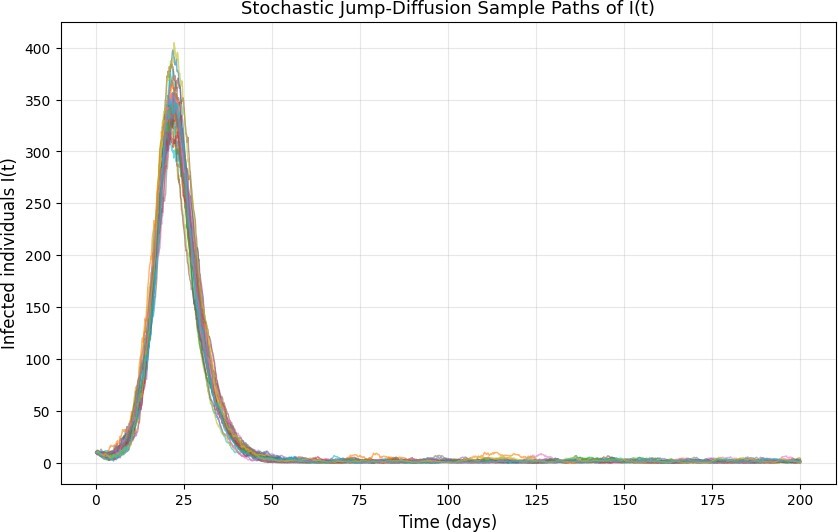
Figure 28 shows the difference between the deterministic trajectory of the infected popu-lation I(t) and the stochastic jump-diffusion trajectory of I(t). The deterministic trajectory has a very small number of infected individuals at the start and a sharp increase following this. In the first portion of the simulation, the amount of the affected population starts to rise rapidly, indicating the beginning of an epidemic outbreak. Vulnerable individuals are susceptible to the disease when they come in contact with water contaminated with Vibrio cholerae bacteria, so the quick rise is associated with the environmental pathway of trans-mission.
The number of people infected is at its peak between Days 22 and 25, at about 345–350 infected people. This point is the maximum intensity of the simulated outbreak, given the baseline parameter values. The timing of the peak implies that the number of new infections that are occurring during this time is high enough to surpass the number of people who are dying from the infection or recovering. This leads to the number of affected people increasing until the peak of the epidemic.
Once infected the population quickly decreases, this decrease is due to the fact that the number of susceptible individuals has decreased significantly in the course of the outbreak, while the infected ones are still recovering at the rate of r. Consequently, there are fewer new cases and epidemics cannot be maintained at high levels of infected persons as occurred during the epidemic. The simulation shows that the infected population drops off rapidly after days 50 and then remains in a low state for the next 200 days of the simulation.
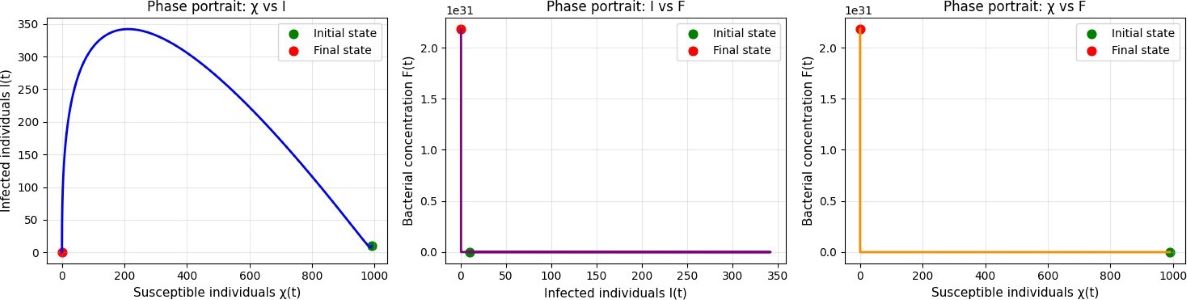
An important characteristic of the model is shown as a reduction in the number of in-fections following the peak of the epidemic. Susceptible individuals' interactions with a reservoir of environmental bacteria are a major determinant of cholera transmission, which is not only determined by the number of infected individuals. The infection pressure drops as the number of susceptible people is decreased and those who are infected recover. There-fore, the number of infected people can be reduced even though there may be bacteria in the environment.
Comparison between Determinstic and Stochastic Solution
The stochastic jump diffusion trajectory shown below does not exactly coincide with the deterministic solution, but it does have the same general shape. On the contrary, the stochastic trajectory is surrounded by the deterministic track. These oscillations are due to environmental unpredictability integrated in the model by stochastic variables. This pro-duces a more diverse epidemic trajectory than the deterministic model, so that the stochastic model produces a greater variety of epidemic trajectories than the deterministic model. One important result is that the basic nature of the epidemic is not completely modified by the inclusion of randomness. Both deterministic and stochastic trajectories show an ini-tial rise in the number of infected individuals to a large epidemic peak followed by a fast decrease. The stochastic model provides more information on uncertainty in the primary epidemic pattern while the deterministic model does. The stochastic simulations show that there can be a range of infected people ranging between about 300 and 400 people on different stochastic sample routes. The peak is also slightly delayed in time. This is important from an epidemiological standpoint because it demon-strates the importance of environmental uncertainty on the size and timing of an outbreak of cholera. 2 outbreaks of equal average conditions can have different epidemic outcomes due to chance environmental variations.
However, environmental uncertainty is not necessarily unimportant for modelling cholera, as seen in the difference between the two paths: deterministic and stochastic. According to the deterministic model, environmental conditions change at predetermined average rates. The stochastic model, on the other hand, recognizes the possibility of unexpected contami-nation occurrences, and the varying levels of environmental variables. The stochastic model, therefore, does not give a single trajectory for the pandemic, but rather a variety of scenarios.
Limitations
The proposed stochastic jump-diffusion cholera model is useful, but there are some lim-itations in the study. First, the model is very simple and contains only three main state variables: the concentration of toxic Vibrio cholerae in the aquatic environment, susceptible individuals and infected individuals. Therefore, other epidemiological parameters such as hospitalized cases, asymptomatic infections and recovered patients are not specifically indi-cated. Second, contaminated water is the main way of infection; other possible channels of infection such as contaminated food and direct touch are not specifically included. Third, stochastic environmental uncertainty is modeled by Poisson jump processes and Brownian motion. These processes offer a simplified picture of the complex reality of real-world envi- ronmental events, whether these are sudden environmental shocks or continuous fluctuations. Furthermore, as opposed to the calibration against a particular cholera outbreak dataset in the real world, the numerical simulations are based on stochastic sample routes and selected parameter values. The results should therefore be considered primarily as theoretical and numerical insights into the model behavior. Finally, the current formulation does not contain specific intervention variables, although sanitation and water treatment are highlighted as key control measures. These constraints allow future researchers to develop more complex models that include more transmission pathways, intervention techniques, real epidemic data and more accurate environmental processes.
Comparision between determinstic and stochastic solution
The stochastic jump diffusion trajectory shown below does not exactly coincide with the deterministic solution, but it does have the same general shape. On the contrary, the stochastic trajectory is surrounded by the deterministic track. These oscillations are due to environmental unpredictability integrated in the model by stochastic variables. This pro-duces a more diverse epidemic trajectory than the deterministic model, so that the stochastic model produces a greater variety of epidemic trajectories than the deterministic model. One important result is that the basic nature of the epidemic is not completely modified by the inclusion of randomness. Both deterministic and stochastic trajectories show an ini-tial rise in the number of infected individuals to a large epidemic peak followed by a fast decrease. The stochastic model provides more information on uncertainty in the primary epidemic pattern while the deterministic model does.
The stochastic simulations show that there can be a range of infected people ranging between about 300 and 400 people on different stochastic sample routes. The peak is also slightly delayed in time. This is important from an epidemiological standpoint because it demon-strates the importance of environmental uncertainty on the size and timing of an outbreak of cholera. 2 outbreaks of equal average conditions can have different epidemic outcomes due to chance environmental variations.
However, environmental uncertainty is not necessarily unimportant for modelling cholera, as seen in the difference between the two paths: deterministic and stochastic. According to the deterministic model, environmental conditions change at predetermined average rates. The stochastic model, on the other hand, recognizes the possibility of unexpected contami-nation occurrences, and the varying levels of environmental variables. The stochastic model, therefore, does not give a single trajectory for the pandemic, but rather a variety of scenarios.
CONCLUSION
The standard χI - F cholera model was extended to a stochastic jump diffusion model, to account for both single- time events of contamination and persistent environmental un-certainty. The deterministic model was shown to be well-posed from a mathematical and a physiological point of view, using positivity and invariant-region analysis. The stability of endemic and disease free equilibria studied by applying Routh-Hurwitz criterion and basic reproduction number R0.
The model was stochastic, allowing sudden environmental changes to be modeled by Pois-son jump processes, and the continuous environmental changes by Brownian motion.The ex-istence and uniqueness of the stochastic solution were proven under the right circumstances. The Euler Maruyama method for numerical simulation of the stochastic trajectories shows that they fluctuate around the deterministic trajectory, while the impact of the jump events causes short-term deviations without changing the overall shape of the epidemic, compared to the deterministic trajectory.
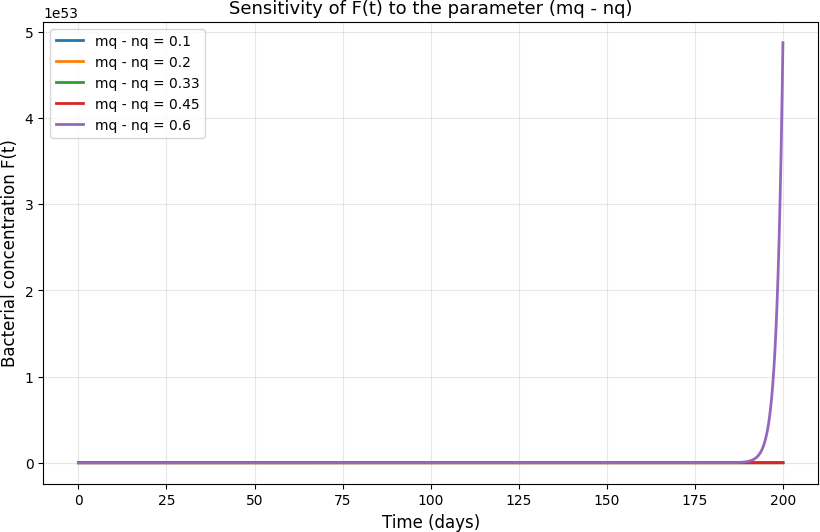
The numerical results show that the number of infected persons initially increased and was close to 345–350 individuals between Days 22 and 25, followed by a fast decline after Day 50. Differences in the size and timing of the outbreak were due to the different stochastic sample routes, reflecting the influence of environmental uncertainty on cholera transmis-sion.By sensitivity analysis, the bacterial clearance rate mq - nq and shedding rate e were determined to be important factors affecting the spread of the disease and outbreak severity. On balance, the proposed stochastic jump diffusion model provides a convenient and statis-tically tractable model for understanding the transmission of cholera in the context of the environmental uncertainty and sporadic contamination events. The results emphasize how crucial sanitation, water treatment, and strategies that lessen Vibrio cholerae persistence and environmental shedding are to containing cholera epidemics.
REFERENCES
- McElroy A, Townsend PK. Medical anthropology in ecological perspective. 5th ed. Boulder (CO): Westview Press; 2009.
- Crooks AT, Hailegiorgis AB. An agent-based modeling approach applied to the spread of cholera. Environ Model Softw. 2014;62:164-177. [Crossref]
- Codeço CT. Endemic and epidemic dynamics of cholera: the role of the aquatic reservoir. BMC Infect Dis. 2001;1:1. [Crossref] [PubMed]
- Fatima S, Krishnarajah I, Jaffar MZAM, Adam MB. A mathematical model for the control of cholera in Nigeria. Res J Environ Earth Sci. 2014;6(6):321-325. [Crossref]
- Akor A. Handbook on management of tropical disease in developing countries: a guide to the diagnosis and treatment of common diseases in the tropics. Lokoja (Nigeria): Bamise Printing Press; 2007.
- Fakai SA, Ibrahim MO, Siddiqui AM. A deterministic mathematical model on cholera dynamics and some control strategies. Int J Sci Eng Technol. 2014;8(3):1115-1118.
- Wang J, Modnak C. Modeling cholera dynamics with controls. Can Appl Math Q. 2011;19(3):255-273.
- Capasso V, Paveri-Fontana SL. A mathematical model for the 1973 cholera epidemic in the European Mediterranean region. Rev Epidemiol Sante Publique. 1979;27(2):121-132. [PubMed]
- Hntsa KH, Kahsay BN. Analysis of cholera epidemic controlling using mathematical modeling. Int J Math Math Sci. 2020;2020:7369204. [Crossref]
- Opoku NKDO, Afriyie C. The role of control measures and the environment in the transmission dynamics of cholera. Abstr Appl Anal. 2020;2020:2485979. [Crossref]
- Mukandavire Z, Liao S, Wang J, Gaff H, Smith DL, Morris JG Jr. Estimating the reproductive numbers for the 2008-2009 cholera outbreaks in Zimbabwe. Proc Natl Acad Sci U S A. 2011;108(21):8767-8772. [Crossref] [PubMed]
- Jensen MA, Faruque SM, Mekalanos JJ, Levin BR. Modeling the role of bacteriophage in the control of cholera outbreaks. Proc Natl Acad Sci U S A. 2006;103(12):4652-4657. [Crossref] [PubMed]
- Ochoche JM. A mathematical model for the transmission dynamics of cholera with control strategy. Int J Sci Technol. 2013;2(11):797-803.
- Ezeagu NJ, Togbenon HA, Moyo E. Modeling and analysis of cholera dynamics with vaccination. Am J Appl Math Stat. 2019;7(1):1-8. [Crossref]
- Posny D, Wang J. Modelling cholera in periodic environments. J Biol Dyn. 2014;8(1):1-19. [Crossref] [PubMed]
- Nyabadza F, Aduamah JM, Mushanyu J. Modelling cholera transmission dynamics in the presence of limited resources. BMC Res Notes. 2019;12:475. [Crossref] [PubMed]
- Lemos-Paião AP, Silva CJ, Torres DFM. An epidemic model for cholera with optimal control treatment. J Comput Appl Math. 2017;318:168-180. [Crossref]
- Peter OJ, Ayoade AA, Abioye AI, Victor AA, Akpan CE. Sensitivity analysis of the parameters of a cholera model. J Appl Sci Environ Manag. 2018;22(4):477-481. [Crossref]
- Nyaberi HO, Malonza DM. Mathematical model of cholera transmission with education campaign and treatment through quarantine. J Adv Math Comput Sci. 2019;32(3):1-12. [Crossref]
- Abdulai T. Using Atanackovic and Stankovic numerical method to investigate fractional order cholera model. Kumasi (Ghana): Kwame Nkrumah University of Science and Technology; 2015.
- Mwasa A, Tchuenche JM. Mathematical analysis of a cholera model with public health interventions. Biosystems. 2011;105(3):190-200. [Crossref] [PubMed]
- Lemaitre J, Pasetto D, Perez-Saez J, Sciarra C, Wamala JF, Rinaldo A. Rainfall as a driver of epidemic cholera: comparative model assessments of the effect of intra-seasonal precipitation events. Acta Trop. 2019;190:235-243. [Crossref]
- Liang Y, Greenhalgh D, Mao X. A stochastic differential equation model for the spread of HIV amongst people who inject drugs. Comput Math Methods Med. 2016;2016:6757928. [Crossref] [PubMed]
- Allen E. Modeling with Itô stochastic differential equations. Dordrecht: Springer; 2007. [Crossref]
- Greenhalgh D, Liang Y, Mao X. SDE SIS epidemic model with demographic stochasticity and varying population size. Appl Math Comput. 2016;276:218-238. [Crossref]
- Ogunlade TO, Ogunmiloro OM, Ogunyebi SN, Fatoyinbo GE, Okoro JO, Akindutire OR, et al. On the effect of vaccination, screening and treatment in controlling typhoid fever spread dynamics: deterministic and stochastic applications. Math Stat. 2020;8(6):621-630. [Crossref]
- Burrage K, Burrage PM, Tian T. Numerical methods for strong solutions of stochastic differential equations: an overview. Proc Math Phys Eng Sci. 2004;460(2041):373-402. [Crossref]
- Doldersum T. The role of water in cholera diffusion: improvements of a cholera diffusion model for Kumasi, Ghana [master's thesis]. Enschede (Netherlands): University of Twente; 2013.
- Pourbohloul B. Modeling infectious diseases in humans and animals by Matthew James Keeling and Pejman Rohani. Clin Infect Dis. 2008;47(6):864-865. [Crossref]
- Kloeden PE, Platen E. Numerical solution of stochastic differential equations. Berlin: Springer-Verlag; 1992. [Crossref]
- Kloeden PE, Platen E. Numerical solution of stochastic differential equations. Berlin: Springer-Verlag; 1992. [Crossref]

Article Processing Timeline
| 2-5 Days | Initial Quality & Plagiarism Check |
| 25-35 Days |
Peer Review Feedback |
| 45-60 Days | Total article processing time |
EDITORIAL & PUBLICATION INFORMATION
| English | Publication Language |
| Single-Blind | Peer-Review Model |
| 17% | Acceptance Rate |
| <18% | Similarity Screening Guideline |
| Open Access | Access Model |
All manuscripts undergo editorial assessment and originality screening as part of the journal's evaluation process. The acceptance rate shown is based on journal-level editorial data and may change over time. Similarity reports are assessed editorially and are not interpreted solely on the basis of a numerical similarity score.
Why Publish with us?
Ethics & Policies
Editorial & Management
Useful Links
Journal Highlights
Open Access Journals
Journal Flyer