


 Download PDF

Department of Chemistry, University of New South Wales, Syndey, Australia
ABSTRACT
The Camassa-Holm (CH) equation, introduced by Roberto Camassa and Darryl Holm in 1993, is an integrable shallow-water wave equation that exhibits the remarkable phenomenon of peaked solitons, or peakons, which are solutions with a sharp corner at their crest that nonetheless interact elastically. The equation models unidirectional propagation of shallow-water waves at the same order of approximation as the Korteweg-de Vries (KdV) equation, but with a fundamentally different nonlinear structure that allows both smooth solitons and nonsmooth peakons, as well as wave breaking: the steepening of a smooth wave until its slope becomes infinite while the wave itself remains bounded. This review provides a comprehensive and critical assessment of the literature on the Camassa-Holm equation. We survey its physical derivation from the water-wave problem, its integrability theory based on the Lax pair, bi-Hamiltonian structure, and inverse scattering transform, the theory of peakons and their orbital and asymptotic stability, wave-breaking and global-existence results, the well-posedness theory in Sobolev and Besov spaces, conservative and dissipative weak solutions, the two-component and multi-component generalizations, the Degasperis-Procesi and Novikov equations of the same family, numerical methods, and the applications to geophysical and biomechanical wave propagation. Particular attention is given to the most recent research, including work published in 2025 and 2026, and the results are compared systematically and summarized in three tables and two figures. We close with open problems and future directions.
Keywords: Camassa-Holm Equation; Novikov Equations; Peakons; Shallow-Water Waves; Solitons
INTRODUCTION
The Camassa-Holm equation,
The equation displayed above is the zero-linear-dispersion member, ω = 0, of the general Camassa-Holm equation, which also contains a linear (KdV-type) dispersion term:
Here ω ≥ 0 is the coefficient of the linear dispersion term 2ω ux. The two regimes are not interchangeable, and several results cited below (for example, the varying-dispersion blow-up theory of refer specifically to the case ω ≠ 0).
The Camassa-Holm equation was introduced by Camassa and Holm in 1993 as an integrable shallow-water wave equation with peaked solitons [1]. Written in the equivalent form in terms of the momentum variable m = u - uxx, it reads m_t + u mx + 2 m ux = 0. The equation was derived as a model for unidirectional propagation of shallow-water waves over a flat bottom at the same formal order as the KdV equation, but it possesses a strikingly different mathematical structure [1-2]. Its most celebrated solutions are the peakons,
which propagate at speed c without change of form, and which collide elastically, a property verified explicitly through their representation as a completely integrable finite-dimensional system [1,3]. The existence of these peaked solitons, which exhibit a discontinuity in their first derivative at the crest, was the principal novelty of the equation and the source of much of its subsequent influence [4]. The Camassa-Holm equation occupies a special place in the theory of nonlinear dispersive wave equations. Unlike the KdV equation, which is integrable and possesses only smooth solitons, the CH equation combines integrability with the presence of nonsmooth peakons and with wave breaking, the phenomenon in which the spatial derivative of a smooth solution becomes unbounded in finite time while the solution itself remains bounded [5]. This combination of properties, integrability, peakons, and wave breaking, is responsible for the extraordinary mathematical and physical interest that the equation has attracted since its introduction. It has been the subject of an enormous literature spanning integrable systems, partial differential equations, numerical analysis, and applied wave theory [2,6].
Scope and Selection of Literature
A review of this kind is only as useful as its coverage is transparent, and we state briefly how the literature was assembled. The corpus was collected by combining structured keyword searches of the main bibliographic databases (MathSciNet, zbMATH, Web of Science, Scopus, and arXiv) with backward and forward citation chaining from the foundational papers [1-5]. The search terms combined “Camassa-Holm”, “peakon”, “shallow-water” and “integrable” with section-specific qualifiers (for example “well-posedness”, “Besov”, “wave breaking”, “Novikov”, “multi-component”, “numerical”). The searches were run through early 2026. Priority was given to (i) foundational and highly cited works, (ii) papers that introduced a method or resolved a question left open by earlier work, and (iii) the most recent research, with explicit emphasis on 2025 and 2026. The 103 references collected here are the subset of that corpus that, in our judgement, best represents the state of the field; works that only restate earlier results were excluded. Where a section relies on a standard result rather than on a single source, the original work and a representative later treatment are cited together.
Relation to Existing Monographs and Added Value
The subject is already served by a comprehensive recent monograph, the two-part treatment of the Camassa-Holm and modified Camassa-Holm equations by Qiao, and a reader is entitled to ask what an additional review contributes [7-8]. This article does not attempt to replace that monograph, which remains the authoritative detailed reference. Its aim is complementary and more sharply comparative: to place the scalar, two-component, modified, and nonlocal members of the family side by side within a single narrative; to make the underlying hypotheses explicit (which function space, which notion of stability, which dispersion regime) instead of leaving them implicit in a citation; to record where independent lines of evidence agree and where claims remain contested; and to collect the results of the peakon and well-posedness sections in tabular form so that they can be compared at a glance (Section 12). Where the monograph develops a single equation in depth, this review is organized around the questions that cut across the whole family.
The purpose of this review is to survey the literature critically and comprehensively. Section 2 recalls the physical derivation of the equation from the water-wave problem and its relation to the KdV equation. Section 3 treats the integrability theory, including the Lax pair, the bi-Hamiltonian structure, and the inverse scattering transform. Section 4 is devoted to peakons: their explicit form, their interactions, and their orbital and asymptotic stability. Section 5 covers wave breaking and global existence. Section 6 reviews the well-posedness theory in Sobolev and Besov spaces. Section 7 surveys conservative and dissipative weak solutions. Section 8 treats the multi-component generalizations. Section 9 examines the Degasperis-Procesi and Novikov equations of the same family. Section 10 reviews numerical methods. Section 11 surveys the applications to geophysical and biomechanical wave propagation. Section 12 presents a critical synthesis of this material, Section 13 collects open problems and future directions, and Section 14 concludes.
Physical Derivation and The Shallow-Water Regime
The Camassa-Holm equation was derived by Camassa and Holm from the shallow-water approximation of the Euler equations, at the same order as the KdV equation but retaining a different combination of terms that allows for the peaked solutions [1-2]. The systematic derivation, and the precise sense in which the equation approximates the water-wave problem, was established by Constantin and Lannes, who proved that the CH equation is an equally valid model of shallow-water waves as the KdV equation, and that both equations describe the free-surface evolution at the same order of accuracy [2]. The variational derivation of the equation, based on a Lagrangian for the shallow-water flow, was provided by Ionescu-Kruse, who derived the CH equation from a variational principle and discussed its relation to the Green-Naghdi and other higher-order shallow-water models [6]. Higher-order shallow-water equations, and their connection to the CH equation, were studied by Parker [7].
The relation of the Camassa-Holm equation to the KdV equation is subtle and illuminating. Both equations are obtained from the same physical scaling; in the long-wave limit the linear dispersion relation of the general Camassa-Holm equation with positive linear dispersion (ω > 0) agrees with that of the KdV equation to the same order in the wave number, while the nonlinear terms differ in a way that changes the nature of the travelling-wave solutions; the nonlinear terms, however, differ in a way that changes the nature of the travelling-wave solutions [1-2]. In particular, the CH equation supports peakons whereas the KdV equation does not, and the soliton solutions of the two equations have different asymptotic behavior at infinity [8-9]. The travelling-wave solutions of the CH equation were classified by Lenells, who showed that the equation possesses peakons, cuspons, and smooth travelling waves depending on the parameters [9]. Boyd studied the peakons and coshoidal waves of the equation from the numerical point of view [8]. The hydrodynamical relevance of the equation, and the comparison with the KdV and Boussinesq models, was emphasized by Constantin and Lannes [2].
The distinction between the two dispersion regimes is made precise by the linear dispersion relation. Linearizing the general equation about the rest state and seeking a plane-wave solution u ~ exp(i(kx - σt)) leaves, for the linear part, σ = 2ωk/(1+k²), so that the phase speed is cphase(k) = σ/k = 2ω/(1+k²). For the KdV equation, whose linear part is ut + 2ωux + uxxx = 0, the phase speed is cphase,KdV(k) = 2ω - k². Expanding the Camassa-Holm phase speed for long waves, 2ω/(1+k²) = 2ω(1 - k² + k⁴ - ...), shows that the two agree up to and including order k², which is the precise sense in which the equations share the same linear dispersion in the shallow-water regime. The difference between them is therefore not linear but nonlinear, and it is this difference that permits the peakon and the wave-breaking phenomenon. For ω = 0 the linear term is absent altogether and the equation is a purely nonlinear balance; this is the regime in which the original peakon solution was found [1,9].
The derivation of the Camassa-Holm equation is closely related to the general theory of asymptotic models for water waves. The equation arises from the Green-Naghdi equations and other strongly nonlinear shallow-water models in appropriate limits, and its variational structure is inherited from the water-wave problem [6-7]. The connection between the CH equation and the geodesic flow on the diffeomorphism group, discovered by Constantin and Escher, provides a geometric interpretation of the equation and of its wave-breaking phenomenon [5,10]. This geometric interpretation, in which the equation describes the geodesic flow of the H1 metric on the group of diffeomorphisms, is one of the most beautiful results of the subject and has been developed extensively in the literature [10].
Integrability, Lax Pairs, and Inverse Scattering
The Camassa-Holm equation is completely integrable. Camassa and Holm showed that it possesses a Lax pair and an associated spectral problem of a type first studied by Fuchssteiner and Fokas in the theory of hereditary symmetries and recursion operators [1,11-12]. The bi-Hamiltonian structure of the equation, which follows from the existence of two compatible Poisson structures, guarantees the existence of an infinite hierarchy of conservation laws and the complete integrability of the equation in the sense of Liouville [11-12]. The Lax pair of the CH equation, unlike that of the KdV equation, involves a spectral parameter in a way that makes the spectral problem nonstandard, and the inverse scattering transform for the equation requires a careful treatment of the associated eigenvalue problem [13-14].
The inverse scattering transform for the Camassa-Holm equation was developed [14-15]. The spectral problem is a string equation, whose scattering theory is related to the theory of the Stieltjes string and to the classical moment problem [13,16]. The solution of the initial-value problem by inverse scattering proceeds through the direct problem, the time evolution of the scattering data, and the reconstruction of the solution by a Marchenko-type equation [14,17]. The inverse spectral problem for the equation, in both the periodic and the nonperiodic cases, has been solved for a broad class of solutions, and the spectral data have been related to the peakon solutions [16,18]. Lenells developed the scattering approach to the CH equation in detail, including the analysis of the scattering data for peakons [17].
The integrability of the Camassa-Holm equation has profound consequences for its dynamics. The peakon solutions are obtained from the finite-dimensional reduction of the equation to a completely integrable system of ODEs for the positions and momenta of the peaks, a system that was shown by Camassa and Holm to be of the Calogero-Moser type [1]. The N-peakon dynamics were studied in detail, and the integrability of the peakon sector was used to prove the elastic nature of peakon collisions [3,19]. The Lax pair for the equation was also used by Chang and Szmigielski to study the modified Camassa-Holm equation and the concept of peakons in the modified case [20]. Avan, Frappat, and Ragoucy constructed a new integrable structure associated to the Camassa-Holm peakons, providing a one-parameter integrable extension of the Ragnisco-Bruschi peakon dynamics [21]. The integrability theory of the CH equation is thus both deep and far-reaching, connecting the equation to the theory of classical integrable systems, string equations, and orthogonal polynomials [14,18].
Peakons and Their Stability
The peaked solitons, or peakons, are the most distinctive feature of the Camassa-Holm equation. The single peakon u(x,t) = c exp(-|x - c t|) is a weak solution of the equation that propagates without change of form, and the N-peakon solutions are obtained from the corresponding finite-dimensional integrable system [1,3]. The peakons have a discontinuity in their first spatial derivative at the crest, and they interact elastically within the integrable scalar dynamics, a property verified both by the explicit solutions and by the inverse scattering analysis; as discussed in Section 12, however, elastic interaction is specific to the integrable scalar equation and is not shared by every member of the family [4,19]. The stability of the peakons was established by Constantin and Strauss, who proved that the peakons are orbitally stable in the energy space H1 [4]. This landmark result, based on the two conserved quantities of the equation and on the analysis of the corresponding variational problem, established that small perturbations of a peakon remain close to a peakon of slightly adjusted speed for all time [4].
The peakon can be obtained by a short computation that also isolates the role of the corner, and we give it here because it is rarely written out in reviews. Insert the travelling-wave ansatz u(x,t) = φ(x - ct) into the zero-dispersion equation; using φ_t = -c φ′ and φxxt = -c φ‴, the equation becomes
The left-hand side is a total derivative: it equals
Integrating once and using φ → 0 as |ξ| → ∞ to set the constant to zero gives the first integral
On either half-line the decaying solution of this second-order equation is φ(ξ) = c exp{-|ξ|}: on ξ > 0, one has φ′ = -φ and φ″ = φ, and every term in the identity is even in ξ, so the same expression solves it on ξ < 0. Requiring φ to be continuous at the crest normalizes the amplitude to the speed, giving
The function is smooth for x ≠ ct but has a jump of size 2c in its first derivative at the crest, as Figure 1(b) shows; its second derivative therefore contains a Dirac mass. Writing the equation in momentum form mt + u mx + 2m ux = 0 with m = u - uxx, the peakon carries m = 2cδ (x - ct), and it is exactly this concentration of momentum that balances the transport terms and makes the peakon a weak solution [1,9]. The same corner that makes the peakon non-smooth is thus not a defect of the solution but the mechanism by which it satisfies the equation.
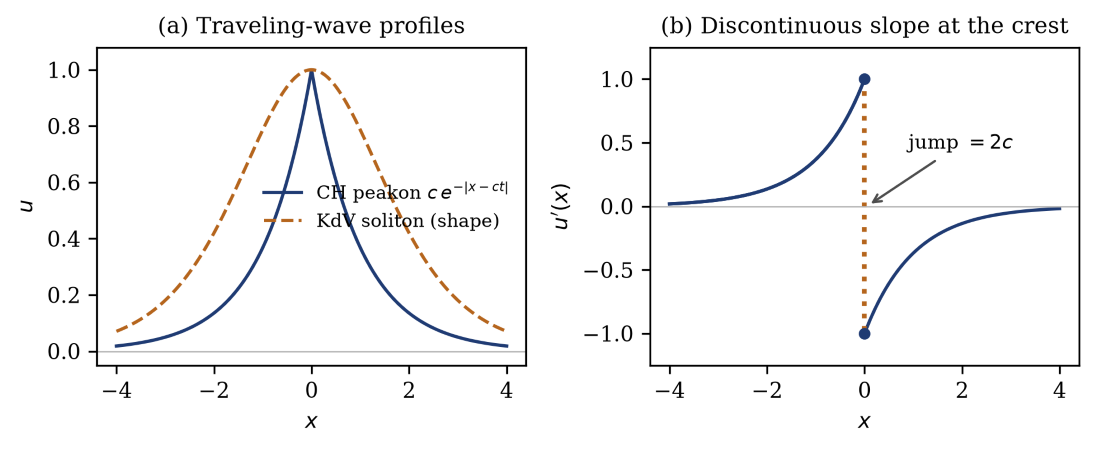
Figure 1: The defining feature of the Camassa-Holm peakon. (a) The profile c exp(-|x-ct|) compared with a KdV soliton of the same amplitude; the peakon decays like exp(-|x|), whereas the KdV soliton has the broader sech2 shape. (b) The first derivative of the peakon, which is discontinuous at the crest with one-sided limits ±c, so that the slope jumps by 2c.
The stability theory of the Camassa-Holm peakons has been developed in many directions. Lenells proved the stability of smooth periodic solutions of the CH equation using the integrability of the equation and the stability of the periodic travelling waves was established in the same work [22]. Molinet proved the asymptotic stability of the peakon under perturbations of the momentum density, and applied the result to the stability of antipeakon-peakon profiles [23]. Eckhardt and Kostenko solved the inverse spectral problem for periodic conservative multi-peakon solutions, connecting the spectral data to the peakon dynamics [18], and Dong and Zhou studied the inverse spectral problem and peakons of an integrable two-component Camassa-Holm system [24]. The stability of the peakons and multi-peakons for the modified Camassa-Holm equation with cubic nonlinearity was established by Qu, and the stability of the mu-Camassa-Holm peakons was proved by Chen [25-26]. The orbital stability of elliptic periodic peakons for the modified Camassa-Holm equation was established by Chen and Lu, and the orbital stability of peakons for the modified Camassa-Holm equation was proved by Li. The orbital stability of peakons for the generalized cubic-quintic and quintic-septic Camassa-Holm type equations was established [27-30]. The stability of smooth solitons for the modified Camassa-Holm equation was proved by Li, and the orbital stability of trains of peaked solitary waves for the modified Camassa-Holm-Novikov equation was established by Luo [31-32]. The orbital stability of pseudo-peakons for the fifth-order Camassa-Holm type equation was proved by Hu and Zhu [33].
The peakon solutions have been studied from many other points of view. The peakons and coshoidal waves were analyzed numerically by Boyd [8]. The wave dynamics for the peaked solitons of the Camassa-Holm equation were studied by Parker [34]. The peakon, pseudo-peakon, and cuspon solutions for two generalized Camassa-Holm equations were obtained by Li and Qiao using the method of dynamical systems [35]. New peaked solitary wave solutions of the generalized Camassa-Holm equation were constructed by Tian and Song [36]. The peakon and kink-peakon solutions to a (2+1)-dimensional generalized Camassa-Holm equation were obtained by Tovar, [37]. The ghostpeakons and characteristic curves for the Camassa-Holm, Degasperis-Procesi, and Novikov equations were studied by Lundmark and Shuaib [38]. The solitons in the Camassa-Holm shallow water equation were studied by Cooper and Shepard, who examined the interaction of the peaked solitons numerically [39]. The periodic peakons of the generalized mu-Camassa-Holm-Novikov equation were obtained by Hwang and Moon, and the orbital stability of the periodic peakons for the generalized modified Camassa-Holm equation was established by Moon [40-41]. New solutions with peakon creation in the Camassa-Holm and Novikov equations were constructed by Kardell [42]. These results demonstrate the extraordinary richness of the peakon phenomenology and the central role of the stability theory in the modern theory of the equation [4,25].
Wave Breaking and Global Existence
Wave breaking, the phenomenon in which the slope of a smooth solution becomes unbounded in finite time while the solution itself remains bounded, is one of the defining features of the Camassa-Holm equation. Constantin and Escher proved that the CH equation exhibits wave breaking for a large class of initial data, and established the precise geometric and analytic conditions under which breaking occurs [5,10]. In particular, they proved that a solution with a positive momentum density m = u - uxx evolves globally, while solutions whose momentum density changes sign can break in finite time [5]. The wave-breaking rate was shown to be Journal of Mathematics, Physics and Mechanics finite, in the sense that the slope remains bounded until the breaking time, at which point one can seek to continue the solution in a weak sense; such a continuation is neither automatic nor unique and requires the conservative or dissipative frameworks discussed in Section 7 [5,10]. The breakdown of the Camassa-Holm equation was also analyzed by McKean, who gave a concise characterization of the breaking time in terms of the inverse spectral data [43].
The global-existence results for the Camassa-Holm equation complement the wave-breaking theory. Constantin and Escher proved the global existence of classical solutions for initial data whose momentum density is nonnegative, and established the wave-breaking criteria for the periodic problem [5,44]. Wahlen proved the global existence of weak solutions to the CH equation, and studied the blow-up of solutions to the periodic equation [45-46]. Yin proved the well-posedness and blow-up phenomena for the periodic generalized Camassa-Holm equation [47]. Zhou proved the blow-up phenomenon for the integrable Degasperis-Procesi equation, the natural companion of the CH equation in the same family [48]. The wave-breaking and blow-up results for the modified and generalized variants of the CH equation were established [49-50]. These results, taken together, provide a fairly complete picture of the finite-time dynamics of the CH equation and its generalizations [5,10].
The blow-up theory for the Camassa-Holm equation is connected to its geometric interpretation as a geodesic flow. Constantin and Escher showed that the breakdown of the solution corresponds to the collision of characteristics in the Lagrangian description of the flow, and that the breaking time is determined by the behavior of the momentum density along the characteristics [10]. This geometric approach to wave breaking, which is specific to the CH equation and its relatives, has been used extensively in the subsequent literature [10,43]. The persistence and decay properties of the solutions, including the compact support of the initial data, were studied [51-52].
Well-Posedness Theory
The well-posedness theory of the Camassa-Holm equation in Sobolev spaces was developed in the late 1990s and early 2000s. Constantin and Escher proved the local well-posedness of the Cauchy problem in the Sobolev spaces Hs, s > 3/2, together with the wave-breaking and global-existence results discussed in Section 5 [5]. The local well-posedness for the periodic problem was established in the same framework [44]. Yin proved the well-posedness and blow-up phenomena for the periodic generalized Camassa-Holm equation [47]. The local well-posedness and orbital stability of solitary wave solutions for the generalized Camassa-Holm equation were established by Hakkaev and Kirchev [53]. Lai and Wu proved the local well-posedness and existence of weak solutions for a generalized Camassa-Holm equation [54].
The well-posedness theory in Besov spaces, which is the natural setting for the CH equation given the structure of its nonlinearity, was developed by several authors. Wu and Yuan proved the local well-posedness of the Cauchy problem for the generalized Camassa-Holm equation in Besov spaces [55]. Tang and Liu proved the well-posedness of the modified Camassa-Holm equation in Besov spaces [56]. The local well-posedness in Besov spaces, together with the Hölder continuity of the data-to-solution map, was established for the sine-type Camassa-Holm equation by Qin [57]. The well-posedness and wave-breaking for the stochastic rotation-two-component Camassa-Holm system was established by Chen, and the global well-posedness of the stochastic Camassa-Holm equation was proved in the same series of works [58-59]. The local well-posedness of a generalized two-component Camassa-Holm system was established by Dündar and Polat [60]. These results show that the well-posedness theory of the CH family in low-regularity function spaces is now well developed, although it is not complete: the critical-regularity problem and the sharpness of the data-to-solution map for several variants remain open (Section 13) [55-56].
The persistence properties of the solutions, which describe the spatial decay of the solutions at infinity, are an important part of the well-posedness theory. Zhu and Fu proved the persistence properties of the solutions to a generalized two-component Camassa-Holm shallow water system [51]. Yu and Wang verified that nontrivial classical solutions of the weakly dissipative Camassa-Holm equation do not have compact support if their initial data have this property, and studied the persistence of the decay properties [52]. Lai, Li, and Wu confirmed the existence of global weak solutions for a weakly dissipative Camassa-Holm equation in H1 [61]. Zhou, Wu, and Zhang proved the local well-posedness and persistence properties for a model containing both the Camassa-Holm and Novikov equations [62]. These results establish the sharp decay rates of the solutions and their dependence on the initial data [51-52].
Conservative and Dissipative Weak Solutions
After wave breaking, the classical solutions of the Camassa-Holm equation cease to exist, and the solution must be continued in a weak sense. Two natural classes of weak solutions have been studied in depth: conservative solutions, which preserve the energy of the system, and dissipative solutions, which dissipate energy at the breaking points [63-64]. Wahlen proved the global existence of weak solutions to the CH equation [45]. Holden and Raynaud constructed the global dissipative multipeakon solutions of the CH equation, and proved the existence of dissipative solutions for general initial data [63]. The theory of global conservative and dissipative solutions for the generalized Camassa-Holm equation was developed by Zhou and Mu, and the global dissipative solutions of the two-component Camassa-Holm system were constructed by Grunert [64-66].
The uniqueness and well-posedness of the weak solutions were established in subsequent work. Guan proved the uniqueness of global conservative weak solutions for the modified two-component Camassa-Holm system [67]. Tu, Liu, and Mu proved the existence and uniqueness of the global conservative weak solutions to the rotation-Camassa-Holm equation [68]. Zhu, Guo, and Wang proved the existence and uniqueness of the global conservative weak solutions to the cubic Camassa-Holm-type equation [69]. These results, together with the earlier constructions, provide a complete theory of weak solutions for the CH family, in which the conservative and dissipative dynamics are distinguished by the behavior of the energy at the wave-breaking points [63-64]. The weak solution theory is essential for the numerical analysis of the equation, since the peakon and wave-breaking phenomena are not captured by classical solutions [65,68]. The viscous and damped variants of the equation, which incorporate dissipation, were studied by Lim, who proved the global well-posedness for the viscous Camassa-Holm equation, and by Gui and Liu, who established the global well-posedness and blow-up of solutions for the Camassa-Holm equations with fractional dissipation [70-71]. The low-regularity conservation laws for the Fokas-Lenells equation and the Camassa-Holm equation were established by Shan, Chen, Lu, and Wang using the perturbation determinant associated with the Lax pair [72].
Two-Component and Multi-Component Generalizations
The Camassa-Holm equation has been generalized to two-component and multi-component systems that couple the horizontal velocity u with a density or height variable rho, describing the motion of waves in a two-layer fluid or with a free surface. Constantin and Ivanov introduced an integrable two-component Camassa-Holm shallow water system and studied its integrability [73]. Mustafa analyzed the smooth traveling waves of this system [74]. Guan and Yin proved the global existence and blow-up phenomena for the integrable two-component Camassa-Holm shallow water system, and established the existence of global weak solutions to the system [75-76]. Escher, Lechtenfeld, and Yin proved the well-posedness and blow-up phenomena for the two-component Camassa-Holm equation [77]. The variational derivation of the two-component Camassa-Holm shallow water system was provided by Ionescu-Kruse [78].
Multi-component generalizations with cubic nonlinearity were introduced and studied by Qu and collaborators. Qu, et al. studied the stability of peakons for an integrable modified Camassa-Holm equation with cubic nonlinearity [25]. Qu, Fu, and Liu studied the blow-up solutions and peakons for a generalized mu-Camassa-Holm integrable equation [79]. Xia, Zhou, and Qiao introduced a three-component Camassa-Holm system with cubic nonlinearity and peakons [80]. Qu and Fu introduced a new three-component Camassa-Holm equation with peakons [81]. Guo studied an integrable Camassa-Holm type equation with cubic nonlinearity [82]. Yan studied the blow-up solutions of a two-component cubic Camassa-Holm system with peakons [83]. These multi-component generalizations extend the rich phenomenology of the scalar CH equation to systems of coupled equations with peakons, wave breaking, and integrability [25,79].
The Degasperis-Procesi and Novikov Equations
The Camassa-Holm equation belongs to a family of integrable shallow-water equations with peakon solutions, the most prominent members of which are the Degasperis-Procesi (DP) and Novikov equations. Degasperis, Holm, and Hone introduced a new integrable equation with peakon solutions, now known as the Degasperis-Procesi equation, which has the same general form as the CH equation but with a different balance of nonlinear and dispersive terms [3]. The DP equation, like the CH equation, is completely integrable, possesses peakon solutions, and exhibits wave breaking, but its peakon dynamics and its Lax pair differ from those of the CH equation [3,19]. Zhou proved the blow-up phenomenon for the integrable Degasperis-Procesi equation [48]. The asymptotic and orbital stability of the DP antipeakon-peakon profiles was established by Khorbatly and Molinet [84-85]. The peakon-antipeakon interactions in the DP equation were analyzed by Szmigielski and Zhou, who showed that peakons can collide only in pairs and that a shockpeakon is created at the collision [19]. The multiscale expansion and integrability of the dispersive wave equations, including the derivation of the CH and DP equations from the general framework, were discussed by Degasperis [86].
The Novikov equation, which has cubic nonlinearity, is another member of the same family of integrable peakon equations. The relation between the CH, DP, and Novikov equations, and their common origin in the theory of integrable shallow-water equations, was discussed by Degasperis and by Lundmark and Shuaib [3,38]. The generalized Camassa-Holm-Degasperis-Procesi equation, which interpolates between the CH and DP equations, was studied by Deng, Guo, and Wang [87]. The short-wave models for the Camassa-Holm and Degasperis-Procesi equations were obtained by Yang, Chen, and Li [88]. The ghostpeakons and characteristic curves for the three equations were studied by Lundmark and Shuaib [38]. The integrability theory of the peakon equations, including the Lax pairs, the recursion operators, and the peakon dynamics, was developed systematically by Degasperis, Holm, and Hone and the soliton solutions of the CH-type equations via the Lax pair and Bäcklund-Darboux transformations continue to be studied [3,87].
The modified Camassa-Holm and Degasperis-Procesi equations, which arise from the corresponding modified equations with cubic nonlinearity, have also been studied extensively. Wazwaz obtained solitary wave solutions for the modified forms of the Degasperis-Procesi and Camassa-Holm equations [89]. He obtained new peakon, solitary wave, and periodic wave solutions for the modified Camassa-Holm equation [90]. Chang and Szmigielski studied the Lax integrability of the modified Camassa-Holm equation and the concept of peakons in the modified case [20]. The periodic peakons of the generalized mu-Camassa-Holm-Novikov equation were studied by Hwang and Moon [40]. The orbital stability of the peakons and trains of peaked solitary waves for the modified Camassa-Holm-Novikov equation was established by Luo [32]. These modified equations extend the peakon paradigm to cubic nonlinearities and provide a rich family of integrable systems with peaked solutions [20,89].
Numerical Methods
The numerical solution of the Camassa-Holm equation is challenging because of the presence of peakons and of wave breaking, which are not captured by standard methods for smooth solutions. The travelling-wave solutions of the CH equation were studied numerically by Kalisch and Lenells, who computed the peakon, cuspon, and smooth travelling-wave solutions and verified their stability [91]. The Galerkin finite element method for the CH equation was analyzed by Antonopoulos, et al., who proved optimal-order error estimates for the semidiscrete approximation and constructed a highly accurate fully discrete scheme for the peakons [92]. The finite difference methods for the CH equation were developed by Cao, Sun, and Gao, who constructed a three-level linearized conservative finite difference scheme that is second-order convergent in both time and space [93]. Wang constructed an energy-preserving finite difference scheme with fourth-order accuracy for the generalized Camassa-Holm equation [94].
The conservative and dissipative weak solutions of the CH equation provide the natural framework for numerical methods that handle wave breaking. The construction of conservative numerical schemes that preserve the energy of the solutions is essential for the accurate long-time simulation of the peakon and wave-breaking dynamics [63,65]. The numerical analysis of the CH equation, including the error estimates for the Galerkin and finite-difference methods, was developed in the works of Antonopoulos, Dougalis, and Mitsotakis, and of Cao, Sun, and Gao [92-93]. The fractional-order Camassa-Holm and Degasperis-Procesi models were solved numerically by Alesemi, who applied the homotopy perturbation transform method and the Elzaki transform decomposition method [95]. The travelling-wave solutions of the Riesz time-fractional Camassa-Holm equation were constructed by Saha Ray and Sahoo [96]. These numerical developments support both the fundamental analysis and the physical applications of the CH family [91,94].
Applications
The Camassa-Holm equation has applications in geophysical and biomechanical wave propagation. The geophysical Camassa-Holm type shallow water equation, which incorporates the Coriolis effect, was derived variationally by Ionescu-Kruse [97]. The low regularity of solutions to the rotation-Camassa-Holm type equation with the Coriolis effect was established by Xu and Yang, and the nonexistence of periodic peaked traveling wave solutions to a rotation mu-Camassa-Holm equation with Coriolis effect was proved by Moon [98-99]. The physical relevance of the CH equation in the description of shallow-water waves, and its relation to the KdV and Green-Naghdi equations, was established by Constantin and Lannes [2]. The equation has also been proposed as a model for the propagation of waves in elastic rods and for the description of certain biological wave phenomena, applications that are discussed in the reviews of the subject [6,100].
The integrable structure of the Camassa-Holm equation makes it a valuable model for the study of wave breaking and of the interaction of nonlinear waves with mean flows. The peakon solutions provide an exactly solvable model for the collision of solitary waves, and their integrability has been used to study the statistical properties of peakon gases and their relation to the theory of integrable turbulence [3,19]. The modified Camassa-Holm and Novikov equations, with their cubic nonlinearities, describe similar phenomena in regimes where the quadratic nonlinearity of the CH equation is subdominant [20,25]. The rogue peakon, a new kind of peaked soliton given in rational-logarithmic form, was introduced for an integrable Camassa-Holm type equation by Zhu [101]. These developments demonstrate the continuing relevance of the CH equation to the physical and mathematical sciences [2,101].
Critical Synthesis and Comparative Assessment
The preceding sections have surveyed the Camassa-Holm equation and its relatives one topic at a time. Read as a whole, however, the literature is not a sequence of independent results but a set of answers, sometimes compatible and sometimes not, to a small number of shared questions: in which function space is the problem well posed, in which sense is a peakon stable, and what happens after a wave breaks. This section draws those threads together. Its purpose is critical rather than exhaustive: for each question we state what is settled, what depends on restrictive hypotheses, and what remains contested, and we collect the underlying assumptions in Tables 1-3 so that they can be compared directly.
Well-Posedness: What Is Actually Known
The well-posedness picture is the part of the theory closest to complete, and it is worth saying exactly how complete. For the scalar equation, local well-posedness in Hs (s > 3/2) and the accompanying blow-up criteria are classical [5,44]. The refinement that has driven much of the subsequent work is the passage to the critical and sub-critical Besov scales, where the data-to-solution map is continuous but not uniformly continuous, and where persistence and sharp decay must be proved separately [51,55-57]. Three points are easy to miss when the papers are read in isolation. First, the results are not stated in a common scale: Sobolev, Besov and H¹ results are interleaved, so a claim that the theory is “complete” is meaningful only once the space is fixed. Second, several of the strongest statements, such as Hölder continuity of the data-to-solution map [57] or uniqueness of conservative weak solutions [67,68], are proved only for particular variants (sine-type, rotation, or cubic) and do not transfer automatically to the scalar equation with linear dispersion. Third, the critical regularity s = 3/2 for the scalar problem remains open (Section 13). The honest summary is that the theory is mature and broadly complete in the super-critical range, but neither uniform across the family nor closed at the critical exponent.
| Result and function space | Equation variant | Authors | Ref. |
|---|---|---|---|
| Local well-posedness, Hs, s > 3/2; blow-up criteria | CH (scalar) | Constantin & Escher | [5,44] |
| Local well-posedness, Bsp,r (Besov) | Generalized CH | Wu & Yuan | [55] |
| Well-posedness in Besov spaces | Modified CH | Tang & Liu | [56] |
| Besov well-posedness + Hölder data-to-solution map | Sine-type CH | Qin, Yan & Guo | [57] |
| Local well-posedness + orbital stability | Generalized CH | Hakkaev & Kirchev | [53] |
| Local well-posedness + weak solutions | Generalized CH | Lai & Wu | [54] |
| Global weak solutions in H1 | Weakly dissipative CH | Lai, Li & Wu | [61] |
| Persistence / sharp spatial decay | Two-component CH | Zhu & Fu | [51] |
| Persistence; loss of compact support | Weakly dissipative CH | Yu & Wang | [52] |
| Local well-posedness + persistence | CH-Novikov model | Zhou, Wu & Zhang | [62] |
| Well-posedness and wave breaking (stochastic) | Rotation two-component CH | Chen, Duan & Gao | [58] |
| Global well-posedness | Stochastic CH | Chen, Duan & Gao | [59] |
| Local well-posedness | Generalized two-component CH | Dündar & Polat | [60] |
| Critical regularity s = 3/2 | CH (scalar) | Open (Section 13) | — |
Table 1: Well-Posedness Results for The Camassa-Holm Family
Note: collected by function space and equation variant so that the hypotheses behind each claim are visible.
Stability: Orbital, Asymptotic, and Equation-Specific
Stability is the area in which the gap between what has been proved and what is often asserted is widest. The orbital stability of the single peakon in H¹ proved by Constantin and Strauss is a genuinely global and unconditional result, resting on the two conserved quantities and a variational characterization of the peakon [4]. Almost every later stability theorem, however, is orbital and conditional in a further way: it holds for a restricted class of perturbations (often those preserving sign, or small in a weighted norm), or for a modified equation, or on a periodic domain. Table 2 sets out the regimes so that these differences are visible. Two patterns stand out. First, there is a systematic strengthening from orbital to asymptotic stability: orbital stability says that a perturbed peakon stays near some peakon, whereas asymptotic stability, proved by Molinet for suitable perturbations of the momentum density, says that it converges to one [18,23]. Second, elastic interaction is a property of the integrable scalar dynamics and not of the whole family: peakon-antipeakon collisions can be inelastic and can create shockpeakons in the Degasperis-Procesi equation, and the modified and cubic equations must be treated on their own terms [19,25,31]. Statements that “peakons are stable and interact elastically” therefore require qualification by equation, norm, and perturbation class, which is precisely what a summary table makes explicit.
| Solution and setting | Equation | Notion of stability | Authors | Ref. |
|---|---|---|---|---|
| Single peakon, H1 | CH | Orbital (global, unconditional) | Constantin & Strauss | [4] |
| Smooth periodic travelling waves | CH (periodic) | Stability via integrability | Lenells | [22] |
| Peakon under momentum perturbations | CH | Asymptotic | Molinet | [23] |
| Periodic conservative multi-peakon | CH | Inverse spectral | Eckhardt & Kostenko | [18] |
| Peakons and multi-peakons | Modified CH (cubic) | Orbital | Qu, Liu & Liu | [25] |
| Peakons | μ-CH | Orbital | Chen, Lenells & Liu | [26] |
| Elliptic periodic peakons | Modified CH | Orbital | Chen & Lu | [27] |
| Peakons | Modified CH | Orbital | Li | [28] |
| Peakons and multi-peakons | Cubic-quintic / quintic-septic CH type | Orbital | Deng & Chen; He, Deng & Zhang | [29-30] |
| Smooth solitons | Modified CH | Orbital | Li, Liu & Zhu | [31] |
| Trains of peaked solitary waves | Modified CH-Novikov | Orbital | Luo | [32] |
| Pseudo-peakons | Fifth-order CH type | Orbital | Hu & Zhu | [33] |
| Antipeakon-peakon profile | Degasperis-Procesi | Orbital and asymptotic | Khorbatly & Molinet | [84-85] |
Table 2: Stability Results, Classified by Solution, Equation, and Notion of Stability
Note: The unconditional H¹ result of [4] is exceptional; latest results are orbital and conditional.
The Family Is Not Interchangeable
Finally, the family is sometimes described as though its members were interchangeable. They are not. The Camassa-Holm, Degasperis-Procesi, and Novikov equations are all integrable and all support peakons, but they differ in the degree of the nonlinearity, in the form of the Lax pair, and, crucially, in whether multi-peakon interactions preserve the number and amplitudes of the peaks [3,19,38]. The modified and μ-equations replace the quadratic nonlinearity by a cubic one and admit cuspons, pseudo-peakons, and elliptic periodic peakons with no scalar counterpart [20,25,27,32,33]. Table 3 summarizes these differences. The practical consequence for a reader entering the field is that results are not freely transferable across the rows of the table: a stability theorem for the modified equation is not a theorem about the Camassa-Holm equation.
| Member | Nonlinearity / dispersion | Distinctive peaked solutions | Integrable | Key refs |
|---|---|---|---|---|
| Camassa-Holm | Quadratic; ω controls linear dispersion | Single peakon; elastic N-peakon dynamics | Yes | [1,3,9] |
| Degasperis-Procesi | Quadratic; different balance | Peakons; inelastic antipeakon collisions, shockpeakons | Yes | [3,19,48] |
| Novikov | Cubic | Peakons with distinct Lax pair | Yes | [3,38] |
| Modified / μ-CH | Cubic; μ-version periodic | Cuspons, pseudo-peakons, elliptic periodic peakons | Lax integrable | [20,25,27,32,33] |
| Two-/multi-component | Coupled quadratic / cubic | Peakons in coupled systems | Some members | [73,80,81] |
| Stochastic / fractional / geophysical | Random, fractional, Coriolis terms | Not classical peakons; well-posedness and breaking | No | [58,95,96,97] |
Table 3: Members of The Camassa-Holm Family and The Features That Distinguish Them
Note: Elasticity of peakon interactions and integrability are not common to all rows.
Recent Developments (2025-2026
The emphasis placed on the most recent work is justified by a genuinely active 2025-2026 literature. The two-part monograph of Qiao, et al. [100,103] now gives book-length treatments of both the Camassa-Holm and modified Camassa-Holm equations and supersedes the older surveys as a first point of reference; the present article is intended to complement rather than duplicate it. Alongside the monograph, recent research has continued to widen the family: the rogue peakon, a peaked soliton of rational-logarithmic form, has been constructed for an integrable Camassa-Holm type equation [101], and the existence and spectral stability of periodic waves for the regularized (μ-type) Camassa-Holm equation have been established [102]. Figure 2 places these and the earlier developments in a single picture, separating the quadratic and cubic integrable members of the family from its two-component, stochastic, geophysical, fractional, and numerical extensions.
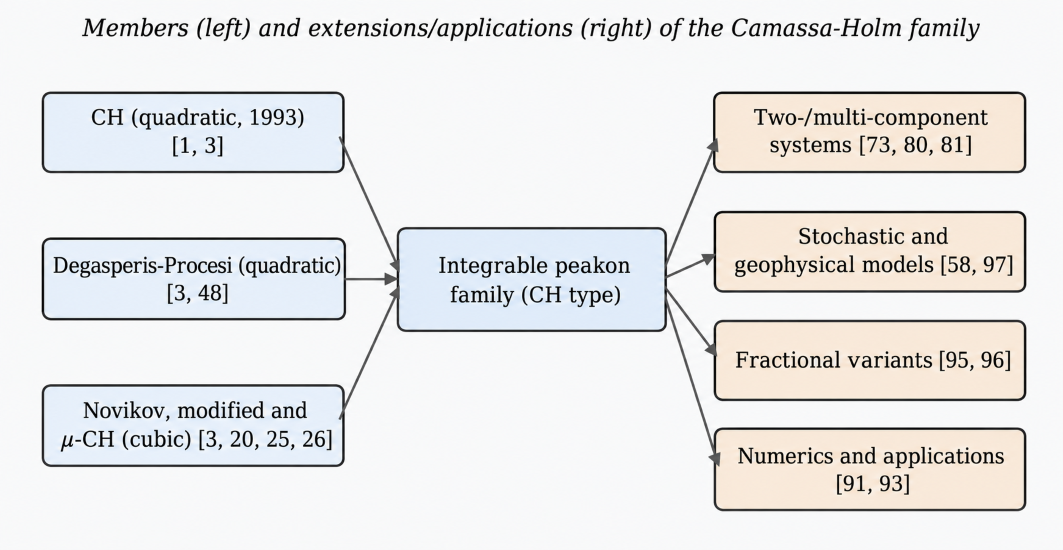
Figure 2: The Camassa-Holm family. The integrable quadratic and cubic members (left) define the core peakon dynamics, while the two-component, stochastic, geophysical, fractional, and numerical branches (right) extend it.
None of this is to suggest that the critical literature is absent: it is not, and the works cited above are careful about their hypotheses. The difficulty is one of presentation. Because the hypotheses are local to each paper, a reader cannot see the pattern without first assembling a table like Table 1 or Table 2. Providing those tables, and stating plainly where the evidence is strong and where it is thin, is the synthesis this review aims to add. The most useful direction for future work is not a further catalogue of solvable cases but a common benchmark on which the existence, selection, and stability results surveyed here can be compared against one another.
OPEN PROBLEMS AND FUTURE DIRECTIONS
Several fundamental questions about the Camassa-Holm equation remain open. First, the complete characterization of the wave-breaking phenomenon, including the sharp description of the breaking profile and the classification of the solutions that break, deserves further development [5,10]. Second, the asymptotic stability of the peakons and of the multi-peakon solutions in the optimal function spaces, extending the results of Molinet and of Eckhardt and Kostenko, remains an active area of research [18,23]. Third, the well-posedness of the equation at the critical regularity, and the behavior of the data-to-solution map at the threshold, are not fully understood [55-56]. Fourth, the theory of conservative and dissipative weak solutions in the multi-component and multi-peakon settings, and the convergence of numerical methods to these weak solutions, deserves further work [63-64].
In applications, several directions stand out. The geophysical variants of the Camassa-Holm equation, with the Coriolis effect and with variable topography, are being developed for the description of equatorial waves and other large-scale phenomena [97-99]. The stochastic Camassa-Holm equation and its well-posedness and wave-breaking theory, developed by Chen, Duan, and Gao, provide a framework for the description of wave propagation in random environments [58-59]. The fractional and nonlocal variants of the equation, including the sine-type and mu-Camassa-Holm equations, extend the theory to anomalous dispersion and nonlocal interactions [57,96]. The application of the CH equation to biomechanics, in particular to the description of waves in arteries and other elastic structures, is an active area with significant potential [6,100].
From a computational perspective, the design of structure-preserving schemes that capture the peakon and wave-breaking dynamics, and the extension of the conservative and dissipative weak solution frameworks to the numerical analysis of the equation, are important goals [92,94]. The development of adaptive methods based on the wave-breaking criteria, and the analysis of the convergence of the finite element and finite difference schemes in the presence of peakons, deserve further work [91,93]. The numerical solution of the multi-component, stochastic, and fractional variants of the equation, and their validation against the exact peakon solutions, is an emerging direction [59,95]. The interplay between integrability, analysis, numerics, and physical application guarantees that the Camassa-Holm equation will continue to generate new problems at the frontier of nonlinear wave theory [1,101].
CONCLUSION
The Camassa-Holm equation is one of the most remarkable equations in the theory of nonlinear dispersive wave equations. It combines complete integrability with the presence of peaked solitons and with wave breaking, a combination of properties that is unique among the classical shallow-water wave equations [1,5]. Its peakons, which collide elastically and are orbitally stable, provided the first example of nonsmooth solitons in a completely integrable system and inaugurated the theory of peakon equations [3-4]. Its wave-breaking theory, based on the geometric interpretation of the equation as a geodesic flow, established the modern understanding of the formation of singularities in shallow-water waves [10,43]. Its well-posedness, weak-solution, and numerical theories have been developed extensively, although important questions remain open (Section 13) [5,63,93].
The trajectory of research on the Camassa-Holm equation mirrors the broader development of nonlinear science: an equation born from the derivation of a new shallow-water model with peaked solutions grew into a central object of the theory of integrable systems, of nonlinear partial differential equations, and of applied wave theory [1-2]. The recent literature, including the work of 2025 and 2026 on rogue peakons, periodic waves for the regularized equation, and the comprehensive treatment of the CH and modified CH equations in [100-103] shows that the subject remains extraordinarily vibrant. We expect that the interplay between integrability, analysis, probability, and physical application will continue to drive progress on this remarkable equation for decades to come.
DECLARATIONS
The author declares no competing interests, no data, and no funding.
REFERENCES
- Camassa R, Holm D D. An integrable shallow water equation with peaked solitons. Physical Review Letters. 1993;71(11):1661-1664. [Crossref] [Google Scholar] [PubMed]
- Constantin A, Lannes D. The hydrodynamical relevance of the Camassa-Holm and Degasperis-Procesi equations. Archive for Rational Mechanics and Analysis. 2009;192(1):165-186. [Crossref] [Google Scholar]
- Degasperis A, Holm D D, Hone A N W. A new integrable equation with peakon solutions. Theoretical and Mathematical Physics. 2002;133(2):1463-1474. [Crossref] [Google Scholar]
- Constantin A, Strauss W. Stability of the Camassa-Holm solitons. Journal of Nonlinear Science. 2002;12(4):415-422. [Crossref] [Google Scholar]
- Constantin A, Escher J. Wave breaking for nonlinear nonlocal shallow water equations. Acta Mathematica. 1998;181(2):229-243. [Crossref] [Google Scholar]
- Ionescu-Kruse D. Variational derivation of the Camassa-Holm shallow water equation. Journal of Nonlinear Mathematical Physics. 2007;14(3):311. [Crossref] [Google Scholar]
- Parker D F. Higher-order shallow water equations and the Camassa-Holm equation. Discrete and Continuous Dynamical Systems - B. 2007;7(3):629-641. [Crossref] [Google Scholar]
- Boyd J P. Peakons and coshoidal waves: Traveling wave solutions of the Camassa-Holm equation. Applied Mathematics and Computation. 1997;81(2-3):173-187. [Crossref] [Google Scholar]
- Lenells J. Traveling wave solutions of the Camassa-Holm equation. Journal of Differential Equations. 2005;217(2):393-430. [Crossref] [Google Scholar]
- Constantin A, Escher J. Existence of permanent and breaking waves for a shallow water equation: a geometric approach. Annales de l'Institut Fourier. 2000;50(2):321-362. [Crossref] [Google Scholar]
- Fuchssteiner B, Fokas A S. Symplectic structures, their Bäcklund transformations and hereditary symmetries. Physica D: Nonlinear Phenomena. 1981;4(1):47-66. [Crossref] [Google Scholar]
- Fokas A S, Fuchssteiner B. Bäcklund transformations for hereditary symmetries. Nonlinear Analysis: Theory, Methods & Applications. 1981;5(4):423-432. [Crossref] [Google Scholar]
- Constantin A. On the scattering problem for the Camassa-Holm equation. Proceedings of the Royal Society of London A. 2001;457(2008):953-970. [Crossref] [Google Scholar]
- Constantin A, Gerdjikov V S, Ivanov R I. Inverse scattering transform for the Camassa-Holm equation. Inverse Problems. 2006;22(6):2197-2207. [Crossref] [Google Scholar]
- Constantin A, Lenells J. On the inverse scattering approach to the Camassa-Holm equation. Journal of Nonlinear Mathematical Physics. 2003;10(3):252. [Crossref] [Google Scholar]
- Constantin A. On the inverse spectral problem for the Camassa-Holm equation. Journal of Functional Analysis. 1998;155(2):352-363. [Crossref] [Google Scholar]
- Lenells J. The scattering approach for the Camassa-Holm equation. Journal of Nonlinear Mathematical Physics. 2002;9(4):389. [Crossref] [Google Scholar]
- Eckhardt J, Kostenko A. The inverse spectral problem for periodic conservative multi-peakon solutions of the Camassa-Holm equation. International Mathematics Research Notices. 2020;2020(16):5126-5151. [Crossref] [Google Scholar]
- Szmigielski J, Zhou L. Peakon-antipeakon interactions in the Degasperis-Procesi equation. Contemporary Mathematics 593, AMS. 2013. [Crossref] [Google Scholar]
- Chang X, Szmigielski J. Lax integrability of the modified Camassa-Holm equation and the concept of peakons. Journal of Nonlinear Mathematical Physics. 2016;23(4):563. [Crossref] [Google Scholar]
- Avan J, Frappat L, Ragoucy E. A new integrable structure associated to the Camassa-Holm peakons. SciPost Physics. 2023;15(6):228. [Crossref] [Google Scholar]
- Lenells J. Stability for the periodic Camassa-Holm equation. Mathematica Scandinavica. 2005;97(2):188. [Crossref] [Google Scholar]
- Molinet L. Asymptotic stability for some non-positive perturbations of the Camassa-Holm peakon with application to the antipeakon-peakon profile. International Mathematics Research Notices. 2020;2020(21):7908-7943. [Crossref] [Google Scholar]
- Dong F, Zhou L. Inverse spectral problem and peakons of an integrable two-component Camassa-Holm system. Journal of Nonlinear Mathematical Physics. 2018;25(2):290. [Crossref] [Google Scholar]
- Qu C, Liu X, Liu Y. Stability of peakons for an integrable modified Camassa-Holm equation with cubic nonlinearity. Communications in Mathematical Physics. 2013;322(3):967-997. [Crossref] [Google Scholar]
- Chen R M, Lenells J, Liu Y. Stability of the μ-Camassa-Holm peakons. Journal of Nonlinear Science. 2013;23(1):97-112. [Crossref] [Google Scholar]
- Chen A, Lu X. Orbital stability of elliptic periodic peakons for the modified Camassa-Holm equation. Discrete and Continuous Dynamical Systems. 2020;40(3):1703-1735. [Crossref] [Google Scholar]
- Li J. Orbital stability of peakons for the modified Camassa-Holm equation. Acta Mathematica Sinica, English Series. 2022;38(1):148-160. [Crossref] [Google Scholar]
- Deng T, Chen A. Orbital stability of peakons and multi-peakons for a generalized cubic-quintic Camassa-Holm type equation. Journal of Nonlinear Mathematical Physics. 2022;30(2):493-530. [Crossref] [Google Scholar]
- He D, Deng T, Zhang K. Orbital stability of peakons and multi-peakons for a generalized quintic-septic Camassa-Holm type equation. Quarterly of Applied Mathematics. 2024;83(1):59-96. [Crossref] [Google Scholar]
- Li J, Liu Y, Zhu G. Orbital stability of smooth solitons for the modified Camassa-Holm equation. Advances in Mathematics. 2024;454:109870. [Crossref] [Google Scholar]
- Luo T. Orbital stability of the trains of peaked solitary waves for the modified Camassa-Holm-Novikov equation. Advances in Nonlinear Analysis. 2024;13(1):20230124. [Crossref] [Google Scholar]
- Hu Q, Zhu M. Orbital stability of pseudo-peakons for the fifth-order Camassa-Holm type equation. Applied Mathematics Letters. 2023;143:108667. [Crossref] [Google Scholar]
- Parker A. Wave dynamics for peaked solitons of the Camassa-Holm equation. Chaos, Solitons & Fractals. 2008;35(2):220-237. [Crossref] [Google Scholar]
- Li J, Qiao Z. Peakon, pseudo-peakon, and cuspon solutions for two generalized Camassa-Holm equations. Journal of Mathematical Physics. 2013;54(12):123501. [Crossref] [Google Scholar]
- Tian L, Song X. New peaked solitary wave solutions of the generalized Camassa-Holm equation. Chaos, Solitons & Fractals. 2004;19(3):621-637. [Crossref] [Google Scholar]
- Tovar E, Gu H, Qiao Z. On peakon and kink-peakon solutions to a (2+1) dimensional generalized Camassa-Holm equation. Journal of Nonlinear Mathematical Physics. 2016;24(1):29. [Crossref] [Google Scholar]
- Lundmark H, Shuaib B. Ghostpeakons and characteristic curves for the Camassa-Holm, Degasperis-Procesi and Novikov equations. Symmetry, Integrability and Geometry: Methods and Applications. 2019;15:017. [Crossref] [Google Scholar]
- Cooper F, Shepard H. Solitons in the Camassa-Holm shallow water equation. Physics Letters A. 1994;194(4):246-250. [Crossref] [Google Scholar]
- Hwang G, Moon B. Periodic peakons to a generalized μ-Camassa-Holm-Novikov equation. Applicable Analysis. 2022;101(14):5042-5052. [Crossref] [Google Scholar]
- Moon B. Orbital stability of periodic peakons for the generalized modified Camassa-Holm equation. Discrete and Continuous Dynamical Systems - S. 2021;14(12):4409-4437. [Crossref] [Google Scholar]
- Kardell M. New solutions with peakon creation in the Camassa-Holm and Novikov equations. Journal of Nonlinear Mathematical Physics. 2015;22(1):1. [Crossref] [Google Scholar]
- McKean H P. Breakdown of the Camassa-Holm equation. Henry P. McKean Jr. Selecta, Springer. 2015. [Crossref] [Google Scholar]
- Constantin A, Escher J. Well-posedness, global existence, and blowup phenomena for a periodic quasi-linear hyperbolic equation. Communications on Pure and Applied Mathematics. 1998;51(5):475-504. [Crossref] [Google Scholar]
- Wahlén E. Global existence of weak solutions to the Camassa-Holm equation. International Mathematics Research Notices. 2006;2006:28976. [Crossref] [Google Scholar]
- Wahlén E. On the blow-up of solutions to the periodic Camassa-Holm equation. Nonlinear Differential Equations and Applications. 2007;13(5-6):643-653. [Crossref] [Google Scholar]
- Yin Z. Well-posedness and blow-up phenomena for the periodic generalized Camassa-Holm equation. Communications on Pure and Applied Analysis. 2004;3(3):501-508. [Crossref] [Google Scholar]
- Zhou Y. Blow-up phenomenon for the integrable Degasperis-Procesi equation. Physics Letters A. 2004;328(2-3):157-162. [Crossref] [Google Scholar]
- Tu X, Yin Z. Local well-posedness and blow-up phenomena for a generalized Camassa-Holm equation with peakon solutions. Discrete and Continuous Dynamical Systems. 2016;36(5):2781-2801. [Crossref] [Google Scholar]
- Zhu M, Zhang S. Blow-up of solutions to the periodic modified Camassa-Holm equation with varying linear dispersion. Discrete and Continuous Dynamical Systems. 2016;36(12):7235-7256. [Crossref] [Google Scholar]
- Zhu Y, Fu F. Persistence properties of the solutions to a generalized two-component Camassa-Holm shallow water system. Nonlinear Analysis. 2015;128:77-85. [Crossref] [Google Scholar]
- Yu S, Wang M. On a dissipative form of Camassa-Holm equation. Journal of Mathematical Physics. 2010;51(9):092704. [Crossref] [Google Scholar]
- Hakkaev S, Kirchev K. Local well-posedness and orbital stability of solitary wave solutions for the generalized Camassa-Holm equation. Communications in Partial Differential Equations. 2005;30(5-6):761-781. [Crossref] [Google Scholar]
- Lai S, Wu Y. The local well-posedness and existence of weak solutions for a generalized Camassa-Holm equation. Journal of Differential Equations. 2010;248(8):2038-2063. [Crossref] [Google Scholar]
- Wu G, Yuan J. Local well-posedness of the Cauchy problem for the generalized Camassa-Holm equation in Besov spaces. Applicationes Mathematicae. 2007;34(3):253-267. [Crossref] [Google Scholar]
- Tang H, Liu Z. Well-posedness of the modified Camassa-Holm equation in Besov spaces. Zeitschrift für angewandte Mathematik und Physik. 2015;66(4):1559-1580. [Crossref] [Google Scholar]
- Qin G, Yan Z, Guo B. A sine-type Camassa-Holm equation: local well-posedness, Hölder continuity, and wave-breaking analysis. Monatshefte für Mathematik. 2022;199(4):853-890. [Crossref] [Google Scholar]
- Chen Y, Duan J, Gao H. Well-posedness and wave-breaking for the stochastic rotation-two-component Camassa-Holm system. Annals of Applied Probability. 2023;33(4):2881-2920. [Crossref] [Google Scholar]
- Chen Y, Duan J, Gao H. Global well-posedness of the stochastic Camassa-Holm equation. Communications in Mathematical Sciences. 2021;19(3):607-627. [Crossref] [Google Scholar]
- Dündar N, Polat N. On the local well-posedness of a generalized two-component Camassa-Holm system. AIP Conference Proceedings. 2015;1676:020097. [Crossref] [Google Scholar]
- Lai S, Li N, Wu Y. The existence of global weak solutions for a weakly dissipative Camassa-Holm equation in H1. Boundary Value Problems. 2013;2013(1):26. [Crossref] [Google Scholar]
- Zhou S, Wu C, Zhang B. Local well-posedness and persistence properties for a model containing both Camassa-Holm and Novikov equation. Boundary Value Problems. 2014;2014(1):9. [Crossref] [Google Scholar]
- Holden H, Raynaud X. Dissipative solutions for the Camassa-Holm equation. Discrete and Continuous Dynamical Systems. 2009;24(4):1047-1112. [Crossref] [Google Scholar]
- Grunert K, Holden H, Raynaud X. Global dissipative solutions of the two-component Camassa-Holm system for initial data with nonvanishing asymptotics. Nonlinear Analysis: Real World Applications. 2014;17:203-244. [Crossref] [Google Scholar]
- Holden H, Raynaud X. Global dissipative multipeakon solutions of the Camassa-Holm equation. Communications in Partial Differential Equations. 2008;33(11):2040-2063. [Crossref] [Google Scholar]
- Zhou S, Mu C. Global conservative and dissipative solutions of the generalized Camassa-Holm equation. Discrete and Continuous Dynamical Systems. 2013;33(4):1713-1739. [Crossref] [Google Scholar]
- Guan C. Uniqueness of global conservative weak solutions for the modified two-component Camassa-Holm system. Journal of Evolution Equations. 2018;18(2):1003-1024. [Crossref] [Google Scholar]
- Tu X, Liu Y, Mu C. Existence and uniqueness of the global conservative weak solutions to the rotation-Camassa-Holm equation. Journal of Differential Equations. 2019;266(8):4864-4900. [Crossref] [Google Scholar]
- Zhu M, Guo L, Wang Y. Existence and uniqueness of the global conservative weak solutions to the cubic Camassa-Holm-type equation. Communications in Nonlinear Science and Numerical Simulation. 2024;132:107903. [Crossref] [Google Scholar]
- Lim W K. Global well-posedness for the viscous Camassa-Holm equation. Journal of Mathematical Analysis and Applications. 2007;326(1):432-442. [Crossref] [Google Scholar]
- Gui G, Liu Y. Global well-posedness and blow-up of solutions for the Camassa-Holm equations with fractional dissipation. Mathematische Zeitschrift. 2015;281(3-4):993-1020. [Crossref] [Google Scholar]
- Shan M, Chen M, Lu Y, Wang J. Low regularity conservation laws for Fokas-Lenells equation and Camassa-Holm equation. Advances in Nonlinear Analysis. 2024;13(1):20240014. [Crossref] [Google Scholar]
- Constantin A, Ivanov R I. On an integrable two-component Camassa-Holm shallow water system. Physics Letters A. 2008;372(48):7129-7132. [Crossref] [Google Scholar]
- Mustafa O G. On smooth traveling waves of an integrable two-component Camassa-Holm shallow water system. Wave Motion. 2009;46(6):397-402. [Crossref] [Google Scholar]
- Guan C, Yin Z. Global existence and blow-up phenomena for an integrable two-component Camassa-Holm shallow water system. Journal of Differential Equations. 2010;248(8):2003-2014. [Crossref] [Google Scholar]
- Guan C, Yin Z. On the existence of global weak solutions to an integrable two-component Camassa-Holm shallow-water system. Proceedings of the Edinburgh Mathematical Society. 2013;56(3):755-775. [Crossref] [Google Scholar]
- Escher J, Lechtenfeld O, Yin Z. Well-posedness and blow-up phenomena for the 2-component Camassa-Holm equation. Discrete and Continuous Dynamical Systems. 2007;17(3):493-513. [Crossref] [Google Scholar]
- Ionescu-Kruse D. Variational derivation of two-component Camassa-Holm shallow water system. Applicable Analysis. 2013;92(6):1241-1253. [Crossref] [Google Scholar]
- Qu C, Fu Y, Liu Y. Blow-up solutions and peakons to a generalized μ-Camassa-Holm integrable equation. Communications in Mathematical Physics. 2014;331(1):375-416. [Crossref] [Google Scholar]
- Xia B, Zhou R, Qiao Z. A three-component Camassa-Holm system with cubic nonlinearity and peakons. Journal of Nonlinear Mathematical Physics. 2015;22(1):155. [Crossref] [Google Scholar]
- Qu C Z, Fu Y. On a new three-component Camassa-Holm equation with peakons. Communications in Theoretical Physics. 2010;53(2):223-230. [Crossref] [Google Scholar]
- Guo Z. On an integrable Camassa-Holm type equation with cubic nonlinearity. Nonlinear Analysis: Real World Applications. 2017;34:225-232. [Crossref] [Google Scholar]
- Yan K. On the blow up solutions to a two-component cubic Camassa-Holm system with peakons. Discrete and Continuous Dynamical Systems. 2020;40(7):4565-4576. [Crossref] [Google Scholar]
- Khorbatly B, Molinet L. On the orbital stability of the Degasperis-Procesi antipeakon-peakon profile. Journal of Differential Equations. 2020;269(6):4799-4852. [Crossref] [Google Scholar]
- Khorbatly B. Asymptotic stability of the Degasperis-Procesi antipeakon-peakon profile. Nonlinear Analysis: Real World Applications. 2022;64:103428. [Crossref] [Google Scholar]
- Degasperis A. Multiscale expansion and integrability of dispersive wave equations. Lecture Notes in Physics 752, Springer. 2008. [Crossref] [Google Scholar]
- Deng S F, Guo B L, Wang T C. Travelling wave solutions of a generalized Camassa-Holm-Degasperis-Procesi equation. Science China Mathematics. 2011;54(3):555-572. [Crossref] [Google Scholar]
- Yang P, Chen Y, Li Z B. An approach for solving short-wave models for Camassa-Holm equation and Degasperis-Procesi equation. Communications in Theoretical Physics. 2008;50(3):583-586. [Crossref] [Google Scholar]
- Wazwaz A M. Solitary wave solutions for modified forms of Degasperis-Procesi and Camassa-Holm equations. Physics Letters A. 2006;352(6):500-504. [Crossref] [Google Scholar]
- He B. New peakon, solitary wave and periodic wave solutions for the modified Camassa-Holm equation. Nonlinear Analysis: Theory, Methods & Applications. 2009;71(12):6011-6018. [Crossref] [Google Scholar]
- Kalisch H, Lenells J. Numerical study of traveling-wave solutions for the Camassa-Holm equation. Chaos, Solitons & Fractals. 2005;25(2):287-298. [Crossref] [Google Scholar]
- Antonopoulos D C, Dougalis V A, Mitsotakis D E. Error estimates for Galerkin finite element methods for the Camassa-Holm equation. Numerische Mathematik. 2019;142(4):833-862. [Crossref] [Google Scholar]
- Cao H Y, Sun Z Z, Gao G H. A three-level linearized finite difference scheme for the Camassa-Holm equation. Numerical Methods for Partial Differential Equations. 2014;30(2):451-471. [Crossref] [Google Scholar]
- Wang X. An energy-preserving finite difference scheme with fourth-order accuracy for the generalized Camassa-Holm equation. Communications in Nonlinear Science and Numerical Simulation. 2023;119:107121. [Crossref] [Google Scholar]
- Alesemi M. Numerical analysis of fractional-order Camassa-Holm and Degasperis-Procesi models. Symmetry. 2023;15(2):269. [Crossref] [Google Scholar]
- Saha Ray S, Sahoo S. Traveling wave solutions to Riesz time-fractional Camassa-Holm equation in modeling for shallow-water waves. Journal of Computational and Nonlinear Dynamics. 2015;10(6):061026. [Crossref] [Google Scholar]
- Ionescu-Kruse D. Variational derivation of a geophysical Camassa-Holm type shallow water equation. Nonlinear Analysis. 2017;156:286-294. [Crossref] [Google Scholar]
- Xu R, Yang Y. Low regularity of solutions to the rotation-Camassa-Holm type equation with the Coriolis effect. Discrete and Continuous Dynamical Systems. 2020;40(11):6527-6547. [Crossref] [Google Scholar]
- Moon B. Nonexistence of periodic peaked traveling wave solutions to a rotation μ-Camassa-Holm equation with Coriolis effect. Nonlinear Analysis: Real World Applications. 2023;70:103793. [Crossref] [Google Scholar]
- Qiao Z, Zhou R, Zhu S. Camassa-Holm (CH) equation. Applied Mathematical Sciences, Springer Nature Switzerland. 2026. [Crossref] [Google Scholar]
- Zhu M, Qiao Z, Wang Z, Jiang Z. Rogue peakon, posedness and blow-up phenomenon for an integrable Camassa-Holm type equation. Advances in Nonlinear Analysis. 2026;15(1):20250139. [Crossref] [Google Scholar]
- Natali F. Periodic waves for the regularized Camassa-Holm equation: existence and spectral stability. Physica D: Nonlinear Phenomena. 2026;490:135180. [Crossref] [Google Scholar]
- Qiao Z, Zhou R, Zhu S. Modified Camassa-Holm (MoCH) equation. Applied Mathematical Sciences, Springer Nature Switzerland. 2026. [Crossref] [Google Scholar]

Article Processing Timeline
| Stage 1 |
Initial Quality & Plagiarism Check The manuscript is reviewed for journal scope, basic submission requirements, ethical compliance, and similarity/plagiarism concerns. |
| Stage 2 |
Editorial Assessment & Peer Review Manuscripts that pass the initial screening undergo editorial assessment and independent peer review in accordance with the journal's peer-review policy. |
| Stage 3 |
Revision & Editorial Decision Authors may be requested to revise their manuscript based on reviewer and editor comments. A final editorial decision is made after the required review and revision stages are completed. |
| Stage 4 |
Production & Publication Accepted manuscripts proceed to production, author proofing, final quality checks, and online publication. |
EDITORIAL & PUBLICATION INFORMATION
| English | Publication Language |
| Single-Blind | Peer-Review Model |
| 17% | Acceptance Rate |
| <18% | Similarity Screening Guideline |
| Open Access | Access Model |
All manuscripts undergo editorial assessment and originality screening as part of the journal's evaluation process. The acceptance rate shown is based on journal-level editorial data and may change over time. Similarity reports are assessed editorially and are not interpreted solely on the basis of a numerical similarity score.
Why Publish with us?
Ethics & Policies
Editorial & Management
Useful Links
Journal Highlights
Open Access Journals
Journal Flyer