


 Download PDF

Department of Chemistry, University of New South Wales, Syndey, Australia
ABSTRACT
The Schamel equation is a modified Korteweg-de Vries (mKdV) equation that describes the propagation of ion-acoustic solitary waves in plasmas when a population of resonant, trapped electrons is present. Introduced by Hans Schamel in 1973, it replaces the quadratic nonlinearity of the classical KdV equation with a fractional nonlinearity of order 3/2, reflecting the non-Maxwellian, flat-topped electron distribution created by wave-particle trapping. The equation occupies a special place in plasma physics: it reconciles the discrepancy between KdV predictions and laboratory and space observations of ion-acoustic solitons, and it underpins the modern kinetic theory of electron and ion holes. This review provides a comprehensive and critical assessment of the literature on the Schamel equation. We survey its derivation from the Vlasov-Poisson system and reductive perturbation theory, its exact travelling-wave and soliton solutions, and its relations to the KdV and modified KdV equations. We examine the extended family of Schamel-type equations, including the Schamel-KdV, Schamel-Burgers, Schamel-KP, and fractional and stochastic variants, and their applications to dust-ion-acoustic, electron-acoustic, and other modes. We review numerical methods and kinetic simulations, and the role of the equation in soliton gas and rogue wave dynamics. Particular attention is given to recent work published in 2025 and 2026. We close with open problems and future directions.
Keywords: Schamel Equation; Ion-Acoustic Solitons; Trapped Electrons; Plasma Physics; Nonlinear Wave Theory; Modified Korteweg-De Vries Equation
INTRODUCTION AND THEMATIC REVIEW OF THE LITERATURE
The Korteweg-de Vries (KdV) equation has served as the canonical model for weakly nonlinear, weakly dispersive waves in a remarkable variety of physical settings, from shallow water waves to ion-acoustic waves in plasmas. In plasma physics, the reductive perturbation analysis of the fluid equations for a collisionless plasma yields the KdV equation for small-amplitude ion-acoustic solitary waves, predicting a specific relationship between the Mach number and the soliton amplitude. Experiments in double-plasma devices, however, revealed a systematic discrepancy: the measured Mach number versus amplitude relation deviated significantly from the KdV prediction [1-2]. The resolution of this discrepancy lies in the influence of trapped electrons, which modify the electron equation of state and hence the character of the nonlinearity [3-4].
In 1973, Schamel derived a modified KdV equation that incorporates the effect of resonant electrons trapped in the potential well of the solitary wave [3]. The resulting equation, now known as the Schamel equation, takes the form
where φ is the normalized electrostatic potential, and α and β are constants determined by the plasma parameters. The crucial difference from the KdV equation is the fractional nonlinearity φ1/2, which arises because the trapped-electron density is proportional to |φ|1/2 rather than to φ. This fractional power law reflects the non-Boltzmann, flat-topped electron distribution produced by particle trapping in the wave potential [3,5]. The Schamel equation predicts a different amplitude-speed relation for ion-acoustic solitons, in much better agreement with experiments [1,4].
The importance of the Schamel equation extends well beyond the original ion-acoustic problem. It provides the small-amplitude limit of Schamel's fully nonlinear pseudo-potential theory, which describes electron holes and ion holes as phase-space vortices in collisionless plasmas [4,6]. It connects the fluid and kinetic descriptions of plasma waves, linking the reductive perturbation formalism to the Vlasov-Poisson system [4,7]. And it has spawned a large family of related equations---Schamel-KdV, Schamel- Burgers, Schamel-KP, fractional and stochastic variants---that model trapped-particle effects across a wide range of plasma environments, from dusty plasmas to relativistic and quantum plasmas, and from laboratory devices to space observations [8-10]. This review surveys this literature critically and comprehensively.
The genesis of the Schamel equation is closely tied to the experimental study of ion-acoustic solitons in double-plasma devices, which flourished in the 1970s and 1980s [1-2]. Early experiments established the existence of ion-acoustic solitons and their elastic interactions, and a series of careful measurements mapped the Mach number as a function of soliton amplitude [1-2]. The systematic deviation of these measurements from the KdV prediction was one of the clearest early demonstrations that a purely fluid, Maxwellian description of the electrons is inadequate for nonlinear ion-acoustic waves [1,4]. Konno and Ichikawa independently derived a modified KdV equation for ion-acoustic waves, and their work, together with Schamel's, established the mathematical framework within which trapping effects are incorporated [3,5]. Subsequent work generalized the multicomponent plasma theory, showing how the presence of negative ions and multiple ion species modifies the nonlinear evolution equations [11-12]. The observation of rarefactive (negative-polarity) solitons in two-electron-temperature plasmas provided further experimental motivation for the theory [13].
Thematic Synthesis of The Literature
The literature on the Schamel equation is extensive, but it is unevenly connected. Read as a whole, it divides into five research programmes that address the same equation from different directions while only rarely citing one another. The first is the fluid, reductive-perturbation programme initiated by Schamel [3] and by Konno and Ichikawa [5], which derives the equation and fixes its coefficients for a given plasma composition. The second is the kinetic programme built on Schamel’s pseudo-potential and the theory of phase-space holes [4,6], which supplies the physical meaning of the trapped-particle population and the amplitude range over which the fluid description is valid. The third is the exact-solution programme, in which a large and still-growing collection of mapping and expansion methods is applied to the Schamel and Schamel-KdV equations. The fourth is the numerical programme, spanning pseudo-spectral, finite-difference, discontinuous-Galerkin and finite-element discretisations of the Schamel equation and its close relatives. The fifth is the data-driven and observational programme, in which the equation serves both as a benchmark for machine-learning solvers and as a model for satellite observations of electrostatic solitary structures. The methodological differences between these programmes are substantial. Only the kinetic programme determines the trapping parameter from first principles, whereas the fluid programme treats it as an adjustable input; the exact-solution programme establishes the mathematical possibility of a solution but says nothing about its stability or accessibility; and the numerical and observational programmes are the only ones that can test whether a predicted structure is realised in a laboratory or space plasma.
Seen historically, the field has advanced chiefly by repeating one successful template. Schamel’s original step replacing the Boltzmann electron response by a trapped, flat-topped one, so that the nonlinearity becomes φ1/2 rather than φ2 has been transplanted into one plasma environment after another: superthermal and kappa-distributed electrons, Fermi-Dirac and quantum-degenerate electrons, relativistic streaming ions, dusty, pair-ion and electronegative plasmas, and two-dimensional and magnetised geometries [3,5,8,19,52,40-43]. Each transplantation yields a Schamel-type equation with modified coefficients, and the resulting parametric studies of amplitude, width and polarity are individually useful, but they rarely alter the structure of the problem. The genuinely structure-changing developments have been fewer: the recognition that the Schamel equation is non-integrable [14-26]; the demonstration that its inelastic collisions generate heavy-tailed, rogue-wave statistics in a soliton gas [27-28]; and the recent re-derivation of the equation as the small-amplitude limit of a velocity-separated, three-mode description of Vlasov-Poisson holes [14,29]. It is these developments, rather than the incremental parametric extensions, that determine which questions remain open.
Four gaps stand out. First, the relation between the fluid-like Schamel equation and the full kinetic theory is still not closed: the trapping parameter that enters the fluid description is not, in general, predicted by the kinetic theory, and the conditions under which the small-amplitude reduction is quantitatively accurate have not been mapped systematically [30-34]. Second, the mathematical theory of the equation remains incomplete—its conservation-law structure, its singularity analysis and the precise sense in which it is close to an integrable model are unresolved [10,26], which limits what can be stated rigorously about interactions. Third, the exact-solution literature is only weakly connected to the physical literature: solutions are frequently reported for coefficient values convenient to the method rather than for values corresponding to a specified plasma, and their stability is seldom examined [21,25,31]. Fourth, and most conspicuously, the equation has almost never been tested against controlled experiments or satellite data in a quantitative, falsifiable way; the comparison is usually qualitative agreement of amplitude–speed trends [1,35-36], and a systematic, error-barred confrontation between Schamel predictions and measured solitary structures is still missing.
Scope and Structure of This Review
The review is organised so that the mathematical, kinetic and applied strands are presented in the order in which they depend on one another. Section 2 develops the derivation and the physical meaning of the fractional nonlinearity, illustrated by Figure 1. Section 3 treats the exact solutions, the pseudo-potential and phase-plane description and the integrability question, and introduces Figures 2 and 3. Section 4 surveys the extended Schamel family and its two- and three-dimensional, dissipative, fractional and stochastic members. Section 5 develops the consequences of non-integrability for soliton interactions, soliton gases and rogue waves. Section 6 connects the fluid-like equation to the kinetic theory of phase-space holes, and Section 7 reviews the plasma applications that motivate the whole framework. Sections 8 and 9 cover numerical and data-driven methods, with Figure 4 illustrating a pseudo-spectral solution of the equation, and Section 10 collects the open problems that follow from the gaps identified above.
Derivation and Physical Foundations
We begin with the physical and kinetic foundations, because the mathematical properties reviewed later all follow from the way the trapped-electron density is constructed. The Schamel equation is derived from the Vlasov-Poisson system for a plasma in which a fraction of the electrons are trapped in the potential well of the ion-acoustic wave. The key step is the construction of an electron distribution function that is Maxwellian for untrapped electrons but flat-topped in the resonant region, reflecting the dynamical evolution of the distribution under particle trapping [3-4]. Integration of this distribution over velocity yields an electron density that depends on the potential through a term proportional to |φ|1/2, which is the microscopic origin of the fractional nonlinearity [3,5]. Combining this density with the cold-ion continuity and momentum equations and applying the reductive perturbation method in the long-wavelength, weak-nonlinearity limit yields the Schamel equation [3,8].
The theory has a two-tier structure. At the fully nonlinear level, Schamel's pseudo-potential method constructs stationary solitary solutions of the Vlasov-Poisson system for arbitrary amplitude, using a nonlinear dispersion relation and a pseudo-potential that plays the role of an effective potential [4,6]. In the small-amplitude limit, these solutions reduce to the solitons of the Schamel equation, providing a rigorous bridge between the kinetic theory of phase-space holes and the fluid-like evolution equation [4,14]. The trapping parameter β, which measures the deviation of the electron distribution from the Boltzmann form, controls the strength of the fractional nonlinearity and hence the amplitude-speed relation of the solitons [1,3].
The physical significance of the Schamel equation is best appreciated by comparing it with the classical KdV theory. For a strictly Maxwellian electron distribution, the electron density is a Boltzmann function of φ, and the KdV equation with quadratic nonlinearity results. Trapping changes the exponent: the density becomes φ-dependent through a |φ|1/2 correction, and the dominant nonlinearity in the evolution equation becomes fractional [3,5]. The resulting solitons are narrower and their speed-amplitude relation is steeper than for KdV solitons, which is precisely what the experiments require [1,4]. The same mechanism operates for electron-acoustic waves with trapped electrons, and more generally whenever a resonant particle population modifies the effective nonlinearity [15-16].
The derivation of the Schamel equation has been revisited and extended in many plasma contexts, and these derivations provide physical insight into the parameters α and β. In superthermal plasmas, where the untrapped electrons follow a kappa distribution, the Schamel equation is obtained with coefficients that depend on the spectral index κ and the trapping parameter, and the parametric study shows how the soliton amplitude and width respond to superthermality [8]. In multicomponent and dusty plasmas, the derivation is generalized to include several ion species, dust charge fluctuations, and non-isothermal electron populations, yielding Schamel-type equations with modified coefficients and, in some cases, both compressive and rarefactive structures [12,17-18]. In relativistic plasmas, the reductive perturbation analysis with relativistic ion flow produces the Schamel-KdV-Burgers equation, and the resulting solitary and shock structures depend sensitively on the relativistic streaming factor [9]. The derivation in quantum and degenerate plasmas incorporates the Fermi-Dirac statistics and quantum diffraction, leading to modified coefficients and trapping parameters [19-20]. These systematic extensions demonstrate the robustness of the Schamel paradigm: wherever trapping occurs, a fractional nonlinearity of order 3/2 emerges in the small-amplitude evolution equation [8,19].
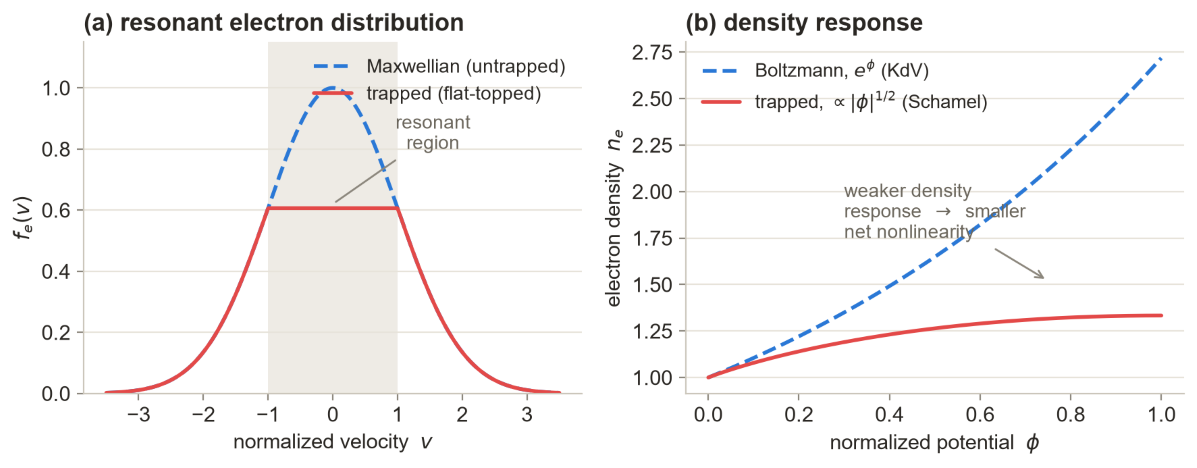
Figure 1: Physical interpretation of the Schamel equation. (a) The resonant, trapped electrons develop a flat-topped, non-Maxwellian velocity distribution, in contrast to the Maxwellian distribution of the untrapped population. (b) Integrating the trapped distribution gives an electron density that responds more weakly to the potential than the Boltzmann response ne = exp(φ) of the KdV theory, reducing the net nonlinearity and producing the fractional |φ|1/2 term.
Exact Solutions and Integrability
Having established where the equation comes from, we now examine its mathematical structure: its exact travelling-wave solutions, their phase-plane description, and the question of integrability. The Schamel equation admits exact travelling-wave solutions analogous to those of the KdV equation, but with different scaling. Substituting the ansatz φ(x,t) = v(ξ) with ξ = x - u t reduces the equation to an ordinary differential equation that can be integrated once to yield an equation of pseudo-potential type. The solitary-wave solution takes the form
with the amplitude A, the width parameter k, and the speed u related through the trapping and dispersion coefficients [3,21]. Because the nonlinearity is of order 3/2, the soliton profile is sech4 rather than sech2, a distinctive signature of the Schamel equation that is readily observable in simulations and experiments [3,22]. The algebraic structure of the solutions has been explored with a wide variety of methods, including the extended G'/G-expansion method, the modified double sub-equation method, the Jacobi elliptic function method, and the extended direct algebraic method [23-25].
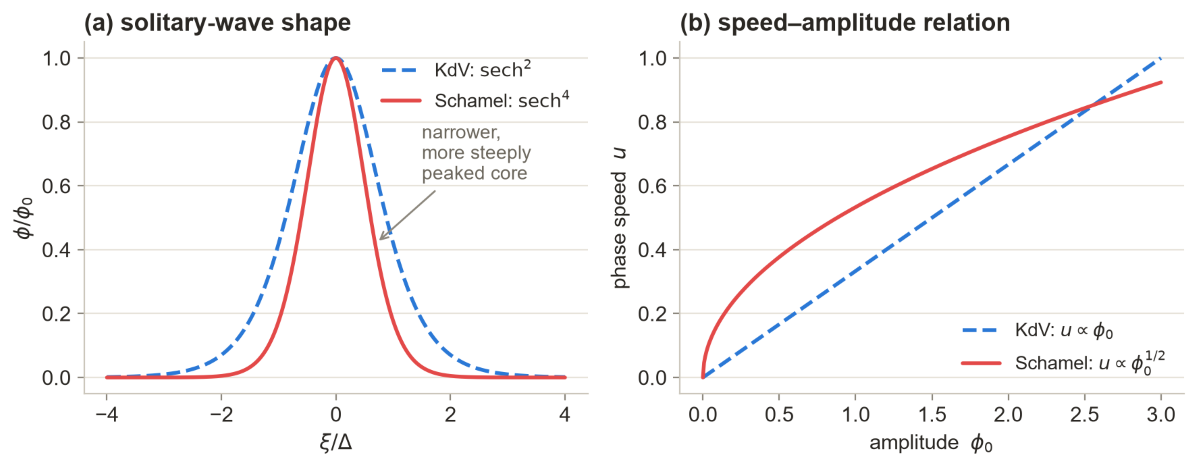
>Figure 2: Representative solitary-wave properties. (a) Normalised profiles of the KdV (sech2) and Schamel (sech4) solitons at equal peak amplitude; the fractional nonlinearity produces a narrower, more steeply peaked core. (b) The corresponding speed–amplitude relations, u proportional to φ0 for KdV and to φ01/2 for Schamel; the Schamel relation rises more steeply at small amplitude, in accordance with the experimental Mach-number data.
It is instructive to recast the travelling-wave reduction as a planar dynamical system. Setting φ′ = ψ, the once-integrated equation becomes ψ′ = (1/β) (u φ − (2/3) α φ3/2), a conservative system with a saddle at the origin and a centre at φ = (3u/2α)2. The separatrix leaving the origin is the solitary wave, with turning point at φ0 = (15u/8α)2, while the closed orbits around the centre are the periodic, cnoidal-type waves; equivalently, the amplitude φ0 is the non-trivial zero of the pseudo-potential U(φ) = −(u/2β)φ2 + (4α/15β)φ5/2. Figure 3 shows the pseudo-potential and the phase portrait. This elementary picture is the natural starting point for the stability analyses discussed in Section 6.
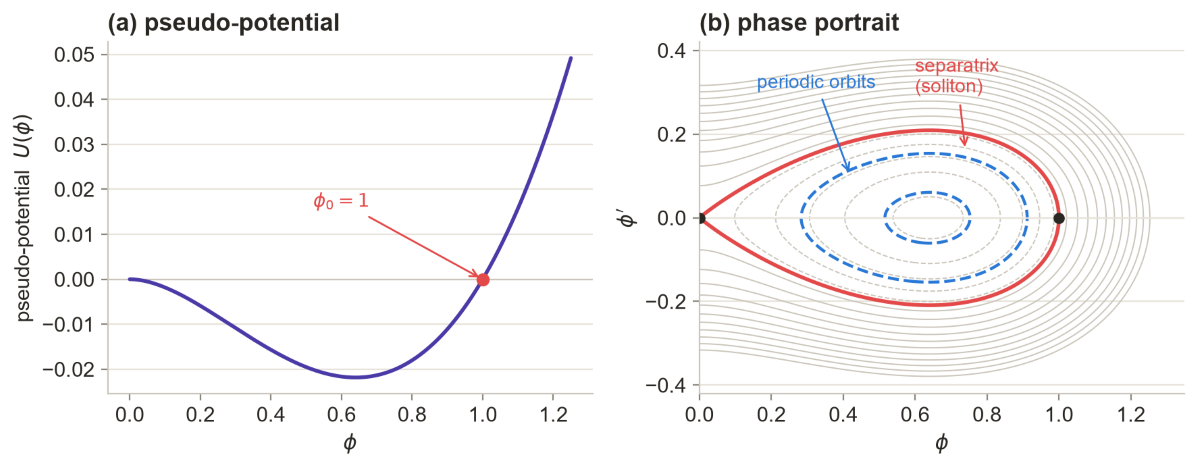
Figure 3: Dynamical-systems view of the travelling-wave reduction. (a) The pseudo-potential U(φ) = −(u/2β)φ2 + (4α/15β)φ5/2, whose non-trivial zero at φ0 fixes the soliton amplitude. (b) Phase portrait of the equivalent planar system φ′ = ψ, ψ′ = (1/β)(uφ − (2/3)αφ3/2); the separatrix (red) is the solitary wave, while the closed orbits around the centre (blue) are the periodic cnoidal-type waves.
The integrability properties of the Schamel equation are subtle and have been investigated through Painlev analysis. Unlike the KdV and mKdV equations, which are integrable and possess multi-soliton solutions and infinite families of conservation laws, the Schamel equation is non-integrable: its Painlev analysis reveals movable critical singularities, and it does not belong to the inverse scattering class [10,26]. This non-integrability has profound consequences for soliton interactions, which are inelastic, and for the statistics of soliton gases, which deviate from the integrable KdV and mKdV predictions [27-28]. Nevertheless, a rich set of exact solutions exists, and the equation serves as a prototypical example of a non-integrable, non-integrable-adjacent evolution equation with algebraic solitons [21,29]. The relations between the Schamel equation and the generalized KdV equation with power-law nonlinearity have been studied, unifying the descriptions of KdV, mKdV, and Schamel-type solitons within a single framework [10,30].
A striking feature of the exact-solution theory is the diversity of solution families that have been obtained. The generalized Schamel equation has been solved by the extended mapping method, yielding Jacobi elliptic function solutions, hyperbolic and rational solutions, and periodic waves that reduce to the solitary waves in appropriate limits [30]. The generalized Jacobi elliptic function expansion and the modified auxiliary equation method have been combined with Lie symmetry analysis to generate novel optical soliton solutions of the Schamel-KdV equation [31]. The Bernoulli sub-ODE and modified auxiliary equation methods provide hyperbolic, trigonometric, power, exponential, and rational solutions for the S-KdV equation [29]. The extended direct algebraic method has recently produced kink, anti-kink, multisoliton, and solitary-wave structures, with the nonlinear and dispersion terms determining the morphology of the waves [25]. The generalized-improved and generalized G'/G expansion methods applied to the Schamel-Burgers equation yield shock-type travelling waves [32]. These results, obtained by independent methods, cross-validate each other and demonstrate that the exact-solution programme for the Schamel family is both rich and robust [21,25,31].
The exact solutions of the Schamel equation also play a practical role as benchmarks. Analytical solutions and parametric studies of the Schamel equation for two different ion-acoustic waves in plasmas, including a newly found solution family with negative phase velocity, have been used to investigate the effects of nonextensivity and trapping on superthermal plasma waves [33]. The modified KdV solitons at supercritical densities in two-electron-temperature plasmas, studied by reductive perturbation and Sagdeev methods, provide the mKdV counterpart of the Schamel solitons and clarify the range of validity of the small-amplitude approximations [34]. The relations between the Schamel equation and the general KdV equation with power-law nonlinearity, for which cnoidal and solitary solutions are available, provide a further reference point for validating numerical and approximate methods [10,35]. In nonplanar and fractional settings, exact and approximate solutions of the cylindrical and modified KdV-type equations, obtained by the Adomian decomposition method and time-space fractional models, serve the same benchmarking role [36-37]. These results ensure that the Schamel equation and its relatives remain among the best-tested models in plasma nonlinear-wave theory [33-34].
The Extended Schamel Family
Because the trapping mechanism does not depend on the detailed plasma composition, it can be combined with other physical effects; this yields the extended family reviewed here. The Schamel equation is the prototype of a large family of Schamel-type evolution equations that arise when trapping effects are combined with additional physical mechanisms. The Schamel-Korteweg-de Vries (S-KdV) equation, in which the trapping nonlinearity coexists with higher-order dispersive or dissipative terms, has been derived in many plasma contexts and solved exactly by a variety of methods [29,38-39]. The Schamel-Korteweg-de Vries-Burgers (S-KdVB) equation, which includes a Burgers-type dissipation, models shock waves and damped solitons in dissipative plasmas [9,26,32]. The Schamel-Burgers equation itself, obtained in the strong-dissipation limit, describes shock structures and has been solved by generalized G'/G expansion methods [32]. The Schamel-Kadomtsev-Petviashvili (S-KP) equation extends the theory to two spatial dimensions and magnetized plasmas [40-41].
| Member | Equation (schematic) | Solutions | Plasma context | Refs. |
|---|---|---|---|---|
| 1. Schamel (mKdV) | sech4 algebraic solitons; M ∝ φ01/2 | Ion-acoustic waves, trapped electrons | [3,5] | |
| 2. Schamel-KdV (S-KdV) | sech4 solitons + Jacobi elliptic, kink, hyperbolic, trigonometric, rational, multi-soliton families | Ion-acoustic and dust-ion-acoustic waves with trapping | [25,29, 38-39] | |
| 3. Schamel-KdV-Burgers (S-KdVB) | Solitary plus monotonic/oscillatory shocks (tanh type) | Dissipative and relativistic plasmas, viscous ions | [9,26] | |
| 4. Schamel-Burgers | Shock-type travelling waves | Strong dissipation, dusty plasmas | [32,42] | |
| 5. Schamel-KP (S-KP) | 2D solitary waves; Bäcklund transformations; non-integrable | Coupled and dusty plasmas, two-dimensional propagation | [40] | |
| 6. Schamel-ZK / S-ZK-Burgers | 3D solitary and shock waves (homogeneous-balance/tanh) | Magnetized plasmas, trapped electrons and ions | [41,43] | |
| 7. Nonplanar (cylindrical/spherical) | Damped solitons with focusing geometry; HPM/MsHPM approximations | Experiments and magnetized space plasmas | [44-46] | |
| 8. Fractional Schamel / TSF-Schamel-KdV | (Caputo/RL/conformable) | Solitons whose amplitude and width depend on fractional order | Nonextensive and trapped electrons, magnetized plasmas | [36,41, 47] |
| 9. Stochastic Schamel | Stochastic solitons; noise modulates and destabilizes profile | Noisy and beam plasmas, white-noise forcing | [48-49] | |
| 10. Damped Schamel | Damped solitons; slowly varying amplitude + phase (KBM); radiative tails | Collisional and magnetized plasmas | [50-51] | |
| 11. Schamel-NLS (envelope) | (fractional order 3/2) | Bright and dark envelope solitons; modulational instability; rogue waves | Quantum and degenerate complex plasmas | [52] |
Table 1: Comparison of the extended Schamel family of evolution equations.
Note: M denotes the Mach number; KBM denotes the Krylov-Bogolyubov-Mitropolsky method; TSF denotes time-space fractional; ZK denotes Zakharov-Kuznetsov.
Nonplanar geometry introduces cylindrical and spherical variants of the Schamel equation, which model the focusing or defocusing of solitary waves in experimental and space plasmas [44-46]. The damped nonplanar Schamel-KdV equation has been solved numerically by homotopy perturbation and improved multistage homotopy perturbation methods, with the results compared against the exact planar solution [44]. The effect of kinematic viscosity on cylindrical and spherical electron-acoustic solitary waves with trapped electrons has been studied systematically [45,53]. In magnetized plasmas, the Zakharov-Kuznetsov and Schamel-Zakharov-Kuznetsov-Burgers equations arise, and their three-dimensional solitary and shock solutions have been obtained by the homogeneous balance and tanh methods [41,43]. The nonplanar and multidimensional formulations are essential for interpreting experiments in which the wave front is spherical or cylindrical, and for describing the propagation of solitary structures in magnetized space plasmas [44,46,53].
Fractional-order extensions of the Schamel equation have been developed using the semi-inverse method and fractional variational principles. The fractional Schamel equation, in which the time or space derivative is replaced by a fractional operator, has been shown to describe the effect of nonextensivity and trapping on solitary ion-acoustic waves [47,54]. The three-dimensional time-space fractional Schamel-KdV equation has been constructed for magnetized plasmas, with its conservation laws and multi-soliton solutions derived through Lie symmetry analysis and the Hirota bilinear method [41]. Time-fractional cylindrical variants have been solved by the Adomian decomposition method [36]. Stochastic Schamel equations, driven by white noise or multiplicative noise, have been solved by F-expansion and auxiliary-equation methods, revealing how noise modulates and destabilizes the soliton profile [48-49]. Space-fractional modifications of the related KdV-Burgers and mKdV equations, obtained through Agrawal's variational principle with beta and conformable derivatives, further illustrate the reach of fractional calculus into the plasma nonlinear-wave literature [55-57]. These extensions illustrate the remarkable reach of the Schamel paradigm into contemporary nonlinear science [47,49].
Soliton Interactions, Soliton Gas, and Rogue Waves
The non-integrability established above has its clearest physical consequences when solitary waves meet, and it is those consequences that we now develop. The non-integrability of the Schamel equation manifests itself most clearly in the interaction of solitary waves. Whereas KdV and mKdV solitons interact elastically and pass through each other unchanged, Schamel solitons undergo inelastic collisions: their amplitudes, speeds, and phases change after interaction, and energy can be exchanged between colliding solitons [27-28]. Bipolar solitary-wave interactions, involving solitons of opposite polarity, have been studied in detail; the maximum field during interaction is generally less than the sum of the individual amplitudes, in contrast to the integrable case [28]. Overtaking collisions of same-polarity Schamel solitons exhibit regimes that resemble the KdV classification in some parameter ranges but deviate in others, and the statistical moments of the interaction differ from the integrable predictions [58].
These interaction properties have direct consequences for the dynamics of soliton gases and soliton turbulence. In an ensemble of many interacting Schamel solitons, the inelastic collisions drive an energy cascade toward the larger-amplitude solitons, which grow at the expense of the smaller ones [27-28]. The statistical distribution of the wave field develops heavy tails, as measured by the excess kurtosis, signalling an increased probability of large-amplitude, freak or rogue waves [27-28]. This behaviour is qualitatively different from that of integrable soliton gases, where collisions are elastic and the statistics are governed by the integrable spectral theory [27]. The Schamel equation thus provides a natural framework for studying non-integrable soliton turbulence and the formation of rogue waves in plasmas [27-28].
The reflection and interaction of modified KdV solitons in inhomogeneous plasmas further enrich the phenomenology. At the critical density of negative ions in a magnetized plasma, both compressive and rarefactive mKdV solitons exist, and their reflection from the density gradient has been analyzed by coupling the equations for oppositely moving solitons [59]. The interaction of geometric solitons, including planar, cylindrical, and spherical KdV solitons launched from a hemispherical exciter, has been observed experimentally in positive ion-negative ion plasmas [60]. The head-on collision of ion-acoustic solitons in non-ideal plasmas with Cairns-Gurevich distributed electrons has been studied by the extended Poincaré-Lighthill-Kuo method, with the phase shifts depending on the hybrid nonthermal trapped electron parameter [61]. The interaction of Schamel-type solitary waves in electronegative plasmas with trapped non-extensive electrons has been examined, showing that the trapping and non-extensivity parameters control the amplitude and width of the interacting structures [62]. These studies connect the exact-solution and interaction theories and demonstrate the breadth of collision phenomena accessible in laboratory and space plasmas [59-61].
Kinetic Simulations and Electron Holes
The fluid-like account given so far is only the small-amplitude limit of a kinetic theory, and this section makes that connection explicit. The Schamel equation is intimately connected to the kinetic theory of phase-space holes. Electron holes are localized electrostatic structures in which the electron distribution function forms a vortex in phase space, and they are described by Schamel's equilibrium theory based on the nonlinear dispersion relation and the pseudo-potential [6,63]. The small-amplitude limit of these structures is governed by Schamel-type evolution equations, one for each of the acoustic modes of the plasma [63]. The validity of the Schamel equation has been tested extensively with fully kinetic simulations, including particle-in-cell and Vlasov-Poisson codes [22,64]. These simulations confirm that solitons formed with the Schamel density profile retain their identity through collisions and that the Schamel speed-amplitude relation is obeyed, while revealing additional kinetic effects such as amplitude oscillations at the electron bounce frequency [22,64].
The kinetic perspective clarifies several subtle issues. Fully kinetic simulations have shown that KdV solitons evolve nonlinearly toward a saturated state that is better described by Schamel's model than by the KdV or Sagdeev models, and that the deviation grows with amplitude [64]. The stability of Sagdeev-pseudopotential solutions, of which the Schamel solitons are the small-amplitude limit, has been studied, revealing a critical trapping parameter that separates stable from unstable structures [65]. The theory of electron and ion holes has been extended to ultrafast electron holes with velocities twice the electron thermal speed [66], and the vortex-like interpretation of holes as phase-space structures has been developed within a fluid-like description of phase space [67]. These results establish the Schamel equation and its equilibrium theory as the cornerstone of the modern theory of phase-space holes in collisionless plasmas [14,63].
The connection between the Schamel evolution equations and the underlying Vlasov-Poisson equilibria has been the subject of renewed attention. Schamel and collaborators have emphasized that the three acoustic modes of a two-component plasma---ion-acoustic, slow electron-acoustic, and slow ion-acoustic---each have a Schamel-type evolution equation, and that the linear limit of these equations is distinct from the linear Vlasov limit [63]. The positivity problem associated with the square root nonlinearity has been resolved by introducing appropriate pedestals for the electrostatic potential, and a general proof of the existence of solitary ion holes over the entire temperature range has been given [63]. The coupled hole-soliton structures that arise in the Buneman instability, and the reflections of electron holes giving persistent counter-propagating potential peaks, have been analyzed in long-duration particle-in-cell simulations [14]. The theory of phase-space vortices and their diffusion in phase space has been extended by fluid-like descriptions in which electron and ion holes appear as vortices, and in which a Schamel-KdV form of the vorticity transport equation is derived [67-68]. The stability of Sagdeev solutions in the ion-acoustic regime has been studied with kinetic simulations, revealing a critical trapping parameter separating stable from unstable structures across a large range of velocities [65]. These developments connect the Schamel equation to the broader theme of structure formation in collisionless plasmas [14,63].
Applications in Plasmas
With the mathematical and kinetic framework now in place, we survey the plasma environments in which the equation and its relatives have been applied. The Schamel equation and its extensions have been applied to a remarkably wide range of plasma systems. In electron-ion plasmas, it describes ion-acoustic solitary waves with trapped electrons in both classical and superthermal (kappa-distributed) settings [8,69]. The trapping parameter and the superthermality index control the amplitude and width of the solitons, and only positive-polarity (compressive) structures are typically supported [8-9]. In relativistic plasmas, the Schamel-KdV-Burgers equation describes ion-acoustic shocks and solitons, with the relativistic factor modifying the wave characteristics [9]. In dusty plasmas, the Schamel and Schamel-KdV equations describe dust-ion-acoustic and dust-acoustic solitary waves with trapped ions and electrons, and their properties are modified by dust charge fluctuations, ion temperatures, and dust density [16-18,70].
Electron-acoustic waves with trapped electrons provide another major application. In plasmas with two electron populations, a vortex-like distribution of hot electrons leads to the Schamel-type equation for electron-acoustic solitary waves, and the resulting structures have been used to interpret broadband electrostatic noise observed in the auroral zone and elsewhere [15,71-72]. In electron-positron-ion and pair-ion plasmas, the Schamel equation describes solitary waves with non-isothermal electrons and trapped positrons [73-74]. The dissipative electron-acoustic solitary waves in magnetized collisional nonthermal plasmas have been described by the Schamel equation, with the collisional and superthermal parameters modifying the solitary profile [75]. In quantum and relativistic-degenerate plasmas, the Schamel nonlinear Schrödinger equation governs envelope solitons and their modulational instability, and the effects of quantum diffraction and degeneracy on the solitary structures have been characterized [19,52]. The modulational instability of dust-acoustic waves and the associated envelope solitons and rogue waves in degenerate Thomas-Fermi plasmas have been studied, and the modulational instability of dust-ion-acoustic waves with associated rogue waves in superthermal plasmas has been analyzed [76-77]. The applications extend to ionospheric and magnetospheric plasmas, where the Schamel-type drift and Zakharov-Kuznetsov equations describe trapped-electron effects on drift waves and solitary structures observed by satellites [78-80].
The dusty-plasma applications of the Schamel framework are particularly extensive. Dust-acoustic and dust-ion-acoustic solitary waves with trapped ions have been studied in unmagnetized and magnetized dusty plasmas, with the trapping parameter and the dust charge fluctuation governing the amplitude, width, and polarity of the structures [16-17,70,81]. Modified Korteweg-de Vries-Burgers equations with trapped ions describe dust-acoustic shocks, and their monotonic and oscillatory shock solutions depend on the kinematic viscosity [42,82]. In electronegative plasmas with both positive and negative ions, the Schamel and Schamel-KdV equations admit solitary waves whose properties depend on the negative-ion density and the trapping of non-extensive electrons [62,74]. In pair-ion plasmas with non-isothermal electrons and negatively charged background dust, the Sagdeev-potential and Schamel-KdV descriptions of dust-ion-acoustic solitons have been derived [17-18]. In cometary and other complex plasmas, KdV-Burgers-type equations with kappa-distributed electrons and ions describe ion-acoustic shocks [83]. The trapping of ions and electrons in magnetized dusty plasmas with nonthermal populations has been treated by the modified Zakharov-Kuznetsov equation and by the damped nonplanar Schamel-KdV equation [44,84]. The modified Zakharov-Kuznetsov and modified Burgers equations have also been used to describe dust-acoustic solitary and shock waves with nonthermal and vortex-like ions [85]. Variational principles, conservation laws, and exact solutions for dust-ion-acoustic shock waves governed by modified Burgers-type equations have been derived, connecting the Schamel framework to the theory of conservation laws [86]. These studies show that the Schamel equation, originally derived for the simplest electron-ion plasma, applies with minor modifications across the entire spectrum of dusty and complex plasmas [16,82-83].
Relativistic and quantum extensions of the Schamel theory have expanded its domain further. In highly relativistic quantum plasmas with positive and negative ions, the KdV equation for ion-acoustic solitary waves has been derived with quantum diffraction and relativistic effects, complementing the Schamel-type descriptions of trapped particles [87]. The effect of kappa-distributed trapped electrons on fully nonlinear electrostatic solitary waves in electron-positron-relativistic ion plasmas has been analyzed by the Sagdeev pseudopotential method, showing how the superthermality and trapping parameters shape the solitary pulse [88]. Dissipative ion-acoustic solitary waves in magnetized kappa-distributed non-Maxwellian plasmas have been described by a damped Schamel-type equation, whose analytical damped-soliton solution depends on the trapping percentage, the spectral index, and the direction of propagation [50]. The damped-drift Zakharov-Kuznetsov equation with fractional nonlinearity arising from adiabatic trapping of electrons has been used to describe solitary waves and their modulation in ionospheric D-, E-, and F-layers [78]. These studies confirm that the Schamel framework extends naturally to relativistic, quantum, collisional, and drifting plasma environments [50,87-88].
The Schamel framework has also been used to interpret space observations. Electrostatic solitary waves observed in the Earth's magnetosheath, magnetopause, auroral regions, and planetary magnetospheres have been modelled with Schamel-type equations and pseudo-potential theory, and the predicted electric-field amplitudes, pulse widths, and propagation speeds are in good agreement with satellite measurements [89-91]. The role of trapped electrons and positrons in determining the polarity and amplitude of these structures has been emphasized in recent reviews [73,90]. At Venus, the Schamel-KdV equation has been used to model phase-space electron holes in the upper mantle boundary, matching Parker Solar Probe and Pioneer Venus Orbiter observations [92]. Obliquely propagating electron-acoustic solitary waves with trapped superthermal electrons in magnetized plasmas have been analyzed, and the results applied to auroral and magnetospheric contexts [93]. Dissipative electron-acoustic solitons in cold electron beam plasmas with superthermal trapped electrons, and beam-driven electron-acoustic waves in the auroral region, further illustrate the applicability of the Schamel formalism to realistic space environments [94-95]. In the electron diffusion region of the Earth's magnetopause, finite-amplitude electron-acoustic waves with vortex-like hot electrons have been modelled with the mKdV-like Schamel equation [79]. Large-amplitude shocklets with trapped hot electrons have been studied for the dayside auroral zone and the magnetopause, where the trapping parameter significantly modifies the solitary and shocklet structures [96]. These applications demonstrate that the Schamel equation is not merely an academic model but a practical tool for understanding nonlinear electrostatic structures throughout the heliosphere [90,92].
Numerical Methods
The algebraic localisation of the Schamel solitons and the non-integrability of the equation make their numerical treatment a problem in its own right, which we review here. The numerical solution of the Schamel equation and its relatives has received considerable attention. Because the equation is non-integrable and its solutions are algebraically localized, specialized methods are required to preserve the soliton profile and capture the inelastic interactions [27-28]. Pseudospectral methods, which exploit the smoothness of the solutions, have been used for direct numerical simulation of the Schamel equation and for studying the decay of damped solitons [51]. The reproducing kernel method has been applied to obtain accurate approximate solutions of the generalized Schamel equation and to validate the exact Jacobi elliptic function solutions [21]. Finite difference and homotopy perturbation methods have been used for damped and nonplanar variants [44-45].
For the broader family of KdV-type equations, conservative and high-order schemes provide the numerical foundation. Conservative discontinuous Galerkin methods for the generalized KdV equation preserve the discrete mass and L^2 norm, yielding accurate long-time approximations of travelling-wave solutions [97]. Optimally convergent hybridizable discontinuous Galerkin methods have been developed for third-order KdV-type equations [98]. For the nonlinear Schrödinger equation with Schamel-type nonlinearity, linearly implicit finite element methods with optimal error estimates have been constructed, providing dissipative and conservative variants [99]. In higher dimensions, multi-domain spectral approaches have been developed for Zakharov-Kuznetsov-type equations with cylindrical symmetry, enabling the study of wave collapse and singular solutions near the ground-state soliton [100]. Finite difference methods have been used to solve modified Burgers equations with trapped ions and non-thermal electrons, with the numerical results validated against analytical solutions and the stability analyzed by the von Neumann criterion [101]. The modified KdV and Schamel-type equations have also been solved by a variety of expansion and mapping methods that provide approximate analytical solutions suitable for benchmarking numerical schemes [102-103]. These numerical advances support both the fundamental analysis and the plasma applications of the Schamel equation.
Figure 4 illustrates the accuracy and the scope attainable with such schemes when they are applied directly to the Schamel equation rather than to a neighbouring model.
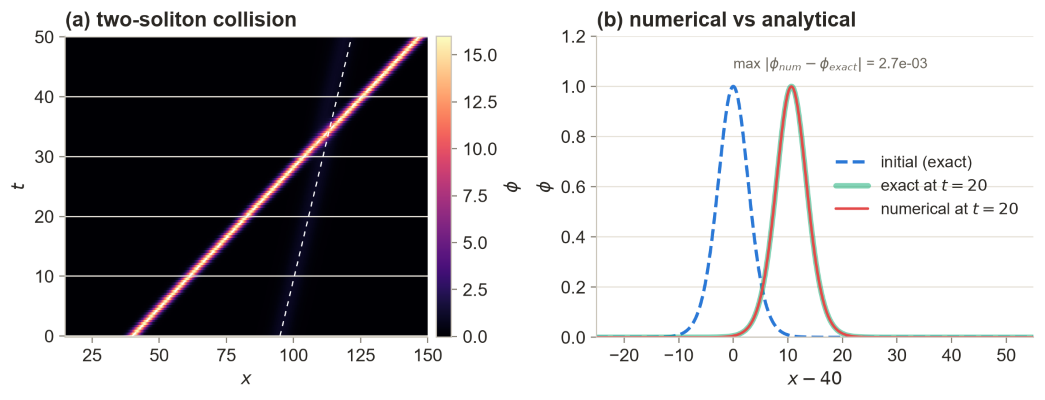
Figure 4: Numerical solution of the Schamel equation. (a) Space–time diagram, obtained with an integrating-factor pseudo-spectral scheme, of two solitary waves of different amplitude crossing; the dashed lines trace the theoretical trajectories x = x0 + u t. (b) Comparison of the numerical (red) and exact analytical (green) sech4 profiles after the scheme has propagated a single soliton over t = 20; the maximum absolute error is about 2.7×10⁻³. The dashed blue curve is the initial condition.
Machine Learning and Data-Driven Perspectives
Finally, alongside these deterministic methods, a data-driven strand of work has begun to emerge, and we summarise it briefly. Although the machine-learning literature on the Schamel equation is less developed than for the Burgers and Fisher equations, the equation has begun to appear as a benchmark in scientific machine learning. The exact soliton solutions of the Schamel equation provide ground truth for training and validating data-driven solvers, analogous to their role in classical numerical analysis [21,29]. Physics-informed neural networks and related frameworks, which have been applied extensively to the Burgers and KdV equations, are natural candidates for the Schamel equation, whose fractional nonlinearity and algebraic solitons pose distinctive challenges [104]. The study of stochastic Schamel-type equations under white noise, using exact stochastic solutions and auxiliary-equation methods, connects the data-driven and analytical strands of the subject [48-49]. As neural operators and foundation models for PDEs mature, the Schamel equation is likely to join the canonical set of plasma-physics benchmarks [49,105].
OPEN PROBLEMS AND FUTURE DIRECTIONS
Several fundamental questions about the Schamel equation remain open. First, a complete understanding of the non-integrability structure---including the precise characterization of its conservation laws, the nature of its singularities, and the relation to neighbouring integrable models---is still lacking [10,26]. Second, the rigorous theory of soliton interactions, soliton gases, and rogue-wave statistics for the non-integrable Schamel equation deserves further development, building on the numerical and phenomenological studies reviewed here [27-28]. Third, the connection between the fluid-like Schamel equation and the fully kinetic theory of phase-space holes, including the stability of holes and the role of trapping dynamics, remains an active and subtle frontier [14,63,65].
A number of plasma-physics questions also remain open. The precise role of trapping in determining the polarity of solitary waves--- why some systems support only compressive structures while others admit rarefactive ones---is not yet fully explained, and the answer depends on the delicate balance among trapping, nonthermality, and composition [8,73-74]. The interaction of Schamel solitons with ion beams, streaming populations, and forced or damped environments introduces additional phenomena, such as forced KdV-Burgers dynamics and the modulation of drift waves, that are only partially understood [69,78]. In quantum and relativistic plasmas, the combination of degeneracy, spin effects, and trapping produces a rich landscape of envelope solitons, breathers, and rogue waves whose full characterization is incomplete [52,77,105]. The extension of the Schamel theory to magnetically quantized plasmas and to systems with anisotropic pressure is in its early stages [106]. Each of these directions offers opportunities for both theory and observation [52,73].
From a computational perspective, the design of structure-preserving schemes for the Schamel equation, and the extension of the numerical methods to higher dimensions, stochastic forcing, and fractional-order operators, are important goals [44,97,99]. The application of machine learning to the Schamel equation, including operator learning and the inverse problem of parameter estimation from noisy data, is an emerging direction [49,104]. The development of accurate numerical solvers for the damped, forced, and stochastic variants, and their validation against the exact soliton solutions, will be essential for quantitative comparison with experiments and satellite observations [44,51]. The study of the conformable and other fractional mKdV and Schamel frameworks for ion-acoustic waves, including Hirota bilinear constructions and phase-portrait analysis, is also an active area [57,108]. Finally, the wealth of new plasma contexts---quantum, relativistic, non-Maxwellian, and dusty---in which trapped-particle effects are significant guarantees that the Schamel equation will continue to generate new problems at the interface of kinetic theory, nonlinear dynamics, and space physics [9,52,90].
CONCLUSION
The Schamel equation occupies a special place in plasma physics and nonlinear wave theory. It resolves the long-standing discrepancy between KdV theory and the experimental observation of ion-acoustic solitons, it connects the fluid and kinetic descriptions of plasma waves through the theory of trapped particles, and it provides the small-amplitude foundation for the modern theory of electron and ion holes [1,3,4]. Its distinctive fractional nonlinearity generates algebraically localized solitons, inelastic interactions, and a rich phenomenology of soliton gases and rogue waves that distinguishes it sharply from the integrable KdV and mKdV equations [3,27]. Its family of extensions---Schamel-KdV, Schamel-Burgers, Schamel-KP, fractional, stochastic, and multidimensional variants---models trapped-particle effects across an extraordinary range of plasma environments [9,41,49].
The trajectory of research on the Schamel equation mirrors the broader development of nonlinear science: a physical mechanism--- particle trapping---gives rise to a distinctive mathematical structure, which in turn becomes a laboratory for theory, a standard for computation, and a bridge between disciplines [4,8,90]. The equation continues to generate new results, and the recent literature, including papers published in 2025 and 2026, shows that the subject remains vibrant [25,51,64,92,99,101,108]. We expect that the interplay between kinetic theory, nonlinear dynamics, numerical analysis, and space observations will continue to drive progress on this remarkable equation for decades to come.
DECLARATIONS
The author declares no competing interests, no data, and no funding.
REFERENCES
- Tran M Q. Ion Acoustic Solitons in a Plasma: A Review of their Experimental Properties and Related Theories. Physica Scripta. 1979;20(3-4):317-327. [Crossref] [Google Scholar]
- Lonngren K E. Soliton experiments in plasmas. Plasma Physics. 1983;25(9):943-982. [Crossref] [Google Scholar]
- Schamel H. A modified Korteweg-de Vries equation for ion acoustic waves due to resonant electrons. Journal of Plasma Physics. 1973;9(3):377-387. [Crossref] [Google Scholar]
- Schamel H. Role of Trapped Particles and Waves in Plasma Solitons-Theory and Application. Physica Scripta. 1979;20(3-4):306-316. [Crossref] [Google Scholar]
- Konno K, Ichikawa Y H. A Modified Korteweg de Vries Equation for Ion Acoustic Waves. Journal of the Physical Society of Japan. 1974;37(6):1631-1636. [Crossref] [Google Scholar]
- Schamel H. Theory of Electron Holes. Physica Scripta. 1979;20(3-4):336-342. [Crossref] [Google Scholar]
- Pécseli H L, Trulsen J, Armstrong R J. Formation of Ion Phase-Space Vortexes. Physica Scripta. 1984;29(3):241-253. [Crossref] [Google Scholar]
- Williams G, Verheest F, Hellberg M A, Anowar M G M, Kourakis I. A Schamel equation for ion acoustic waves in superthermal plasmas. Physics of Plasmas. 2014;21(9):092103. [Crossref] [Google Scholar]
- Hafez M G. Nonlinear Schamel Korteweg-De Vries-Burgers Equation to Report Ion-Acoustic Waves in the Relativistic Plasmas. IEEE Transactions on Plasma Science. 2019;47(12):5314-5323. [Crossref] [Google Scholar]
- El-Tantawy S A, Salas A H, Albalawi W. New Localized and Periodic Solutions to a Korteweg-de Vries Equation with Power Law Nonlinearity: Applications to Some Plasma Models. Symmetry. 2022;14(2):197. [Crossref] [Google Scholar]
- Das G C, Tagare S G. Propagation of ion-acoustic waves in a multi-component plasma. Plasma Physics. 1975;17(12):1025-1032. [Crossref] [Google Scholar]
- Das G C. Ion-acoustic solutions and shock waves in multicomponent plasmas. Plasma Physics. 1979;21(3):257-265. [Crossref] [Google Scholar]
- Sayal V K, Yadav L L, Sharma S. Study of ion-acoustic rarefactive soliton in a two-electron temperature plasma. Physica Scripta. 1993;47(4):576-578. [Crossref] [Google Scholar]
- Schamel H, Chakrabarti N. On the Evolution Equations of Nonlinearly Permissible, Coherent Hole Structures Propagating Persistently in Collisionless Plasmas. Annalen der Physik. 2023;535(8):2300102. [Crossref] [Google Scholar]
- Mamun A A, Shukla P K. Electron-acoustic solitary waves via vortex electron distribution. Journal of Geophysical Research: Space Physics. 2002;107(A7):1135. [Crossref] [Google Scholar]
- Shukla P K, Mamun A A. Solitons, shocks and vortices in dusty plasmas. New Journal of Physics. 2003;5(1):17-17. [Crossref] [Google Scholar]
- Mushtaq A, Khattak M N, Ahmad Z, Qamar A. Dust ion acoustic soliton in pair-ion plasmas with non-isothermal electrons. Physics of Plasmas. 2012;19(4):042304. [Crossref] [Google Scholar]
- Rahman O, Haider M M. Modified Korteweg-de Vries (mK-dV) Equation Describing Dust-ion-acoustic Solitary Waves in an Unmagnetized Dusty Plasma with Trapped Negative Ions. Advances in Astrophysics. 2016;1(3):169-181. [Crossref] [Google Scholar]
- Schamel H, Eliasson B. On the correct implementation of Fermi-Dirac statistics and electron trapping in nonlinear electrostatic plane wave propagation in collisionless plasmas. Physics of Plasmas. 2016;23(5):052110. [Crossref] [Google Scholar]
- Irfan M, Alam I, Ali A, Shah K, Abdeljawad T. Electron-acoustic solitons in dense electron-positron-ion plasma: Degenerate relativistic enthalpy function. Results in Physics. 2022;38:105625. [Crossref] [Google Scholar]
- Ghanbari B, Akgül A. Abundant new analytical and approximate solutions to the generalized Schamel equation. Physica Scripta. 2020;95(7):075201. [Crossref] [Google Scholar]
- Hosseini Jenab S M, Spanier F. Fully kinetic simulation study of ion-acoustic solitons in the presence of trapped electrons. Physical Review E. 2017;95(5):053201. [Crossref] [Google Scholar]
- Kangalgil F. Travelling wave solutions of the Schamel-Korteweg-de Vries and the Schamel equations. Journal of the Egyptian Mathematical Society. 2016;24(4):526-531. [Crossref] [Google Scholar]
- Yépez-Martínez H, Rezazadeh H. New analytical solutions by the application of the modified double sub-equation method to the (1+1)-Schamel-KdV equation, the Gardner equation and the Burgers equation. Physica Scripta. 2022;97(8):085218. [Crossref] [Google Scholar]
- Sahoo B, Mohanty S K, Pany A K, Chand S. Exact Solutions of the Schamel Korteweg-de Vries Equation by Extended Direct Algebraic Method. International Journal of Mathematical, Engineering and Management Sciences. 2025;10(6):2083-2102. [Crossref] [Google Scholar]
- El-Kalaawy O H, AL-Denari R B. Painlevé analysis, auto-Bäcklund transformation, and new exact solutions for Schamel and Schamel-Korteweg-de Vries-Burger equations in dust ion-acoustic waves plasma. Physics of Plasmas. 2014;21(9):092308. [Crossref] [Google Scholar]
- Flamarion M V, Pelinovsky E, Didenkulova E. Non-integrable soliton gas: The Schamel equation framework. Chaos, Solitons & Fractals. 2024;180:114495. [Crossref] [Google Scholar]
- Didenkulova E, Pelinovsky E, Flamarion M V. Bipolar Solitary Wave Interactions within the Schamel Equation. Mathematics. 2023;11(22):4649. [Crossref] [Google Scholar]
- Karakoç S B G, Ali K K, Mehanna M S. Exact Traveling Wave Solutions of the Schamel-KdV Equation with Two Different Methods. Universal Journal of Mathematics and Applications. 2023;6(2):65-75. [Crossref] [Google Scholar]
- Hassan M M. New Exact Solutions of Two Nonlinear Physical Models. Communications in Theoretical Physics. 2010;53(4):596-604. [Crossref] [Google Scholar]
- Hussain A, Chahlaoui Y, Usman M, Zaman F D, Park C. Optimal system and dynamics of optical soliton solutions for the Schamel KdV equation. Scientific Reports. 2023;13(1):15711. [Crossref] [Google Scholar]
- Mohanty S K, Kravchenko O V, Dev A N. Exact traveling wave solutions of the Schamel Burgers' equation by using generalized-improved and generalized G'/G expansion methods. Results in Physics. 2022;33:105124. [Crossref] [Google Scholar]
- Dağhan D, Dönmez O. Analytical Solutions and Parametric Studies of the Schamel Equation for Two Different Ion-Acoustic Waves in Plasmas. Journal of Applied Mechanics and Technical Physics. 2018;59(3):389-396. [Crossref] [Google Scholar]
- Verheest F, Olivier C P, Hereman W. Modified Korteweg-de Vries solitons at supercritical densities in two-electron temperature plasmas. Journal of Plasma Physics. 2016;82(2):905820208. [Crossref] [Google Scholar]
- Abu Hammad M, Khalid M, Alrowaily A W, Tiofack C G L, El-Tantawy S A. Ion-acoustic cnoidal waves in a non-Maxwellian plasma with regularized κ-distributed electrons. AIP Advances. 2023;13(10):105127. [Crossref] [Google Scholar]
- Abdelwahed H G, El-Shewy E K, Mahmoud A A. On Time-Fractional Cylindrical Nonlinear Equation. Chinese Physics Letters. 2016;33(11):115201. [Crossref] [Google Scholar]
- Liu Q, Chen L. Time-Space Fractional Model for Complex Cylindrical Ion-Acoustic Waves in Ultrarelativistic Plasmas. Complexity. 2020;2020:1-16. [Crossref] [Google Scholar]
- Tariq K U, Rezazadeh H, Zubair M, Osman M S, Akinyemi L. New Exact and Solitary Wave Solutions of Nonlinear Schamel-KdV Equation. International Journal of Applied and Computational Mathematics. 2022;8(3):121. [Crossref] [Google Scholar]
- Al Atawi N O. Exact Solitary Wave Solutions for the Generalized Schamel Korteweg-De Vries Equation. Journal of Mathematics Research. 2017;9(5):126. [Crossref] [Google Scholar]
- El-Kalaawy O H, Moawad S M, Wael S. Stability: Conservation laws, Painlevé analysis and exact solutions for S-KP equation in coupled dusty plasma. Results in Physics. 2017;7:934-946. [Crossref] [Google Scholar]
- Guo M, Fu C, Zhang Y, Liu J, Yang H. Study of Ion-Acoustic Solitary Waves in a Magnetized Plasma Using the Three-Dimensional Time-Space Fractional Schamel-KdV Equation. Complexity. 2018;2018:6852548. [Crossref] [Google Scholar]
- Elhanbaly A, El-Shewy E K, Sallah M, Darweesh H F. Linear and nonlinear analysis of dust acoustic waves in dissipative space dusty plasmas with trapped ions. Journal of Theoretical and Applied Physics. 2015;9(3):167-176. [Crossref] [Google Scholar]
- Guo S, Mei L, He Y L, Guo H, Zhao Y. The effect of trapped electrons on the three-dimensional ion-acoustic shock wave in magnetized ionic-pair plasma. Europhysics Letters. 2016;114(2):25002. [Crossref] [Google Scholar]
- Almutlak S A, El-Tantawy S A. On the approximate solutions of a damped nonplanar modified Korteweg-de Vries equation for studying dissipative cylindrical and spherical solitons in plasmas. Results in Physics. 2021;23:104034. [Crossref] [Google Scholar]
- Roy S, Saha S, Raut S, Das A N. Studies on the effect of kinematic viscosity on electron-acoustic cylindrical and spherical solitary waves in a plasma with trapped electrons. Journal of Applied Mathematics and Computational Mechanics. 2021;20(2):65-76. [Crossref] [Google Scholar]
- El-Zahar E R, Demiray H. Analytical solutions of cylindrical and spherical dust ion-acoustic solitary waves. Results in Physics. 2019;13:102154. [Crossref] [Google Scholar]
- Nazari-Golshan A. Investigation of nonextensivity trapped electrons effect on the solitary ion-acoustic wave using fractional Schamel equation. Physics of Plasmas. 2016;23(8):082109. [Crossref] [Google Scholar]
- Ghany H A, Zakarya M. Exact Traveling Wave Solutions for Wick-Type Stochastic Schamel KdV Equation. Journal of Applied Mathematics. 2014;2014:1-9. [Crossref] [Google Scholar]
- Alsatami K A. Analysis of solitary wave behavior under stochastic noise in the generalized Schamel equation. Scientific Reports. 2025;15(1):17990. [Crossref] [Google Scholar]
- Sultana S, Kourakis I. Dissipative Ion-Acoustic Solitary Waves in Magnetized κ-Distributed Non-Maxwellian Plasmas. Physics. 2022;4(1):68-79. [Crossref] [Google Scholar]
- Flamarion M V, Pelinovsky E, Talipova T. Asymptotic and numerical study to the damped Schamel equation. Zhurnal Srednevolzhskogo Matematicheskogo Obshchestva. 2025;27(2):229-242. [Crossref] [Google Scholar]
- El-Tantawy S A, Abu Hammad M, Alotaibi B M, Tag-Eldin E, Ismaeel S M E, El-Awady E I. On the modulational instability of Schamel nonlinear Schrödinger equation and the associated envelope excitations in a degenerate relativistic quantum complex plasma. Results in Physics. 2023;51:106702. [Crossref] [Google Scholar]
- Raut S, Roy S, Saha S, Das A N. Effect of Kinematic Viscosity on Ion Acoustic Waves in Superthermal Plasma Comprising Cylindrical and Spherical Geometry. International Journal of Applied and Computational Mathematics. 2022;8(4):1-18. [Crossref] [Google Scholar]
- Nazari-Golshan A, Nourazar S S. Effect of trapped electron on the dust ion acoustic waves in dusty plasma using time fractional modified Korteweg-de Vries equation. Physics of Plasmas. 2013;20(10):103701. [Crossref] [Google Scholar]
- Uddin M F, Hafez M G, Hwang I H, Park C. Effect of Space Fractional Parameter on Nonlinear Ion Acoustic Shock Wave Excitation in an Unmagnetized Relativistic Plasma. Frontiers in Physics. 2022;9:766035. [Crossref] [Google Scholar]
- Zafar A. The exp a function method and the conformable time-fractional KdV equations. Nonlinear Engineering. 2019;8(1):728-732. [Crossref] [Google Scholar]
- Hussain A, Ibrahim T F, Osman Birkea F M, Yahya M A, Hassaballa A A, Mukalazi H. Abundant different types of soliton solutions for fractional modified KdV equation using auxiliary equation method. Scientific Reports. 2025;15(1):23857. [Crossref] [Google Scholar]
- Flamarion M V, Pelinovsky E, Didenkulova E. Investigating overtaking collisions of solitary waves in the Schamel equation. arXiv. 2023;2306.11130. [Crossref] [Google Scholar]
- Singh D K, Malik H K. Reflection of nonlinear solitary waves (mKdV solitons) at critical density of negative ions in a magnetized cold plasma. Plasma Physics and Controlled Fusion. 2007;49(9):1551-1563. [Crossref] [Google Scholar]
- Aossey D W, Cooney J L, Williams J E, Lonngren K E. Interacting geometric solitons in a positive ion-negative ion plasma. Journal of Physics D: Applied Physics. 1993;26(2):215-221. [Crossref] [Google Scholar]
- El-Taibany W F, Zedan N A. On the interaction of nonlinear ion acoustic solitary waves in non-ideal plasma incorporated with Cairns-Gurevich distributed electrons. Physica Open. 2020;5:100033. [Crossref] [Google Scholar]
- Ghosh U N. Interaction of Schamel type solitary waves in an electronegative plasma with trapped non-extensive electrons. Indian Journal of Physics. 2022;96(7):2175-2184. [Crossref] [Google Scholar]
- Schamel H, Pelinovsky E, Flamarion M V. On the existence, linearity and stability of electrostatic hole structures in the Vlasov-Poisson plasma from the perspective of its three velocity-separated evolution equations. Reviews of Modern Plasma Physics. 2025;9(1):16. [Crossref] [Google Scholar]
- Sam A, Kumar P, Fletcher A, Crabtree C, Lee N, Elschot S. Nonlinear evolution, propagation, electron-trapping, and damping effects of ion-acoustic solitons using fully kinetic PIC simulations. Physics of Plasmas. 2025;32(2):022103. [Crossref] [Google Scholar]
- Hosseini Jenab S M, Spanier F, Brodin G. A study of the stability properties of Sagdeev solutions in the ion-acoustic regime using kinetic simulations. arXiv. 2018;1806.07106. [Crossref] [Google Scholar]
- Hosseini Jenab S M, Kourakis I, Brodin G, Juno J. Ultrafast Electron Holes in Plasma Phase Space Dynamics. arXiv. 2020;2009.12708. [Crossref] [Google Scholar]
- Lobo A, Sayal V K. Theory of electron and ion holes as vortices in the phase-space of collision-less plasmas. arXiv. 2023;2307.15447. [Crossref] [Google Scholar]
- Lobo A, Sayal V K. Diffusion and turbulence in phase-space and formation of phase-space vortices. arXiv. 2024;2410.22840. [Crossref] [Google Scholar]
- Chowdhury S, Mandi L, Chatterjee P. Effect of externally applied periodic force on ion acoustic waves in superthermal plasmas. Physics of Plasmas. 2018;25(4):042112. [Crossref] [Google Scholar]
- Mamun A A, Shukla P K. Electrostatic Solitary and Shock Structures in Dusty Plasmas. Physica Scripta. 2001;T98:107. [Crossref] [Google Scholar]
- Pakzad H R. Effect of q-nonextensive electrons on electron acoustic solitons. Physica Scripta. 2011;83(1):015505. [Crossref] [Google Scholar]
- Shan S A, Rehman A, Mushtaq A. Electron-acoustic solitary waves in a beam plasma with electron trapping and nonextensivity effects. Physics of Plasmas. 2016;23(9):092106. [Crossref] [Google Scholar]
- Habib K M M, Hassan M H, Alam M, Sultana S. An overview of ion-acoustic solitary and shock waves in a magnetized nonthermal plasma: influence of trapped positrons and electrons. Plasma Physics and Controlled Fusion. 2024;66(6):065027. [Crossref] [Google Scholar]
- Abdikian A. Dust-ion-acoustic solitary waves in a magnetized dusty pair-ion plasma with Cairns-Gurevich electrons and opposite polarity dust particles. Contributions to Plasma Physics. 2019;59(1):20-30. [Crossref] [Google Scholar]
- Hassan M H, Rajib T I, Sultana S. Electron-Acoustic Solitons in Magnetized Collisional Nonthermal Plasmas. IEEE Transactions on Plasma Science. 2021;49(12):3749-3758. [Crossref] [Google Scholar]
- Wahed F, Rahman A, Alyousef H A, El-Sherif L S, El-Tantawy S A. Modulational instability and associated low-frequency dust-acoustic waves in a degenerate Thomas-Fermi plasma: Envelope solitons and rogue waves. Journal of Low Frequency Noise, Vibration and Active Control. 2025;44(2):784-799. [Crossref] [Google Scholar]
- Sharmin B E, Shikha R K, Tamanna N, Chowdhury N A, Mannan A, Mamun A A. Modulational instability of dust-ion-acoustic waves and associated first and second-order rogue waves in a super-thermal plasma. Results in Physics. 2021;26:104373. [Crossref] [Google Scholar]
- Tariq Z, Asam M T, Iqbal Z, Shah H A, Kahlon L Z. Nonlinear dynamical behaviour of damped-drift Zakharov-Kuznetsov equation in ionospheric plasmas: from solitary waves to modulation. Physics of Plasmas. 2025;32(4):042902. [Crossref] [Google Scholar]
- Rufai O R, Khazanov G V, Singh S V. Finite amplitude electron-acoustic waves in the electron diffusion region. Results in Physics. 2021;24:104041. [Crossref] [Google Scholar]
- Ghosh S S, Lakhina G S. Anomalous width variation of rarefactive ion acoustic solitary waves in the context of auroral plasmas. Nonlinear Processes in Geophysics. 2004;11(2):219-228. [Crossref] [Google Scholar]
- Hadjaz I, Tribeche M. Alternative dust-ion acoustic waves in a magnetized charge varying dusty plasma with nonthermal electrons having a vortex-like velocity distribution. Astrophysics and Space Science. 2014;351(2):591-598. [Crossref] [Google Scholar]
- Kalita R K, Deka M K, Dev A N, Sarma J. Characteristics of dust acoustic waves in dissipative dusty plasma in the presence of trapped electrons. Plasma Science and Technology. 2017;19(5):055303. [Crossref] [Google Scholar]
- Michael M, Willington N T, Jayakumar N, Sebastian S, Sreekala G, Venugopal C. Korteweg-deVries-Burgers (KdVB) equation in a five component cometary plasma with kappa described electrons and ions. Journal of Theoretical and Applied Physics. 2016;10(4):289-296. [Crossref] [Google Scholar]
- Dev A N, Deka M K, Subedi R, Sarma J. Dust Acoustic Compressive Waves in a Warm Dusty Plasma Having Non-Thermal Ions and Non-Isothermal Electrons. Plasma Science and Technology. 2015;17(9):721-727. [Crossref] [Google Scholar]
- Dev A N, Sarma J, Deka M K, Adhikary N C. Dust Acoustic Shock Waves with Non-Thermal and Vortex-Like Ions in Dusty Plasma. Plasma Science and Technology. 2015;17(4):268-275. [Crossref] [Google Scholar]
- El-Kalaawy O H. Variational principle, conservation laws and exact solutions for dust ion acoustic shock waves modeling modified Burger equation. Computers & Mathematics with Applications. 2016;72(4):1031-1041. [Crossref] [Google Scholar]
- Madhukalya B, Das R, Hosseini K, Hınçal E, Osman M S, Wazwaz A M. Nonlinear analysis of ion-acoustic solitary waves in an unmagnetized highly relativistic quantum plasma. Heat Transfer. 2024;53(8):4036-4051. [Crossref] [Google Scholar]
- Elkamash I S, Elhanbaly A. The effect of κ-distributed trapped electrons on fully nonlinear electrostatic solitary waves in an electron-positron-relativistic ion plasma. Journal of Physics A: Mathematical and Theoretical. 2021;54(6):065701. [Crossref] [Google Scholar]
- Lakhina G S, Singh S V, Kakad A, Goldstein M L, Viñas A F, Pickett J S. A mechanism for electrostatic solitary structures in the Earth's magnetosheath. Journal of Geophysical Research: Space Physics. 2009;114(A9):A09212. [Crossref] [Google Scholar]
- Lakhina G S, Singh S V, Rubia R, Devanandhan S. Electrostatic Solitary Structures in Space Plasmas: Soliton Perspective. Plasma. 2021;4(4):681-731. [Crossref] [Google Scholar]
- Rufai O R, Khazanov G V, Singh S V, Lakhina G S. Large-amplitude electrostatic fluctuations at the Earth's magnetopause with a vortex-like distribution of hot electrons. Results in Physics. 2022;35:105343. [Crossref] [Google Scholar]
- Gamal A, Moslem W M, Yousef M S, Ellithi A Y. Phase space electron hole in the Venusian upper mantle boundary. Scientific Reports. 2025;15(1):16975. [Crossref] [Google Scholar]
- Sultana S, Mannan A, Schlickeiser R. Obliquely propagating electron-acoustic solitary waves in magnetized plasmas: the role of trapped superthermal electrons. European Physical Journal D. 2019;73(10):231. [Crossref] [Google Scholar]
- Shan S A. Dissipative electron-acoustic solitons in a cold electron beam plasma with superthermal trapped electrons. Astrophysics and Space Science. 2019;364(2):37. [Crossref] [Google Scholar]
- Jahangir R, Ali S, Eliasson B. Beam-driven electron-acoustic waves in auroral region of magnetosphere with superthermal trapped electrons. Physics of Plasmas. 2025;37(2):022106. [Crossref] [Google Scholar]
- Alharbi M, Ali S, Naeem I, Al-Hadeethi Y. Large-Amplitude Shocklets With Trapped Hot-Electrons in Space Plasmas. Journal of Geophysical Research: Space Physics. 2023;128(10):e2023JA031401. [Crossref] [Google Scholar]
- Bona J L, Chen H, Karakashian O A, Xing Y. Conservative, discontinuous Galerkin-methods for the generalized Korteweg-de Vries equation. Mathematics of Computation. 2013;82(283):1401-1432. [Crossref] [Google Scholar]
- Dong B. Optimally Convergent HDG Method for Third-Order Korteweg-de Vries Type Equations. Journal of Scientific Computing. 2017;73(2-3):712-735. [Crossref] [Google Scholar]
- Paraschis P, Zouraris G E. Linearly Implicit Finite Element Methods Approximating the Solution to the Nonlinear Schrödinger Equation with a Schamel-Type Nonlinearity. Journal of Scientific Computing. 2026;108(1):7. [Crossref] [Google Scholar]
- Klein C, Roudenko S, Stoilov N. Multi-domain spectral approach for Zakharov-Kuznetsov equations in 3D with cylindrical symmetry. arXiv. 2026;2604.17521. [Crossref] [Google Scholar]
- Deka H, Sarma J. A numerical investigation of modified Burgers' equation in dusty plasmas with non-thermal ions and trapped electrons. Nanosystems: Physics, Chemistry, Mathematics. 2023;14(1):5-12. [Crossref] [Google Scholar]
- Cheemaa N, Seadawy A R, Sugati T G, Băleanu D. Study of the dynamical nonlinear modified Korteweg-de Vries equation arising in plasma physics and its analytical wave solutions. Results in Physics. 2020;19:103480. [Crossref] [Google Scholar]
- Zahed H, Seadawy A R, Iqbal M. Structure of analytical ion-acoustic solitary wave solutions for the dynamical system of nonlinear wave propagation. Open Physics. 2022;20(1):313-333. [Crossref] [Google Scholar]
- Vitanov N K. Simple Equations Method (SEsM): An Effective Algorithm for Obtaining Exact Solutions of Nonlinear Differential Equations. Entropy. 2022;24(11):1653. [Crossref] [Google Scholar]
- Wahed F, Rahman A, Naeem S N, Alharbey R A, Al Huwayz M, El-Sherif L S, El-Tantawy S A. Modulational instability and associated ion-acoustic modulated envelope solitons in a quantum plasma having ion beams. Open Physics. 2025;23(1):20250180. [Crossref] [Google Scholar]
- Pradhan B, Dev A N, Deka M K. Wave Propagation in Anisotropic Magnetically Quantized Ion Plasma with Trapped Electron and Positron. East European Journal of Physics. 2025;(3):103-114. [Crossref] [Google Scholar]
- Alsatami K A. Ion-acoustic waves in a conformable fractional mKdV framework: Solitons, periodic solutions, and Hirota bilinear construction. AIMS Mathematics. 2025;10(12):29189-29235. [Crossref] [Google Scholar]
- Faisal F, Sultana S, Mukta K N, Mamun A A. Dust-acoustic shock structures in magnetized dusty plasma with trapped nonthermal electrons and positrons. AIP Advances. 2025;15(11):115106. [Crossref] [Google Scholar]

Article Processing Timeline
| Stage 1 |
Initial Quality & Plagiarism Check The manuscript is reviewed for journal scope, basic submission requirements, ethical compliance, and similarity/plagiarism concerns. |
| Stage 2 |
Editorial Assessment & Peer Review Manuscripts that pass the initial screening undergo editorial assessment and independent peer review in accordance with the journal's peer-review policy. |
| Stage 3 |
Revision & Editorial Decision Authors may be requested to revise their manuscript based on reviewer and editor comments. A final editorial decision is made after the required review and revision stages are completed. |
| Stage 4 |
Production & Publication Accepted manuscripts proceed to production, author proofing, final quality checks, and online publication. |
EDITORIAL & PUBLICATION INFORMATION
| English | Publication Language |
| Single-Blind | Peer-Review Model |
| 17% | Acceptance Rate |
| <18% | Similarity Screening Guideline |
| Open Access | Access Model |
All manuscripts undergo editorial assessment and originality screening as part of the journal's evaluation process. The acceptance rate shown is based on journal-level editorial data and may change over time. Similarity reports are assessed editorially and are not interpreted solely on the basis of a numerical similarity score.
Why Publish with us?
Ethics & Policies
Editorial & Management
Useful Links
Journal Highlights
Open Access Journals
Journal Flyer