
Journal of Cardiology and Heart Failure
 Download PDF
ABSTRACT
Background
Cardiopulmonary resuscitation (CPR) in patients supported by left ventricular assist devices (LVADs) presents unique challenges. While manual chest compressions are recommended in the setting of hypoperfusion, the safety and efficacy of mechanical CPR devices in this population remain poorly defined.
Case Summary
We report the case of an elderly female with non-ischemic cardiomyopathy supported by a durable LVAD as destination therapy who suffered cardiac arrest at home. Prolonged mechanical CPR using a piston-driven device (LUCAS) was initiated by emergency medical services and continued for 45 minutes, resulting in restoration of Doppler-measured perfusion. Despite preserved LVAD function without device dislodgement, the patient sustained catastrophic thoracic injury, extensive embolic cerebral infarctions, multiorgan failure, and ultimately poor neurological recovery, leading to withdrawal of care.
Keywords: Cardiopulmonary Resuscitation; Cardiomyopathy; Left Ventricular Assist Devices; LUCAS Device; Doppler-measured Perfusion.
INTRODUCTION
The use of durable left ventricular assist devices (LVADs) has expanded significantly as both bridge-to-transplant and destination therapy for patients with advanced heart failure. As survival improves, clinicians increasingly encounter emergencies unique to this population, including cardiac arrest and severe hypoperfusion. Traditional markers of arrest such as palpable pulses and automated blood pressure measurements are unreliable in patients supported by continuous-flow LVADs, complicating rapid decision-making during resuscitation.
Society guidelines recommend initiation of chest compressions when there is evidence of inadequate perfusion in unconscious LVAD patients, despite limited supporting data [1-2]. Mechanical cardiopulmonary resuscitation (CPR) devices are widely used in out-of-hospital cardiac arrest; however, their role in patients with mechanical circulatory support remains controversial due to concerns regarding device dislodgement, bleeding, and thoracic injury. Evidence supporting their safety is largely anecdotal, derived from small observational studies and isolated case reports. We present a case illustrating a potentially hazardous outcome following prolonged mechanical CPR using a piston-driven device in an LVAD patient.
CASE PRESENTATION
An elderly female with non-ischemic cardiomyopathy underwent implantation of a HeartMate II LVAD in 2017 as destination therapy. Her clinical course was complicated by recurrent gastrointestinal bleeding, requiring a reduced anticoagulation strategy with an international normalized ratio (INR) goal of 1.5–2.0. Prior implantable cardioverter-defibrillator interrogations revealed episodes of nonsustained ventricular tachycardia.
In the days prior to presentation, the patient experienced generalized malaise and progressive weakness. She was found unresponsive at home by family members after low-flow LVAD alarms were noted. Bystander CPR was initiated. Upon arrival, emergency medical services transitioned resuscitation to mechanical CPR using a LUCAS device. Mechanical chest compressions were continued for approximately 45 minutes, after which Doppler-measured mean arterial pressure was restored. As a result of prolonged mechanical CPR using the LUCAS device, the patient sustained significant lower sternal ecchymosis and two open anterior chest wall wounds. (Figure 1)
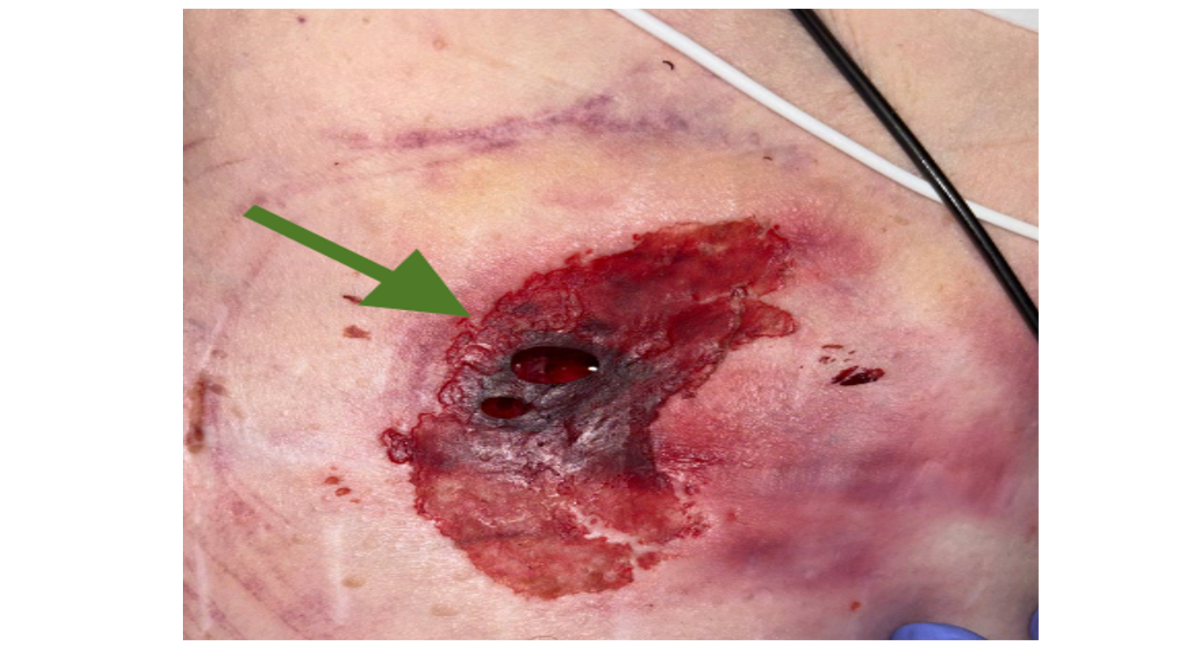
Figure 1: Lower sternum showing ecchymosis and two open wounds (Green arrow) from prolonged CPR with LUCAS device
The patient was transported to the hospital for further management. Examination and imaging revealed extensive thoracic trauma, including a large open chest wound. LVAD interrogation demonstrated preserved pump function without evidence of inflow or outflow cannula dislodgement. Despite hemodynamic stabilization, the patient suffered widespread embolic cerebral infarctions, developed multiorgan failure, and failed to demonstrate meaningful neurological recovery. After multidisciplinary discussion with the family, life-sustaining therapies were withdrawn.
DISCUSSION
Cardiac arrest in patients supported by continuous-flow LVADs poses unique diagnostic and therapeutic challenges. Assessment of systemic perfusion is difficult, as palpable pulses and automated blood pressure measurements are unreliable. Current guidelines emphasize the use of Doppler blood pressure assessment and waveform capnography to guide resuscitation decisions [1-2]. A Doppler pressure below 50 mm Hg or an end-tidal carbon dioxide level less than 20 mm Hg in an unconscious patient supports the initiation of chest compressions [2].
Mechanical CPR devices, including load-distributing band systems and piston-driven devices such as LUCAS, offer theoretical advantages by providing consistent compression depth and minimizing rescuer fatigue [3-4]. However, contemporary evidence does not demonstrate superior survival or neurological outcomes compared with high-quality manual CPR [5-6]. Moreover, systematic reviews and meta-analyses have shown that mechanical CPR is associated with significantly higher rates of compression-related injuries, including rib fractures, cardiac contusions, and posterior thoracic injuries [7]. These risks may be particularly pronounced in LVAD patients due to altered thoracic anatomy, chronic anticoagulation, and the presence of intracardiac and extracardiac cannulas.
Available data regarding CPR in LVAD patients remain limited. Registry-based analyses suggest a decline in the use of chest compressions during LVAD-related hospitalizations for cardiac arrest, likely reflecting concerns regarding safety and effectiveness [8]. More recent observational data suggest that chest compressions, including limited cases involving mechanical CPR, are not commonly associated with LVAD dislodgement [9]. Additionally, isolated case reports have described successful prolonged mechanical CPR with LUCAS devices in LVAD patients without immediate complications [10]. However, the total number of reported cases remains exceedingly small, and adverse outcomes may be underrecognized or underreported.
The present case represents, to our knowledge, the first report describing a catastrophic clinical outcome following prolonged mechanical CPR with a piston-driven device in a patient supported by a durable LVAD. Although direct causality cannot be definitively established, the severity of thoracic injury and subsequent embolic complications raise important concerns regarding the routine use of mechanical CPR in this population. This case highlights the need for cautious, individualized decision-making and underscores the importance of accurate perfusion assessment prior to initiation of mechanical chest compressions.
Current guidelines recommend cautious initiation of chest compressions in LVAD patients following confirmation of inadequate systemic perfusion. Mechanical CPR devices have been associated with higher rates of compression-related injuries compared with manual CPR. Published experience with mechanical CPR in LVAD patients is limited to a small number of case reports and registry analyses. This case represents the first report describing a severe adverse outcome following prolonged mechanical CPR in an LVAD patient, highlighting potential risks that may outweigh perceived benefits.
CONCLUSION
Mechanical cardiopulmonary resuscitation in patients supported by LVADs remains an area of clinical uncertainty. This case highlights a potentially hazardous outcome associated with prolonged use of a piston-driven mechanical CPR device despite preserved LVAD integrity. Until larger studies are available, clinicians should exercise caution when considering mechanical CPR in LVAD patients and prioritize meticulous assessment of systemic perfusion to guide resuscitative efforts. This case underscores the need for heightened caution when considering mechanical CPR devices in LVAD patients and emphasizes the importance of accurate perfusion assessment. Larger studies are required to better define the safety profile and clinical role of mechanical CPR in this high-risk population
REFERENCES
- Peberdy MA, Gluck JA, Ornato JP, Bermudez CA, Griffin RE, Kasirajan V, et al. Cardiopulmonary resuscitation in adults and children with mechanical circulatory support: a scientific statement from the American Heart Association. Circulation. 2017;135(24):e1115-34. [Crossref] [Google Scholar] [PubMed]
- Saeed D, Feldman D, El Banayosy A, Birks E, Blume E, Cowger J, et al. The 2023 International Society for Heart and Lung Transplantation guidelines for mechanical circulatory support: a 10-year update. J Heart Lung Transplant. 2023;42(7):e1-222. [Crossref] [Google Scholar] [PubMed]
- Roesel MJ, Nersesian G, Neuber S, Thau H, von Gudenberg RW, Lanmueller P, et al. LVAD as a Bridge to Transplantation—Current Status and Future Perspectives. Rev Cardiovasc Med. 2024;25(5):176. [Crossref] [Google Scholar] [PubMed]
- Sweitzer NK, Airhart S. LVAD Clinic: Outpatient Monitoring and Causes for Readmission. Textbook of Transplantation and Mechanical Support for End‐Stage Heart and Lung Disease. 2023:833-48. [Google Scholar]
- El-Menyar A, Naduvilekandy M, Rizoli S, Di Somma S, Cander B, Galwankar S, et al. Mechanical versus manual cardiopulmonary resuscitation (CPR): an umbrella review of contemporary systematic reviews and more. Crit Care. 2024;28(1):259. [Crossref] [Google Scholar] [PubMed]
- Uriel N. New analysis shows LVAD therapy offers similar survival outcomes as heart transplant. NY Presbyterian Advances. 2025.
- Gao Y, Sun T, Yuan D, Liang H, Wan Y, Yuan B, et al. Safety of mechanical and manual chest compressions in cardiac arrest patients: a systematic review and meta-analysis. Resuscitation. 2021;169:124-35. [Crossref] [Google Scholar] [PubMed]
- Barssoum K, Patel H, Rai D, Kumar A, Hassib M, Othman HF, et al. Outcomes of cardiac arrest and cardiopulmonary resuscitation in patients with left ventricular assist device; an insight from a national inpatient sample. Heart Lung Circ. 2022;31(2):246-54. [Crossref] [Google Scholar] [PubMed]
- Senman B, Pierce J, Kittipibul V, Barnes S, Whitacre M, Katz JN. Safety of chest compressions in patients with a durable left ventricular assist device. JACC Heart Fail. 2024;12(11):1928-30. [Crossref] [Google Scholar] [PubMed]
- Theeuwes C, Frost M, Vierecke J. Prolonged cardiopulmonary resuscitation with LUCAS device in a patient with left ventricular assist device. J Heart Lung Transplant. 2023;42(4 Suppl):S356. [Crossref] [Google Scholar]

Article Processing Timeline
| 2-5 Days | Initial Quality & Plagiarism Check |
| 15 Days |
Peer Review Feedback |
| 85% | Acceptance Rate (after peer review) |
| 30-45 Days | Total article processing time |
Journal Flyer