


Journal of Plant Science and Biotechnology
ISSN:
3139-6437 (Online)
DOI Prefix (Crossref): 10.67238
 Download PDF
ABSTRACT
A Field experiment was laid out at the field laboratory of department of Horticulture, Bangladesh Agricultural University for improving the local variety through conventional breeding methods of carrot. Under the experiments 6 accessions of wild carrot relatives (CWRS’s) viz. Ames 29084, PI 652410, PI 163235, PI 181052, PI 218076, PI269486 were used as improved lines and Prima agroflora (PA) and Bacilla agroflora (BA) used as local germplasm for adopting hybridization. After successful artificial pollination in and between the improved accessions with the local accessions and fifteen (15) derivatives were obtained which successfully produced seeds. Seed collected from these crossed plants were evaluated in this field experiments later. Significant improvements were found in the F2 generation and results from the derivatives comparison with the local varieties in respect of growth parameters as well as both root and seed yield components. Among the derivatives crossed accession no PI 181052 X PI 652410 gave maximum seed germination (58.34%), crossed accession PI 181052 X PA grown with maximum plant height and superior into the other growth parameters. The highest root yield was found 9.78 MT/ha in PI 269486 X PI 652410 comparison the lowest root yield was 0.68 MT from PI 269486 X PA derivatives. In case of seed production, the maximum seed yield per hectare was found 356.8 kg in check variety BA other than the derivatives. It was observed the improvements of the local varieties was promising for further improvement for carrot variety development in Bangladesh.
Highlights
- Wild carrots relatives (CWR) may be domesticated through hybridization
- Derivatives of carrots come from CWRs and Prima Agroflora and Bacilla Agroflora performed significantly while test cross.
- Derivatives from CWRs are more capable in a stressful environment.
Keywords: Wild Carrot Relatives (CWRS’s); Cross Pollination; Carrot Breeding; Seed Production.
INTRODUCTION
The carrot (Daucus carota var. sativus) is a member of the family Apiaceae [1]. The genus Daucus to which the carrot belongs, contains 25 species, and is currently estimated to be the largest genus in the family [2]. Cultivated carrot [D. carota L. subsp. sativus (Hoffm.) Schübl. & G. Martens] (2n = 2x = 18), is a crop yields and production area have risen significantly in the last 50 yr, with an especially sharp rise in Asian production [3]. Carrot is a root crop and evaluated as a top ten most economically important vegetable crops in the world, considering both area of production and market [4,5]. Carrot is a cool season vegetable crop, performing well under cooler weather at 10 to 25°C [2,6,7]. It is one of the most ancient vegetables grown in spring and summer in temperate countries and during winter in tropical and subtropical climate [8]. Carrot is a root vegetable, usually orange in color, though purple, red, white, and yellow color diversification exists. Among vegetables, carrots are very important for their high nutritional value. Now a days, people especially like it very much for its diverse use in making different palatable dishes, availability in off season due to its long shelf life and less susceptibility to storage pests and diseases [9,10].
In Bangladesh total area under cultivation in 2022-23 was 6488.56 acres and total production was 35270 M. ton [11]. There is no actual statistics about the annual requirement of carrot seed in Bangladesh. In 2022, different seed companies sold 15000 kg of seeds all over the country, the market price of which stands at 7.5 crores taka and most of all were imported from different countries [12]. The climatic condition of Bangladesh is not very suitable for the seed production of mostly cultivated exotic varieties. Carrots habitually require relatively low temperature for root development as well as for flowering. In Bangladesh, it is grown during winter season as temperature ranges from 11.7°C to 28.9°C [13]. Due to the lack of favorable climatic conditions, it is difficult to make commercially viable seeds in this country. To ensure production of carrot seed under the climatic conditions, it is necessary to search, or improvement of this crop is required. For successfully growing and flowering needed to manipulate so that the seed of carrot can be produced within short span of our winter season [14].
Currently in the country there is no remarkable variety of carrots. Most of the seed companies of the world produce carrot seeds suiting their own climatic conditions and if the seeds are used without adaptability test other than the producing area, the growers may face economic losses as this the case of Bangladesh’s farmers. Thus, varietal selection plays an important role in root and seed production of carrot. There is a vast scope for increasing the yield of carrot per hectare by using seeds of high yielding variety. Many countries have developed number of good quality high yielding varieties even through introduction. Commercial production of carrot seeds will be possible if genotypes capable of seed production and at the same time good quality are operational. Almost entire production of carrots in the country is based upon imported seeds. Moreover, several popular exotic cultivars are hybrid varieties, and it is not to be recommended for seed production; therefore, it has become a permanent task for the seed supplying organizations to import the carrot seeds from abroad year after year. Nevertheless, imported seeds are relatively expensive, which are not always available in time for sowing. As well as most of the seed companies of the world produce carrot seeds suiting their own climatic conditions and if the seeds are used without adaptability tests other than the producing area, the growers may face diversified crop related problems and finally get economic losses but unfortunately farmers are doing this as they have only option. Prima Agroflora and Brasilia Agroflora are two seeds producing varieties collected and introduced from abroad and looks promising both root and seed production [15]. Besides, the varietal selection for sowing at optimum time is the important factor for successful carrot growth and production [16]
Considering the above facts, the current research work has been undertaken to find out the high yielding varieties and the ways of its producing high quality abundant carrot seeds under stressful condition of Bangladesh to meet up the requirement for the farmers as well as save priceless foreign currency. Thus, the main objective of the research work is to improve the local varieties through hybridization aiming for producing maximum root and seed yield.
MATERIALS AND METHODS
The experiment was conducted at the single factor RCBD with three replications. Seeds Wild carrot relatives (CWRS’s) accessions were collected from different countries. After the primary screening of CWRS’s accessions in different locations in Bangladesh like Lalmonirhat northern part of Bangladesh, Satkhira of Southern part of Bangladesh and Mymensingh Near the Capital for the different stressful conditions adopted the CWR accessions. Potential resistance of the three stressful conditions viz. drought, Saline and warm soil conditions were fetched, and the selected naturally improved CWR accessions were kept for seed production. Produced seeds were used for cross pollination finally cross-pollinated seeds were used for planting materials in this experiment. Plants were evaluated in the field along with the local breeds as well as parents. The selected F1 derivatives of different improved CWR accessions viz. Accessions no. Ames 29084, PI 163235, PI 181052, PI 218076, PI 269486 and PI 652410 with two local Prima agroflora (PA) and Basilla agroflora (BA) found seeds from different combinations viz. Ames 29084 X PA, Ames 29084 X BA, Ames 29084 X PI 652410, PI 163235 X PI 652410, PI 163235 X PA, PI 163235 X BA, PI 181052 X PI 652410, PI 181052 X PA, PI 181052 X BA, PI 218076 X PI 652410, PI 218076 X PA, PI 218076 X BA, PI 269486 X PI 652410, PI 269486 X PA, PI 269486 X BA used as trial material with check PA and BA.
The unit plot size was 1.0 m × 1.0 m accommodating individual accessions of 20 seeds per accession in a line sowing with spacing maintained for seed to seed of 5 cm and line to line distance was maintained 50 cm. Before the flowering all the plants covered by insect protected nets to prevent crossing naturally. During the pollination period artificial pollination has been made for smooth outcrossing posture. Seeds collected from the desired plants are dried and kept in incubator for better viability. Data were recorded of the different growth, yield and seed production related parameters. All the data were statistically analyzed using DMRT and the results were presented in the results and discussion sections.
RESULTS AND DISCUSSIONS
Results were found statistically significant, most of the parameters studied. Among the 15 derivatives crossed accession between PI 181052 X PI 652410 performed maximum germination (58.34%) in the field and minimum germination was recorded (30.66%) in crossed accession between Ames 29084 X PI 652410 (Table 1). Crossed accession between PI 181052 X PA showed maximum plant height (46.82 cm) and minimum plant height was (22.50 cm) in check BA, number of leaves also varied significantly (Chart 1). The difference in the number of leaves per plant as affected by the time of sowing was due to the variation in the climatic conditions during growth period and the sowing of early carrots which imparts maximum photosynthesis with longer growth period as compared to the crop sown late [17]. The results have mostly similarities with the authors [16-18].
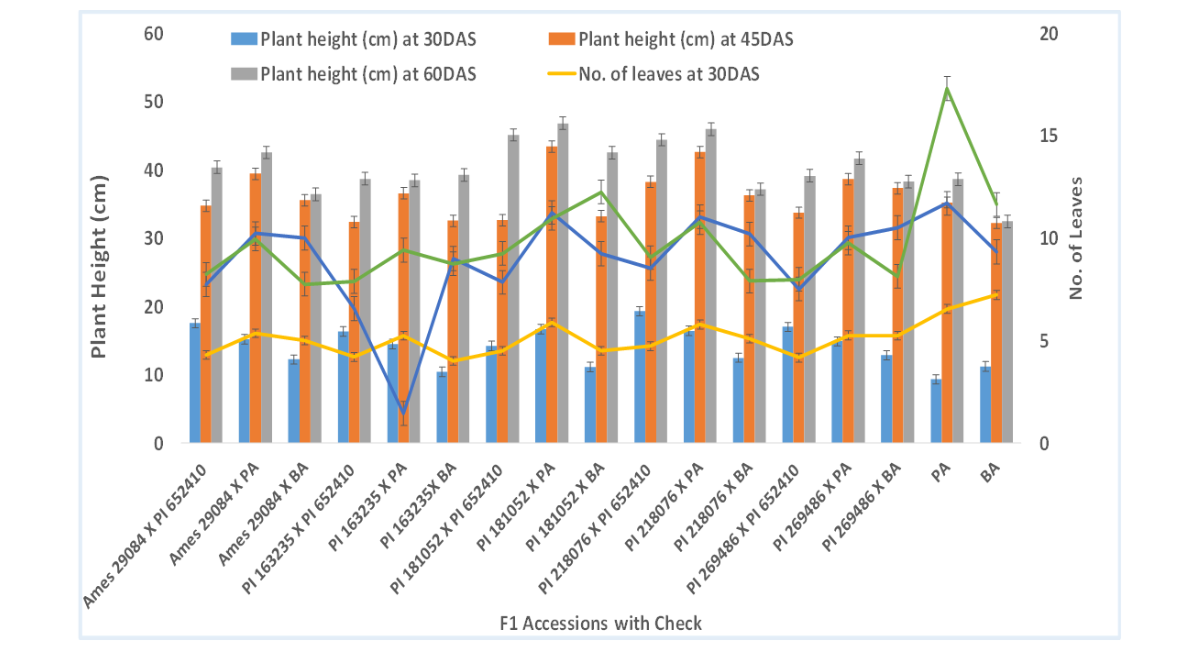
Chart 1: Showing field performance of hybrid accessions of carrot (Crossed between CWR,s and Check) at BAU for plant height and number of leaves at different date after sowing (DAS).
The longest roots found 16.06 cm in crossed accession between PI 181052 X PA and the shortest roots were recorded 11.23 cm from hybrid derivatives PI 181052 X BA reported in an investigation that root length has a signification effect with varietal differentiation [19]. The maximum diameter of roots was found 5.5 cm in crossed accession between PI 181052 X BA and minimum was recorded 3.20 cm from check BA. Maximum fresh weight of leaves was found 41.23g in check BA followed by 32.56g in also check PA and minimum was recorded 22.35g from PI 181052 X BA. Maximum fresh weight of roots was found 50.11g in PI 218076X PI 652410 and minimum was recorded 4.24 g from hybrid accession no. PI 163235 X PA. Maximum dry weight of roots was found 6.5g in PI 181052 X BA and minimum was measured 0.62 g from PI 269486 X PA (Chart 2).
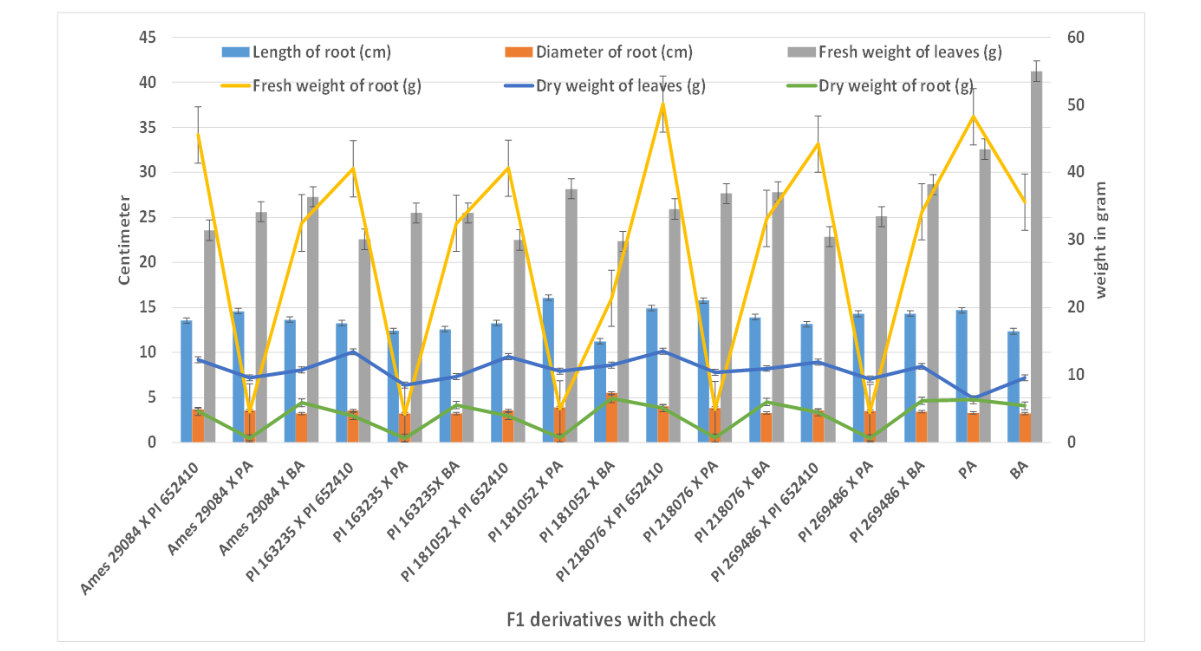
Chart 2: Showing field performance of hybrid accessions of carrot (Crossed between CWR, s and Check) at BAU for root character and biomass level after harvest.
In case of root yield proficiencies also found signification variation among the derivatives studied in this experiment and shown by the crossed derivatives and the highest yield found 9.78 MT in PI 269486 X PI 652410 followed by 9.47 MT in PI 181052 X PI 652410 and minimum was recorded 0.68 MT also from hybrid PI 269486 X PA (Table 1). The results found were similarities who also found the heritability to be high for total root yield [20,21].
In case of flowering behavior and observed parameters related with the flowering characters also found signification variation among the derivatives studied. The Maximum (135 days) required 50% flowering in Ames 29084 X PA and minimum took minimum (118 days) in hybrid PI 218076 X PA. The Maximum number of primary umbels per plant was found 2.2 pcs in PI 181052 X PA and PI 218076 X PI 652410 jointly whereas minimum was counted 1.00 pcs from hybrid PI 163235 X PI 652410 (Chart 3). Maximum number of secondary umbels per plant was found 21.33 in check PA followed by 21.00 in hybrid accession no. PI 163235 X BA and minimum was recorded 6.5 from hybrid accession no. PI 181052 X BA. Maximum diameter of primary umbel was found 12.65 cm in PI 218076 X PI 652410 and minimum was recorded 6.5 cm from hybrid accession no. PI 181052 X BA. Maximum diameter of secondary umbel was found 3.85 cm in also PI 218076 X PI 652410 other than minimum was recorded 3.02 cm from hybrid PI 163235 X PA (Chart 3).
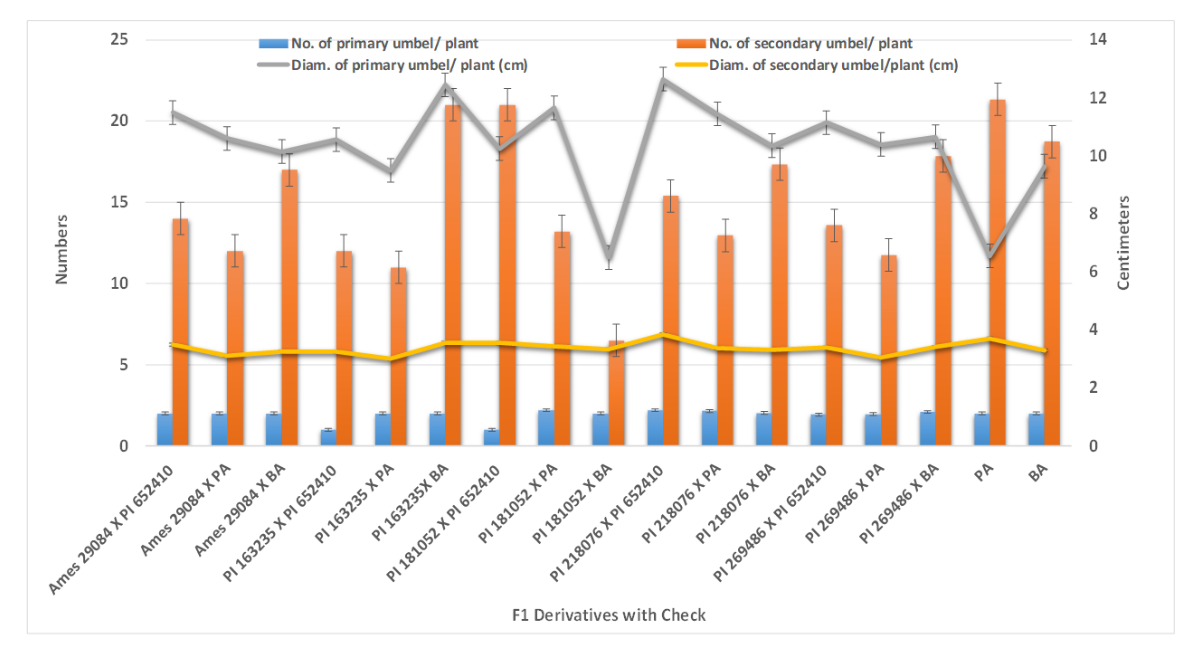
Chart 3: Showing field performance of hybrid accessions of carrot (Crossed between CWR, s and Check) at BAU for flowering characteristics.
In case of seed production behavior, it was not found signification variation among the derivatives studied. Hybrid accessions were not prominent in the case of seed production. It may happen due to the non-transfer of character which is dominant for seed production. However, maximum seed yield per hectare was found 356.8 kg in check BA other than minimum was found 11.04 kg from hybrid Ames 29084 X BA. But maximum germination was found 55.0% g in hybrid Ames 29084 X PA on the other hand minimum was found 12.0% from hybrid accession no. PI 181052 X BA. Weight of 1000 seeds were found maximum 2.95 g in hybrid accession no. PI 218076 X PI 652410 on the other hand minimum was found 2.10 g from hybrid between Ames 29084 X PA (Table 1).
|
Ac. Name |
Germination % |
Root yield/plot (g) |
Root yield/ha (MT) |
Seed yield (g) |
Seed yield/ha (Kg) |
Germination % of produced seed |
Wt. of 1000 seed (g) |
|
Ames 29084 X PI 652410 |
30.66 |
698.28 |
5.59 |
- |
- |
- |
- |
|
Ames 29084 X PA |
41.66 |
94.98 |
0.76 |
2.37 |
18.96 |
55.00 |
2.10 |
|
Ames 29084 X BA |
37.87 |
615.39 |
4.92 |
1.38 |
11.04 |
37.00 |
2.55 |
|
PI 163235 X PI 652410 |
54.37 |
1,102.35 |
8.82 |
- |
- |
- |
- |
|
PI 163235 X PA |
44.33 |
93.98 |
0.75 |
10.62 |
84.96 |
50.00 |
2.66 |
|
PI 163235X BA |
45.33 |
735.48 |
5.88 |
24.53 |
196.24 |
52.00 |
2.75 |
|
PI 181052 X PI 652410 |
58.34 |
1,184.30 |
9.47 |
- |
- |
- |
- |
|
PI 181052 X PA |
44.23 |
110.93 |
0.89 |
4.56 |
36.48 |
32.00 |
2.35 |
|
PI 181052 X BA |
38.23 |
408.11 |
3.26 |
2.50 |
20.00 |
12.00 |
2.33 |
|
PI 218076 X PI 652410 |
32.23 |
807.44 |
6.46 |
3.97 |
31.76 |
40.00 |
2.95 |
|
PI 218076 X PA |
36.98 |
91.06 |
0.73 |
- |
- |
- |
- |
|
PI 218076 X BA |
40.36 |
668.97 |
5.35 |
- |
- |
- |
- |
|
PI 269486 X PI 652410 |
55.36 |
1,223.00 |
9.78 |
- |
- |
- |
- |
|
PI 269486 X PA |
38.2 |
85.35 |
0.68 |
- |
- |
- |
- |
|
PI 269486 X BA |
31.22 |
532.69 |
4.26 |
- |
- |
- |
- |
|
PA |
42.55 |
1,026.09 |
8.21 |
21.50 |
172.00 |
45.66 |
2.63 |
|
BA |
40.23 |
716.70 |
5.73 |
44.60 |
356.80 |
50.36 |
2.45 |
|
CV% |
7.16 |
4.91 |
4.92 |
5.47 |
5.47 |
7.86 |
9.68 |
|
Level of significance |
** |
** |
** |
** |
** |
** |
** |
|
LSD 0.05 |
4.94 |
49.02 |
0.39 |
0.62 |
4.97 |
2.88 |
0.22 |
|
LSD 0.01 |
6.64 |
65.90 |
0.53 |
0.83 |
6.69 |
3.87 |
0.29 |
Table 1: Field performance of hybrid accessions of carrot (Crossed between CWR,s and Check) at BAU for yield components and quality seed production.
** indicates significant at 1% levels of probability (-) indicates data not determined
CONCLUSION
Carrot is a potential crop in respect of nutrition’s, and economic viability based on current demand in Bangladesh. Due to seed unavailability, it has been always raising issues for mitigating the national demand. Only challenge is to develop new sustainable variety which may be capable of producing seed locally. Considering the issues and overview from the current experiment it may concluded that the potential expression among the derivatives was to indicate that the carrot variety development becomes outcome-based research and will be a good source of the parent materials for further breeding programs. From this experiment it will be summarized that after hybridization of PI 269486 X PI 652410 to be better for root and seed production. Further investigation is suggested to improve the accessions especially for stress adaptive and climate resilient accessions is recommended.
CONFLICT OF INTEREST
The authors declare that there is no conflict of interest.
ACKNOWLEDGEMENT
Department of Horticulture, Bangladesh Agricultural University, Bangladesh for ensuring field laboratory support.
FUNDING
Self-funding
REFERENCES
- Peirce LC. Characteristics, production, and marketing. 1987. [Google Scholar]
- Quiros CF, Simon PW. Carrots and related vegetable Umbelliferae. New York; 1999. [Google Scholar]
- Simon PW. Domestication, historical development, and modern breeding of carrot. Plant breeding reviews. 2000:157-90. [Crossref] [Google Scholar]
- Fontes RR, Vilela NJ. The current status of brazilian vegetable crops and future opportunities. In IX International Symposium on Timing of Field Production in Vegetable Crops 607 2001(pp. 135-141). [Crossref] [Google Scholar]
- Joubert TG, La G, Boelema BH, Daiber KC. The production of carrots. Vegetable and Ornamental Plant Institute. Agricultural Research Council-Roodeplaat. 1994. [Google Scholar]
- Kumar R, Vashisht P, Gupta RK, Singh M, Kaushal S. Characterization of European carrot genotypes through principal components and regression analyses. International Journal of Vegetable Science. 2010;17(1):3-12. [Crossref] [Google Scholar]
- K. Bose and M.G. Som. Vegetable crops in India. Naya Prakash, Calcutta-Six, India.1990, pp 408-442.
- Hossain MM. Seed production of onion and carrot. Lecture notes presented in postgraduate Program. Bangabandhu Sheikh Mujibur Rahman Agricultural University, Gazipur-1706. 2004.. [Google Scholar]
- Simon P, Rahim M, Ali A. Utilization of Carrot Cwrs for Carrot Pre-Breeding in Bangladesh and Pakistan. In 2018 ASHS Annual Conference 2018. ASHS. [Google Scholar]
- Statistics B. Bangladesh bureau of statistics (BBS). Statistics and Informatics Division, Ministry of Planning www. bbs. gov. bd. 2018.. [Google Scholar]
- Anonymous 2022. Industry Picture 2021 for dealers, field forces and market assessment. Giant Agro Processing Limited. Dhaka. P 5.
- Hasan SM. Standardization of technology for high quality carrot seed (Doctoral dissertation, PhD Thesis, Department of Horticulture, Bangladesh Agricultural University, Bangladesh. 203p). [Google Scholar]
- Latha PM, Reddy SS, Reddy R. Studies on the effect of sowing dates on growth and root yield of certain carrot (Daucus carota L.) cultivars. Agriculture: Towards a New Paradigm of Sustainability. 2012:116-9. [Google Scholar]
- Lavanya AV, Vani VS, Reddy PS, Shashikala P. Effect of sowing dates and spacing on growth and root yield of radish cv. pusa chetki. Int. J Pure App. Bio Sci. 2017;5(4):1774-9.[Crossref] [Google Scholar]
- Malek MA, Sikder M, Mohammed D. Effect of variety and age of stecklings on yield and quality of carrot seed. J. Agrofor. Environ. 2011;5(2):93-6. [Google Scholar]
- Karklelienė R, Dambrauskienė E, Radzevičius A. Evaluation of the morphological, physiological and biochemical parameters of edible carrot (Daucus sativus Röhl.). biologija. 2008;54(2). [Google Scholar]
- Ladumor RG, Nandre BM, Sharma MK, Wankhade VR, Joshi PC. Performance of different varieties of carrot (Daucus carota L.) with respect yield, quality and chemical compositions under varying sowing times. International Journal of Current Microbiology and Applied Sciences. 2020;9(2):126-32. [Crossref] [Google Scholar]
- Kumar A. Performance of carrot (Dacus carota L.) varieties for yield and its associated characters. Journal of Krishi Vigyan. 2024;12(2):351-5.[Crossref] [Google Scholar]
- Malek MA 2014. Yield and quality of carrot seed as influenced by production practices. PhD Thesis, Department of Horticulture, Bangladesh Agricultural University, Bangladesh.
- Alim A. An introduction to Bangladesh agriculture. [Google Scholar]
- Simon PW. Economic and academic importance. In The Carrot Genome 2019 (pp. 1-8). Cham: Springer International Publishing. [Crossref] [Google Scholar]

Article Processing Timeline
| 2-5 Days | Initial Quality & Plagiarism Check |
| 25-35 Days |
Peer Review Feedback |
| 45-60 Days | Total article processing time |
EDITORIAL & PUBLICATION INFORMATION
| English | Publication Language |
| Single-Blind | Peer-Review Model |
| 17% | Acceptance Rate |
| <18% | Similarity Screening Guideline |
| Open Access | Access Model |
All manuscripts undergo editorial assessment and originality screening as part of the journal's evaluation process. The acceptance rate shown is based on journal-level editorial data and may change over time. Similarity reports are assessed editorially and are not interpreted solely on the basis of a numerical similarity score.
Why Publish with us?
Ethics & Policies
Editorial & Management
Useful Links
Journal Highlights
Open Access Journals
Journal Flyer