

Journal of Climate Change and Pollution
ISSN:
3108-2025 (Online)
DOI Prefix (Crossref): 10.67238
Peer Review
Our Peer Review Philosophy
At Confmeets Publishing, the peer review process is the cornerstone of our mission to uphold scientific excellence and foster the dissemination of trustworthy knowledge. Our approach is built upon a foundation of four synergistic principles that guide every evaluation:
Equitable & Unbiased Scrutiny (Single-Anonymized Model)
We employ a single-anonymized review model to cultivate an environment of impartiality. While reviewers remain anonymous to authors, author identities are disclosed to reviewers. This strategy is deliberately chosen to mitigate apprehensions of reprisal, thereby promoting forthright and objective feedback. Crucially, it allows reviewers to contextualize the research within the authors' existing body of work. Our editorial team is rigorously trained to identify and counteract potential biases stemming from institutional prestige, geographical origin, or personal affiliations, reassigning manuscripts or soliciting extra opinions whenever necessary.
Developmental & Mentorship-Oriented Assessment
Peer review at Confmeets is fundamentally constructive. We task reviewers with a dual mandate: not only to gatekeep quality but to act as mentors in prose. Reviewers are expected to deliver actionable, evidence-based critiques designed to elevate the manuscript's clarity, methodological soundness, analytical depth, and interpretive insights. The objective is a formative evaluation that amplifies the scholarly impact of the work, transforming the review into a collaborative endeavor towards excellence.
Uncompromising Rigor & Domain-Specific Expertise
Every submission is meticulously evaluated by referees with verifiable and substantial expertise in the manuscript's specific niche. Reviewers are required to dissect the methodological robustness, the appropriateness of the study design, the application of statistical or analytical techniques, the completeness of reporting (including strict adherence to field-specific guidelines like CONSORT, PRISMA, etc.), and the logical coherence of conclusions derived from the presented data.
Transparent Dialogue & Author-Centric Support
We believe in demystifying the peer review process. All editorial decisions are accompanied by a comprehensive rationale, often including anonymized reviewer reports and direct editorial commentary. We commit to predictable timelines and maintain open channels of communication, ensuring authors fully comprehend the decision-making process and the precise pathway to successful revision and publication.
The Confmeets Editorial Workflow
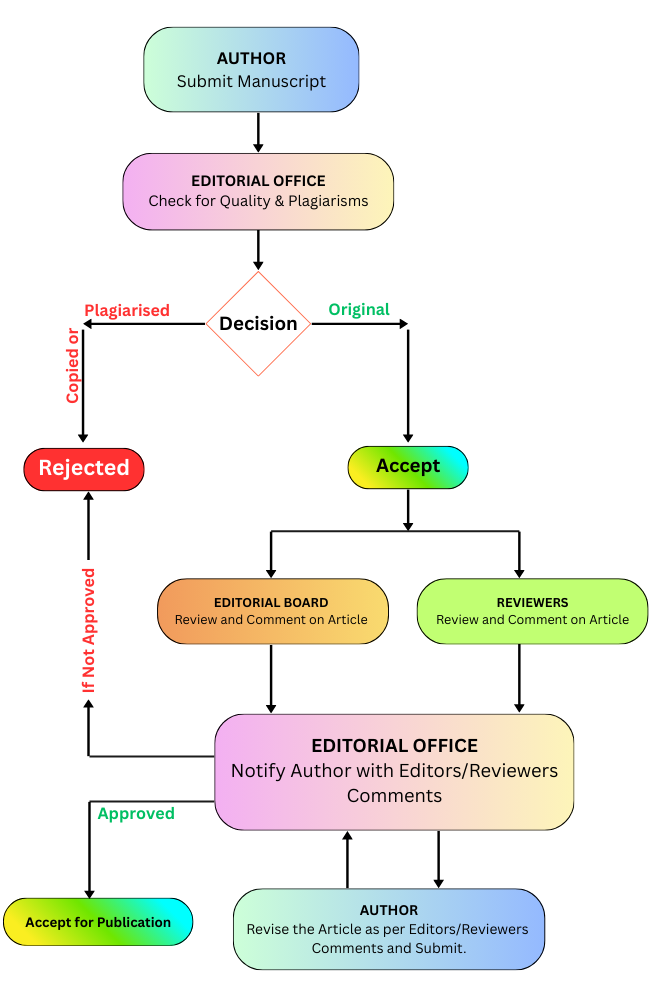
To guarantee a systematic, timely, and equitable review, our editorial process unfolds through seven distinct, managed stages:
Stage 1: Submission & Comprehensive Editorial Triage
Upon submission via our online portal, each manuscript undergoes a multi-faceted initial screening. This critical first check verifies:
- Alignment with the journal's scope and intellectual aims
- The presence of all mandatory components (structured abstract, keywords, funding/competing interest declarations)
- Complete ethical documentation (IRB/IACUC approvals, informed consent forms, clinical trial registration numbers)
- Adherence to basic formatting and word-count specifications
- A rigorous similarity analysis using cross-referencing software to safeguard academic originality
- The absence of immediate ethical or legal concerns, such as duplicate submission or data integrity issues
Outcome: Manuscripts progressing beyond this stage are assigned a Handling Editor. Those with deficiencies are returned with a detailed desk-reject decision, offering constructive guidance for resubmission.
Stage 2: Strategic Assignment to a Handling Editor
A dedicated Handling Editor, selected for their deep subject-matter expertise, is appointed to steward the manuscript. This editor is responsible for curatorially selecting reviewers, managing the review timeline, synthesizing conflicting reviewer opinions, and formulating the provisional decision, all while ensuring the entire process remains ethically sound and constructive.
Stage 3: Curated Reviewer Selection
We commit to securing a minimum of three independent reviewers for original research articles to enrich the assessment perspective. Our selection algorithm prioritizes:
- Demonstrable, cutting-edge expertise in the manuscript's specific sub-field
- A robust publication record in high-impact, relevant venues
- A commitment to achieving geographic, gender, and career-stage diversity
- A confirmed absence of conflicts of interest with the authors or their institution
- A documented history of providing thorough, timely, and constructive reviews
For highly complex or interdisciplinary works, editors are empowered to invite additional specialist reviewers.
Stage 4: In-Depth, Single-Anonymized Peer Review
Reviewers evaluate the manuscript against a detailed set of standardized criteria. They are required to submit two distinct outputs:
- Confidential remarks for the editor: These may include assessments of novelty priority, sensitive ethical concerns, or suspicions of misconduct that should not be relayed to the authors.
- Developmental comments for the authors: A comprehensive, respectful, and concrete report outlining the manuscript's strengths and weaknesses, complete with specific suggestions for enhancement. Reviewers also score core elements (originality, methodology, clarity) and categorize recommended revisions as "Essential" or "Discretionary."
Stage 5: Nuanced Editorial Decision
Integrating the reviewers' recommendations with their own expert assessment, the Handling Editor renders one of four decisions:
- Accept: The manuscript is accepted for publication, pending only minor stylistic corrections.
- Minor Revision: Required amendments are modest and can be confirmed by the editor without re-engaging reviewers.
- Major Revision: The manuscript necessitates substantial revisions (e.g., re-analysis of data, experimental augmentation). The revised version will typically be returned to the original reviewers for re-evaluation.
- Reject: The manuscript is deemed unsuitable due to irreparable foundational flaws in conception, methodology, or relevance.
Every decision is communicated via a structured letter that synthesizes all feedback and provides a clear, itemized list of required actions.
Stage 6: Author Revision & Point-by-Point Rebuttal
Authors are required to submit:
- A detailed, point-by-point response document addressing every reviewer and editor comment
- A revised manuscript with changes highlighted and a clean version
- Any additional data, code, or supplementary materials requested during review
The editor meticulously verifies that all concerns have been adequately addressed before proceeding, often re-consulting reviewers for major revisions.
Stage 7: Final Acceptance & Production
Once accepted, the manuscript enters the production pipeline for professional copyediting, typesetting, and proof generation. Authors review the page proofs for final approval. Upon sign-off, the article is published online and indexed in major databases, with any post-publication corrections handled via a clear and prompt policy.
Guidelines for Confmeets Reviewers
Core Responsibilities
- Objective & Evidence-Anchored Critique: Base all assessments on empirical evidence and established scholarly conventions, free from personal bias.
- Strict Confidentiality: Treat the manuscript as a privileged document; neither disseminates nor appropriates its content.
- Proactive Conflict of Interest Disclosure: Immediately declare any potential conflicts (professional, collaborative, or financial) and recuse oneself if necessary.
- Punctuality & Professionalism: Honor agreed-upon deadlines or provide ample notice if an extension is required.
- Constructive & Respectful Communication: Frame all criticism diplomatically, focusing on the scholarly work, not the authors.
- Vigilance for Ethical Integrity: Alert the editor to any suspected ethical breaches (plagiarism, data manipulation, duplicate submission) with specific, evidence-based concerns.
Multidimensional Evaluation Criteria
Reviewers should appraise manuscripts based on the following pillars, providing specific, referenced comments for each:
- Novelty & Scholarly Significance: Does the work present a genuine advance be it empirical, theoretical, or methodological? Is its contribution clearly framed and justified against the current literature?
- Methodological Transparency & Reproducibility: Is the design, protocol, and analysis described with sufficient granularity to allow for replication? For quantitative studies, are statistical methods sound and assumptions verified? For qualitative work, is the analytical framework transparent and justified?
- Result Validity & Evidentiary Strength: Are all findings, including negative or null results, reported transparently? Do the conclusions logically follow from the evidence, and are alternative explanations thoughtfully considered?
- Analytical Depth & Interpretative Prudence: Are the interpretations constrained by the data, avoiding undue speculation or overstatement? Is the discussion focused and insightful?
- Ethical Soundness & Compliance: Are required ethics approvals and consent procedures explicitly documented? Are there concerns regarding participant welfare or data privacy?
- Narrative Clarity & Structural Coherence: Is the manuscript's argument logically structured and compelling? Are tables and figures both necessary and effectively explained? Is the referencing accurate and contemporary?
- Commitment to Open Science: Is there a data availability statement? Is the underlying data, code, or materials accessible in a recognized repository to facilitate verification and reuse?
Architecture of an Exemplary Review Report
- Synopsis: A brief (2-4 sentences) neutral summary of the paper's objectives, methods, and key findings.
- Overall Recommendation: A clear verdict (Accept/Minor/Major/Reject) with a succinct justification.
- Major Concerns: A numbered list of fundamental issues that must be rectified for the manuscript to be considered for publication.
- Minor Concerns & Suggestions: A separate list of recommendations to improve clarity, style, and presentation.
- Specific Line-by-Line Annotations (Optional): Precise comments linked to page and line numbers for granular edits.
- Confidential Editor Remarks: Any sensitive feedback, such as ethical concerns or questions of originality, reserved for the editor's eyes only.
Ethical Stewardship in Review
Reviewers are the guardians of academic trust. They must maintain confidentiality, abstain from using reviewed content for personal advantage, and promptly report any ethical transgressions with detailed evidence, all while ensuring their language remains professional and non-discriminatory.
Join the Confmeets Reviewer Collegium
The Value of Reviewing with Confmeets
Serving as a reviewer is a reciprocal scholarly service that offers tangible benefits:
- Intellectual Leadership: Directly influence the trajectory of knowledge in your discipline.
- Early Insight: Gain privileged access to emerging research and innovative methodologies before publication.
- Career Advancement: Enhance your professional profile and gain formal recognition valuable for promotion and tenure portfolios.
- Editorial Pathway: Exceptional reviewers are fast-tracked for consideration for roles on our Editorial Boards.
Reviewer Eligibility
Ideal candidates possess:
- A Ph.D. or equivalent terminal research degree and demonstrated expertise
- A track record of recent publications in reputable, peer-reviewed journals
- Familiarity with methodological and reporting standards in their field
- A commitment to ethical, timely, and constructive peer review
We actively encourage applications from advanced doctoral candidates and postdoctoral researchers, who may be invited to co-review under mentorship.
Application Process
Prospective reviewers can express interest by submitting: Reviewer Form Signup Link
- An updated CV highlighting relevant publications and methodological competencies.
- A digital academic profile (ORCID, Scopus, or Google Scholar).
- A detailed list of specific research interests and keywords for accurate manuscript matching.
- (Optional) A summary of previous reviewing experience.
Recognizing Our Reviewers
Acknowledging Scholarly Service
Confmeets Publishing is committed to formally valuing the invaluable contribution of our reviewers through:
- Annual Reviewer Excellence Certificates: Digitally certified documents detailing yearly contributions.
- Opt-In Public Acknowledgment: Reviewers can choose to be listed in an annual "Recognized Reviewers" roll of honor on the journal website.
- Prestigious Reviewer Awards: Periodic accolades awarded to top reviewers based on metrics of timeliness, depth, and constructiveness.
- Editorial Board Candidacy: High-performing reviewers are prioritized for vacancies on our Editorial Boards.
All recognition strictly adheres to confidentiality norms; identities are never disclosed without explicit, prior consent.

Article Processing Timeline
| 2-5 Days | Initial Quality & Plagiarism Check |
| 25-35 Days |
Peer Review Feedback |
| 45-60 Days | Total article processing time |
Ethics & Policies
Editorial & Management
Useful Links
Journal Highlights
Open Access Journals
Journal Flyer