
 Download PDF
ABSTRACT
Precision medicine has been profoundly shaped by advances in genomic technologies, enabling the identification of genetic variants associated with disease susceptibility, prognosis, and therapeutic response. However, the genome does not directly represent the biological state of an individual, and genomic information alone may be insufficient to explain phenotypic heterogeneity or differences in disease progression and treatment response. The biological consequences of genetic variation depend on a broader context encompassing molecular, cellular, tissue, temporal, environmental, and clinical factors. In this Opinion, we argue that the next generation of precision medicine should therefore move beyond a genome-centered paradigm toward a context-aware framework. Multi-omics technologies provide complementary layers of information that can connect genomic variation with functional biological states, while artificial intelligence (AI) offers new opportunities to integrate these heterogeneous and multidimensional data. Importantly, AI should not be viewed solely as a predictive tool, but as an integrative framework capable of identifying biologically meaningful relationships and generating mechanistic hypotheses. Such predictions, however, require interpretability, causal reasoning, experimental validation, and robust clinical evaluation. We propose a conceptual model in which the genome provides the foundation, biological context provides meaning, AI provides integration, and experimental and clinical validation provide confidence. This transition from genotype-centered prediction toward context-aware biological understanding could enable more dynamic, individualized, and clinically meaningful precision medicine.
Keywords: Precision medicine; Genomics; Biological context; Multi-omics; Artificial intelligence; Systems biology; Personalized medicine; Functional genomics
INTRODUCTION
The Genome Is Not the Phenotype
The rapid expansion of genomic technologies has transformed our ability to characterize human genetic variation and has provided an essential foundation for precision medicine [1]. Whole-genome and whole-exome sequencing can identify millions of genetic variants within an individual, while increasingly sophisticated computational approaches can classify these variants according to their predicted functional or clinical relevance. Yet, an important conceptual gap remains: the presence of a genetic variant does not necessarily predict its biological consequence, and the genome itself is not the phenotype [2].
The relationship between genotype and phenotype is neither linear nor deterministic [3]. Although pathogenic variants can have profound effects, their phenotypic expression may depend on genetic background, cell type, tissue state, developmental stage, age, environmental exposure, and other biological factors. Even individuals carrying the same pathogenic variant may exhibit substantial differences in disease onset, severity, progression, or treatment response. Conversely, genetically distinct individuals may develop remarkably similar phenotypes through convergent alterations in cellular pathways. These observations challenge a genome-centered view of precision medicine in which the identification of a molecular variant is assumed to provide sufficient information for predicting an individual's clinical trajectory [4].
One important limitation is that genomic information describes potential rather than activity [5]. A DNA sequence provides the blueprint from which biological processes may emerge, but it does not indicate which genes are actively transcribed, which proteins are produced, how signaling pathways are functioning, or how cells respond to their surrounding environment. These processes are dynamically regulated through epigenetic modifications, transcriptional programs, post-transcriptional regulation, protein–protein interactions, metabolic states, and intercellular communication. Consequently, the biological effect of a genomic variant cannot always be inferred from its sequence alone.
This distinction becomes particularly important for variants of uncertain significance. Modern sequencing technologies continue to generate genetic findings faster than they can be functionally interpreted [6]. Computational prediction can estimate whether a variant may alter protein structure, gene regulation, or evolutionary conservation, but prediction does not necessarily establish biological causality [7]. A variant may be statistically associated with disease without being sufficient to produce the phenotype, or its effect may emerge only under specific cellular or environmental conditions. Thus, the central challenge is increasingly shifting from variant detection to functional interpretation.
The problem is further complicated by biological heterogeneity. The human body is not a homogeneous system, and a genetic alteration may have markedly different consequences in different tissues or cellular states [8]. A regulatory variant that is functionally relevant in hepatocytes may have little effect in endothelial cells, neurons, or cardiomyocytes. Similarly, the consequences of a mutation may change during disease progression as cells undergo metabolic, epigenetic, or phenotypic reprogramming. Precision medicine therefore requires more than knowing which variant is present; it requires understanding where, when, and under what biological conditions that variant becomes functionally relevant [9].
The same principle applies to complex diseases, in which phenotypes rarely result from a single genetic alteration. Cancer provides perhaps the clearest example: the clinical behavior of a tumor reflects not only its mutational landscape but also transcriptional states, epigenetic regulation, metabolic adaptation, cellular plasticity, immune interactions, and the tumor microenvironment [10]. Similar principles apply to cardiovascular, metabolic, neurological, and inflammatory diseases, where genetic susceptibility interacts continuously with cellular and environmental factors. In such settings, a genomic profile represents one layer of information within a much larger biological system.
This does not diminish the importance of genomics. Rather, it changes how genomic information should be interpreted. The genome should be regarded as the starting layer of precision medicine, not its endpoint. The critical question is no longer simply whether a particular genetic variant is present, but how that variant influences biological function within a specific cellular, tissue, and clinical context [11].
This shift from genotype-centered prediction to context-dependent biological interpretation represents an important conceptual step toward the next generation of precision medicine. To move from genomic information to clinically meaningful insight, genomic data must therefore be connected with the molecular and functional states that ultimately generate the phenotype.
From Genomics to Biological Context
If the genome represents the foundation of biological information, the next challenge is to understand how this information is translated into cellular function and, ultimately, into phenotype. This requires moving beyond the genome as an isolated molecular layer and considering the biological context in which genetic information is interpreted. The emergence of multi-omics technologies provides an opportunity to make this transition by connecting genomic variation with epigenetic regulation, gene expression, protein abundance, metabolic activity, cellular states, and clinical phenotypes [12].
Each omics layer captures a different aspect of biological organization [13]. Genomics describes relatively stable genetic information; epigenomics provides insight into regulatory states that influence gene activity; transcriptomics reflects patterns of gene expression; proteomics captures the abundance and modification of functional proteins; and metabolomics provides a closer representation of the biochemical state of cells and tissues. These layers are not independent. Rather, they form a dynamic molecular network in which alterations at one level can propagate through multiple levels of biological organization. Consequently, the interpretation of a genomic variant may become substantially more informative when its effects can be traced through downstream molecular processes [14].
This perspective changes the role of multi-omics in precision medicine. The objective should not simply be to collect as many molecular measurements as possible, but to determine which combination of biological layers is necessary to explain a clinically relevant phenotype [14]. In some settings, genomic and transcriptomic information may be sufficient to identify a disease-associated mechanism. In others, proteomic or metabolomic information may be required to determine whether a predicted molecular alteration is actually translated into a functional cellular state. Thus, multi-omics should not be viewed as an accumulation of datasets, but as a framework for reconstructing biological relationships [15].
The distinction between data accumulation and biological integration is particularly important because different molecular layers operate on different temporal and spatial scales [16]. The genome is relatively stable, whereas transcription, protein activity, metabolism, and cellular signaling can change rapidly in response to disease, treatment, environmental exposure, or physiological state. A single genomic profile therefore provides only a static representation of a biological system that is inherently dynamic. Capturing this dynamic dimension is essential if precision medicine is to move from predicting susceptibility toward understanding disease activity and treatment response [17].
Spatial and cellular heterogeneity adds another dimension to this complexity [18]. Bulk tissue measurements can obscure biologically distinct cell populations and may average molecular signals originating from cells with very different functions. The development of single-cell and spatial omics has begun to address this limitation by allowing molecular states to be resolved at cellular or spatial levels. These technologies make it possible to ask not only which molecular alterations are present, but also which cells carry them, where they occur, and how neighboring cells influence their consequences. Such information may be particularly important in heterogeneous diseases such as cancer, where tumor cells, immune cells, stromal cells, and endothelial cells form an interacting ecosystem rather than an isolated population. Single-cell and spatial approaches are therefore extending the concept of biological context from molecular context to cellular and tissue context [19].
Importantly, biological context extends beyond molecular measurements. Clinical phenotype, lifestyle, environmental exposures, medication history, longitudinal trajectories, and other patient-level information can influence how molecular alterations manifest. Recent approaches to multimodal integration increasingly combine multi-omics data with electronic health records, imaging, biobank information, and longitudinal phenotypes, creating a more comprehensive representation of the individual. The resulting model is fundamentally different from a genome-only approach: rather than asking whether a patient carries a particular variant, it asks how genetic variation interacts with molecular, cellular, environmental, and clinical factors to produce the observed phenotype [20].
However, adding more biological layers does not automatically produce better precision. Multi-omics integration introduces substantial analytical challenges, including differences in data structure and scale, missing measurements, batch effects, high dimensionality, limited sample sizes, and difficulties in determining which associations are biologically meaningful [21]. Current integration strategies therefore require not only computational sophistication but also careful biological validation and interpretability.
This leads to an important conceptual distinction: more data are not necessarily more information. A clinically useful biological context emerges when heterogeneous measurements can be connected into a coherent explanation of biological function [22]. The goal of precision medicine should therefore not be the generation of increasingly large molecular datasets, but the identification of the minimal and most informative set of biological signals that explains why a disease develops, progresses, or responds differently in a particular individual.
In this context, multi-omics represents an important transition from a genome-centered to a systems-level view of human disease [23]. Yet the increasing complexity of these datasets creates a new challenge: how can we integrate multiple biological layers into a model that is sufficiently comprehensive to capture biological complexity while remaining interpretable and clinically useful? This is where artificial intelligence and advanced computational approaches may become particularly important—not simply as tools for prediction, but as potential frameworks for discovering relationships across otherwise disconnected layers of biological information.
AI as the Integrator of Biological Context
The increasing complexity of biological data creates a problem that cannot be solved simply by generating more measurements. Genomics, transcriptomics, proteomics, metabolomics, single-cell analyses, imaging, and clinical data each provide only a partial view of the biological system. The challenge is to determine how these heterogeneous layers interact and which relationships are relevant to an individual patient's phenotype. In this context, artificial intelligence (AI) may become more than a predictive tool: it may serve as an integrative framework for reconstructing biological context. The major advantage of AI lies in its ability to identify complex, nonlinear relationships across high-dimensional datasets that are difficult to recognize using conventional analytical approaches [24]. Machine learning can integrate molecular features across multiple omics layers, identify latent patterns, and classify patients according to biological rather than purely clinical characteristics. Deep learning and emerging foundation models may further facilitate the joint analysis of heterogeneous data types, including molecular profiles, medical imaging, clinical records, and longitudinal measurements. The potential consequence is a shift from analyzing individual molecular layers toward constructing patient-specific representations of biological state.
However, integration should not be confused with simple data fusion. The objective of an AI-driven precision medicine framework should be to establish meaningful relationships between molecular observations and biological mechanisms [25]. For example, the identification of a genomic variant becomes considerably more informative when an AI model can connect that variant with altered gene regulation, downstream protein activity, metabolic consequences, cellular state, and ultimately a clinically measurable phenotype. In such a framework, AI acts as a bridge between molecular variation and biological function rather than merely assigning a probability of disease.
This distinction is particularly relevant to heterogeneous diseases. In cancer, for example, the biological behavior of a tumor emerges from interactions among genetic alterations, transcriptional programs, epigenetic states, metabolism, immune responses, stromal components, and the tumor microenvironment [26]. An AI model capable of integrating these dimensions could potentially identify biologically coherent patient subgroups that are not apparent from genomic classification alone. Similar principles may apply to cardiovascular, neurological, autoimmune, and metabolic diseases, in which disease phenotypes arise from interactions between genetic susceptibility and dynamic biological processes.
AI may also help introduce a temporal dimension into precision medicine. Most genomic profiles are obtained at a single time point, whereas disease is a dynamic process [27]. Treatment, environmental exposure, aging, inflammation, and disease progression can alter transcriptional, proteomic, metabolic, and cellular states without changing the underlying genome. Longitudinal AI models could therefore move precision medicine from a static description of molecular risk toward prediction of changing biological states [28]. Rather than asking only what disease a patient is predisposed to develop, future models may increasingly ask whether the patient's current biological state indicates disease progression, therapeutic resistance, or an opportunity for intervention.
Another important opportunity lies in connecting molecular data with functional phenotypes. Integrating omics profiles with imaging, pathology, cellular phenotyping, and clinical trajectories may allow AI models to establish links between molecular alterations and observable biological outcomes. This could be particularly valuable when genomic findings are difficult to interpret, including rare variants or variants of uncertain significance. Instead of relying exclusively on sequence-based prediction, AI-assisted models could incorporate functional and contextual evidence to estimate whether a molecular alteration is biologically consequential [29].
Nevertheless, the use of AI as an integrator of biological context introduces a fundamental paradox. The more complex the biological system and the more heterogeneous the input data, the more difficult it may become to understand why a model reaches a particular conclusion. A highly accurate prediction is not necessarily equivalent to biological understanding. In precision medicine, this distinction is critical because clinical decisions require not only reliable predictions but also confidence that the underlying associations are reproducible, biologically plausible, and clinically meaningful [30].
For this reason, explainability should not be treated as an optional feature of AI-driven precision medicine. The objective should be to develop models capable of identifying not only what is predicted, but also which biological relationships contribute to that prediction. This requires integrating interpretable features, pathway-level information, causal reasoning, and experimentally validated biological mechanisms. Importantly, explainable AI should not be reduced to post hoc visualizations or feature rankings. A model may identify a statistical association without demonstrating that the identified feature is causally responsible for the phenotype [31].
This raises an additional challenge: AI models can discover associations far more rapidly than biology can validate them. Consequently, the future role of AI should not be to replace experimental biology but to prioritize hypotheses for biological testing. An effective AI–biology cycle could therefore follow a recurrent process:
multi-omics data → AI-driven pattern discovery → mechanistic hypothesis → experimental validation → model refinement.
Such an iterative framework could transform AI from a predominantly predictive technology into a component of a broader discovery system. Experimental validation would provide an essential safeguard against spurious associations and would allow computational predictions to be progressively connected to biological mechanisms.
The ultimate value of AI in precision medicine may therefore depend less on the sophistication of individual algorithms than on the quality of the biological context they integrate. An AI model trained on incomplete, poorly characterized, or biologically disconnected datasets may produce highly precise predictions that nevertheless have limited clinical meaning. Conversely, a model informed by well-characterized molecular, cellular, temporal, environmental, and clinical information may provide a more biologically meaningful representation of the patient [32].
Thus, the most important question is not whether AI can predict disease more accurately than conventional methods. It is whether AI can help us move from prediction to explanation, from isolated molecular signals to biological networks, and from population-level associations to patient-specific mechanisms. If this transition can be achieved, AI could become a critical integrative layer of next-generation precision medicine—connecting the genome to the biological context in which disease actually occurs. Figure 1 summarizes the proposed conceptual shift from genome-centered prediction toward context-aware precision medicine, in which multi-omics, biological context, AI-driven integration, and mechanistic validation are combined to support individualized clinical decision-making.
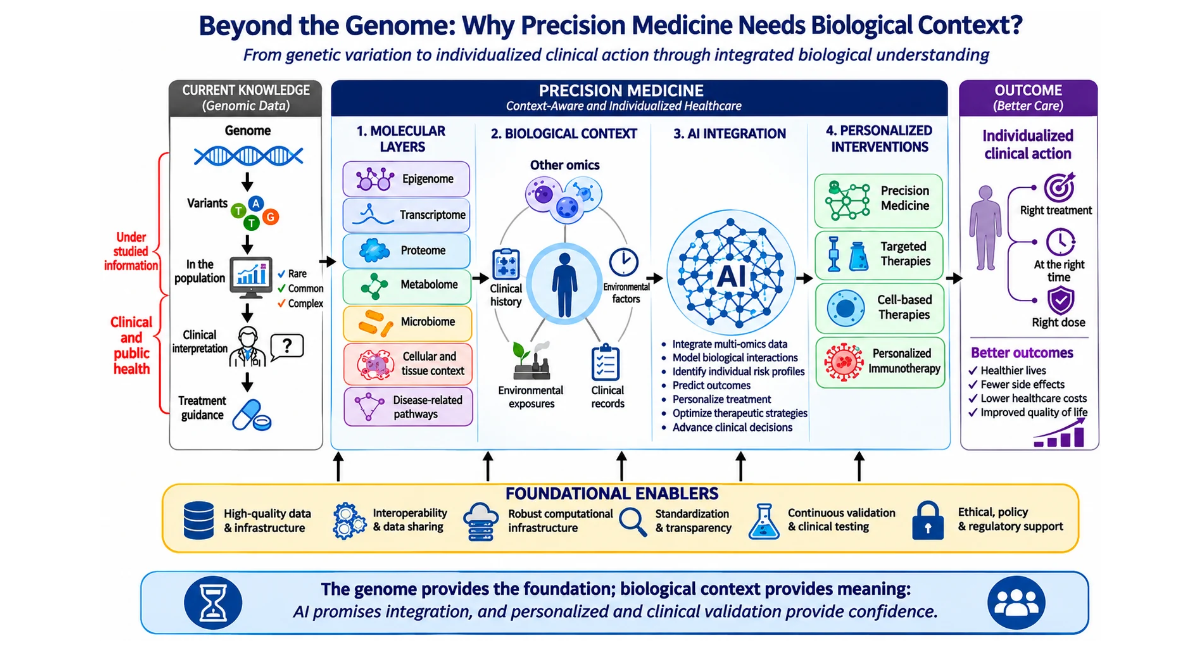
Figure 1: From genome-centered prediction to context-aware precision medicine. The conceptual framework illustrates the proposed transition from a conventional genome-centered paradigm, in which genomic variants are primarily used for prediction and clinical interpretation, toward an integrated model incorporating multi-omics data, cellular, tissue, temporal, environmental, and clinical context. Artificial intelligence serves as an integrative layer connecting heterogeneous biological information and supporting the identification of biologically meaningful patterns and mechanisms. Experimental and clinical validation provide essential confidence before translation into individualized clinical decisions.
Toward Context-Aware Precision Medicine
The evolution from genome-centered to context-aware precision medicine requires a fundamental change in how patient information is conceptualized. Precision medicine has traditionally focused on identifying molecular features that distinguish individuals or disease subtypes. The next step should be to understand how these features operate within the dynamic biological system of each patient. In this framework, genomic information remains essential, but it becomes one component of a broader representation that incorporates molecular, cellular, temporal, environmental, and clinical context [33].
We propose that future precision medicine should be built around a context-aware biological model in which the patient's phenotype is considered an emergent property of interacting biological layers. Such a model can be represented as:
genome → molecular state → cellular state → tissue environment → phenotype → clinical outcome.
We propose that future precision medicine should be built around a context-aware biological model in which the patient's phenotype is considered an emergent property of interacting biological layers (Figure 1). Importantly, this relationship is not unidirectional. Disease and treatment can alter cellular and molecular states, which in turn may influence subsequent clinical outcomes. Precision medicine should therefore evolve from a static model of risk prediction toward a dynamic framework capable of capturing biological trajectories over time.
A context-aware approach would integrate several dimensions of patient information (Table 1). The genomic context would define inherited and acquired genetic variation. The molecular context would capture epigenetic, transcriptional, proteomic, and metabolic states. The cellular and tissue context would describe cellular heterogeneity, spatial organization, and interactions within the tissue microenvironment. The temporal context would incorporate disease progression, treatment exposure, and longitudinal molecular changes [34]. Finally, the clinical and environmental context would include phenotype, medical history, lifestyle, environmental exposures, and treatment history. The value of this framework would not arise from the presence of all possible data types, but from their ability to provide complementary information about the same biological process.
Dimension | Genome-centered paradigm | Context-aware paradigm |
|---|---|---|
Primary information | Genomic variants | Genomic + multi-omics + clinical data |
Biological focus | Genetic variation | Molecular, cellular and tissue states |
View of disease | Relatively static | Dynamic and context-dependent |
Patient stratification | Genotype-based | Biological-state-based |
Biomarkers | Individual molecular markers | Integrated biological signatures |
Role of AI | Prediction/classification | Data integration and hypothesis generation |
Interpretation | Association/prediction | Mechanistic and contextual interpretation |
Validation | Computational performance | Computational + experimental + clinical validation |
Clinical goal | Risk/disease prediction | Individualized decision-making |
Key question | “What variant does the patient carry?” | “What biological state is the patient in, and why?” |
Dimension | Genome-centered paradigm | Context-aware paradigm |
Primary information | Genomic variants | Genomic + multi-omics + clinical data |
Biological focus | Genetic variation | Molecular, cellular and tissue states |
View of disease | Relatively static | Dynamic and context-dependent |
Patient stratification | Genotype-based | Biological-state-based |
Biomarkers | Individual molecular markers | Integrated biological signatures |
Role of AI | Prediction/classification | Data integration and hypothesis generation |
Interpretation | Association/prediction | Mechanistic and contextual interpretation |
Validation | Computational performance | Computational + experimental + clinical validation |
Clinical goal | Risk/disease prediction | Individualized decision-making |
Key question | “What variant does the patient carry?” | “What biological state is the patient in, and why?” |
Table 1: From Genome-Centered to Context-Aware Precision Medicine
Within such a framework, AI could function as an integrative layer connecting heterogeneous measurements. Instead of producing a single risk score based primarily on genomic features, AI models could generate a dynamic representation of the patient's biological state and identify the molecular processes most strongly associated with disease progression or therapeutic response. This would allow precision medicine to move toward state-based rather than solely genotype-based decision making [35].
Such a transition could be particularly important for therapeutic selection. Two patients with apparently similar genomic profiles may differ substantially in transcriptional activity, immune status, metabolism, or tissue microenvironment and may consequently respond differently to the same treatment. Conversely, patients with different genomic alterations may converge on similar dysfunctional pathways and therefore potentially benefit from similar therapeutic strategies [36]. A context-aware framework could identify these convergent or divergent biological states more effectively than genomic classification alone.
The proposed model also changes the meaning of a biomarker. Rather than viewing a biomarker as an isolated molecular variable associated with an outcome, biomarkers could increasingly be interpreted as components of a biological state signature. Such signatures may combine genomic variants with transcriptomic, proteomic, metabolic, cellular, imaging, and clinical features. Their purpose would not simply be to distinguish patients statistically, but to characterize the biological processes that define a particular disease state and its likely trajectory [37].
However, the transition toward context-aware precision medicine should not be interpreted as an argument for measuring everything in every patient [38]. Such an approach would be technically demanding, expensive, and potentially counterproductive. The central challenge is to identify the most informative biological context for a specific clinical question. A patient being evaluated for hereditary cancer risk may require a different molecular profile from a patient undergoing treatment selection for an advanced tumor or monitoring for therapeutic resistance. Precision therefore applies not only to the patient, but also to the selection of the information needed to understand that patient [39].
This principle introduces the concept of adaptive precision medicine. Rather than obtaining a fixed set of molecular measurements at a single time point, future clinical workflows could use sequential information acquisition. An initial genomic or clinical assessment could identify the most relevant biological uncertainties, after which targeted transcriptomic, proteomic, metabolic, cellular, or functional analyses could be performed. AI systems could help determine which additional information is most likely to reduce uncertainty and improve a clinical decision. In this model, data acquisition itself becomes personalized. Several barriers must nevertheless be addressed before such a framework can become clinically routine [40]. Biological datasets remain heterogeneous and incomplete, while many multi-omics studies are limited by relatively small cohorts, inconsistent sampling strategies, and insufficient longitudinal validation. AI models may also inherit biases from the populations and datasets on which they are trained. Importantly, a model that performs well in one population, institution, or experimental system may not necessarily generalize to another. Context-aware precision medicine will therefore require not only advanced algorithms, but also standardized data generation, robust external validation, transparent reporting, and continuous assessment of clinical utility.
Another essential requirement is the preservation of biological and clinical interpretability. A context-aware system should not simply provide a more complex prediction. Its purpose should be to provide a more meaningful explanation of why a particular patient behaves differently from another patient. This requires models that can connect predictions to molecular pathways, cellular processes, and clinically relevant phenotypes. Whenever possible, computationally inferred relationships should be supported by independent experimental or clinical evidence [41]. Ultimately, the transition toward context-aware precision medicine represents a shift from asking “What genetic information does this patient carry?” to asking “What biological state is this patient in, why has this state emerged, and how is it likely to change?” The first question is primarily genomic. The second is systems-level, dynamic, and inherently contextual.
The future of precision medicine may therefore depend not on replacing genomics, but on placing the genome within the biological system to which it belongs. The genome provides the foundation; biological context provides meaning; AI provides integration; and experimental and clinical validation provide confidence. Together, these elements could transform precision medicine from a framework centered on molecular prediction into one centered on individualized biological understanding [42]. The ultimate goal should not be to create the most comprehensive molecular profile possible, but to construct the most clinically useful representation of an individual's biological state. In this sense, the next generation of precision medicine will be defined not by how much data we can generate, but by how effectively we can translate heterogeneous biological information into understanding, prediction, and action.
Practical Challenges and Pathways to Clinical Implementation
Despite its conceptual promise, the transition toward context-aware precision medicine faces several practical challenges that must be addressed before integrated biological and AI-driven approaches can become part of routine clinical decision-making. The integration of multi-omics profiles, clinical records, imaging, and longitudinal measurements may provide a more comprehensive representation of an individual's biological state, but it also increases the technical, ethical, and organizational complexity of translating research findings into clinical practice. The central challenge is therefore not only to develop models that capture biological complexity, but also to demonstrate that their outputs are reliable, interpretable, feasible, and clinically beneficial.
Data Heterogeneity and Interoperability
Biological and clinical datasets are generated using different analytical platforms, experimental protocols, sampling procedures, and data-processing pipelines. Differences in sequencing technologies, sample handling, measurement scales, clinical definitions, and patient characteristics may introduce technical variation that is difficult to distinguish from genuine biological differences. Furthermore, missing omics layers, incomplete clinical records, and differences in data availability across institutions may limit the applicability of models to individual patients. A model trained on one dataset may consequently learn platform-specific or institution-specific patterns rather than relationships that generalize across populations. Addressing these limitations requires harmonized data definitions, transparent preprocessing procedures, appropriate correction for technical variation, and systematic assessment of missing data. Where possible, models should also be designed to accommodate incomplete input profiles, provided that their performance under these conditions is explicitly evaluated. Importantly, harmonization should preserve clinically meaningful biological variation rather than remove it indiscriminately.
Patient Privacy, Data Governance, and Equitable Access
Context-aware precision medicine relies on increasingly detailed and potentially identifiable combinations of genomic, molecular, clinical, and longitudinal data. Genomic information presents particular challenges because it may reveal information about biological relatives and cannot be replaced in the same way as a compromised password. Combining datasets may also increase the risk of re-identification, even when direct identifiers have been removed. Clinical implementation therefore requires appropriate informed consent, clear rules governing data access and secondary use, secure data storage and transfer, and compliance with applicable data-protection requirements, including the General Data Protection Regulation (GDPR) in the European Union. Privacy-preserving approaches, such as federated learning and carefully evaluated secure computation techniques, may facilitate collaboration across institutions without requiring all patient-level data to be pooled centrally. However, these approaches do not eliminate privacy risks and must be accompanied by appropriate technical and organizational safeguards. In addition, the representativeness of training datasets is essential: underrepresentation of particular populations may lead to less reliable predictions and unequal access to the benefits of precision medicine.
Model Interpretability and Biological Plausibility
Integrating multiple data modalities may improve predictive performance, but increasing model complexity can make it difficult to determine why a particular prediction was generated. In clinical practice, a risk score alone may be insufficient when a prediction informs treatment selection, additional diagnostic testing, or decisions involving substantial clinical consequences. Interpretability should therefore extend beyond the identification of statistically influential features to an assessment of whether the model's outputs are biologically plausible, reproducible, and consistent with independent evidence. Pathway-level analyses, transparent model architectures where appropriate, sensitivity analyses, and comparisons with established clinical predictors may help clarify the contribution of individual biological layers. Nevertheless, post hoc explanation methods should not be interpreted as proof of causality. Computationally inferred mechanisms should be distinguished from experimentally demonstrated relationships, and the level of explanation required should reflect the intended clinical use and the potential consequences of an incorrect prediction.
External Validation and Clinical Utility
High performance in a development dataset does not establish that a model will remain reliable in other hospitals, populations, or clinical settings. Differences in disease prevalence, patient demographics, clinical practice, sample acquisition, and laboratory procedures may result in dataset shift and reduced performance after deployment. Robust evaluation should therefore progress from internal validation to independent external validation using data from different institutions and, where relevant, geographically and demographically diverse populations. Performance assessment should include appropriate measures of discrimination and calibration, clinically relevant sensitivity and specificity, and analyses of subgroup performance. Comparisons with existing clinical predictors and decision-making pathways are also necessary to determine whether the additional biological information provides meaningful incremental value. Ultimately, prospective studies and evaluations in real-world clinical workflows are needed to establish whether model-guided decisions improve patient outcomes, reduce diagnostic uncertainty, or support more appropriate treatment selection without introducing unacceptable risks.
Cost-Effectiveness and Implementation Feasibility
Comprehensive multi-omics profiling and the computational infrastructure required for data integration may be expensive and are not equally available across healthcare systems. Beyond the cost of sequencing or other analytical assays, implementation may require sample-processing infrastructure, data storage, specialized personnel, software maintenance, clinician training, and ongoing model monitoring. The clinical value of these investments cannot be inferred from predictive accuracy alone. Economic evaluations should consider the total cost of the diagnostic pathway, including whether integrated profiling reduces unnecessary testing, shortens the time to diagnosis, avoids ineffective treatment, or improves the allocation of healthcare resources. A clinically useful strategy may therefore involve selecting a limited set of complementary biological measurements rather than collecting every available omics layer. The optimal approach should be determined by the clinical question, the expected incremental benefit, the consequences of diagnostic error, and the resources available in the intended setting.
Taken together, these challenges suggest that clinical translation should proceed through a staged and use-case-specific pathway. A relevant clinical problem should first be defined, followed by the selection of the minimum informative combination of biological and clinical measurements. The resulting model should undergo analytical and technical assessment, independent external validation, and prospective evaluation of its clinical utility and economic implications. Implementation should then include clinician oversight, transparent communication of uncertainty, appropriate governance, and continued monitoring for changes in performance across populations and over time. This pathway is consistent with the broader principle that AI-enabled clinical systems require evaluation and risk management throughout their lifecycle rather than assessment at the point of model development alone [43,44].
Thus, the practical objective of context-aware precision medicine should not be to maximize the number of integrated data modalities or the complexity of the analytical model. It should be to establish whether a biologically informed approach provides sufficiently reliable, interpretable, equitable, and cost-effective information to improve a defined clinical decision. Only when these requirements are met can the integration of biological context and AI progress from a conceptual framework toward a clinically meaningful component of individualized healthcare.
Real-World Examples of Context-Aware Precision Medicine
The clinical relevance of context-aware precision medicine is illustrated by examples in which integrating complementary biological and clinical information provides insights beyond those obtained from a single molecular measurement. These applications differ in their level of clinical maturity: some are established components of routine clinical practice, whereas others remain investigational approaches whose clinical utility requires further evaluation.
Integration of Molecular and Functional Information in Acute Myeloid Leukemia
Acute myeloid leukemia (AML) provides an example of how molecular characterization can be complemented by direct assessment of functional drug responses. In a prospective study involving 252 samples from 186 patients, a functional precision medicine tumor board integrated clinical information, molecular profiling, and ex vivo drug-response data to inform treatment recommendations. Actionable drug options were identified for 97% of patients, and recommendations were implemented in 37 patients with relapsed or refractory disease. Among these patients, the individually tailored treatments were associated with an objective response rate of 59%, including 13 complete responses [45]. The study also identified potential response-associated biomarkers, illustrating how integration across patients may generate hypotheses about treatment sensitivity and resistance. Although these findings are encouraging, the treated cohort was limited, and the results should not be interpreted as definitive evidence that this strategy is superior to standard treatment selection. Nevertheless, the study illustrates the potential value of combining molecular information with functional measurements of drug response.
Combining Genomic and Protein-Level Information in HER2-Positive Breast Cancer
A more established clinical example is the characterization of human epidermal growth factor receptor 2 (HER2) status in breast cancer. HER2 assessment uses immunohistochemistry to evaluate protein expression and, when indicated, in situ hybridization to determine gene amplification. These complementary measurements help establish HER2 status and guide eligibility for HER2-targeted therapies [46]. This example illustrates a fundamental principle of context-aware medicine: genomic alterations and their functional consequences are related but not interchangeable, and treatment decisions benefit from combining molecular findings with protein-level and pathological evidence. However, HER2 testing represents a targeted integration of complementary biomarkers rather than comprehensive multi-omics analysis or AI-driven clinical decision-making.
Multimodal Real-World Data and Explainable AI in Oncology
Recent research has also explored whether clinical records, tumor mutation profiles, and imaging-derived features can be integrated to characterize disease and treatment outcomes across different cancer types. A 2025 study in Nature Cancer analyzed real-world data from 15,726 patients representing 38 solid cancer entities using multimodal data and explainable AI. The approach identified 114 key markers accounting for 90% of the neural network's decision process [47]. This study demonstrates the feasibility of combining heterogeneous clinical, imaging, and molecular information to investigate factors associated with treatment outcomes. However, identifying influential predictive features does not by itself establish causal mechanisms or demonstrate that model-guided decisions improve patient outcomes. Prospective clinical evaluation is therefore necessary before such approaches can be considered validated tools for treatment selection.
The Limitations of Genomic Matching Alone
The NCI-MATCH trial provides an important complementary perspective. This large precision oncology initiative assigned treatment according to tumor molecular alterations, irrespective of cancer type. In the initial 27 evaluated substudies, 7 met their prespecified signal-seeking criteria for antitumor activity [48]. These results illustrate both the potential and the limitations of molecularly guided treatment selection. Identifying a potentially actionable alteration does not guarantee therapeutic response, and the clinical consequences of a molecular finding depend on additional factors, including tumor biology, treatment availability, and the suitability of the selected therapeutic strategy. NCI-MATCH was not designed to establish that comprehensive context-aware approaches outperform genomic matching; rather, it highlights why the identification of a molecular target must be followed by careful evaluation of therapeutic efficacy.
Taken together, these examples illustrate different stages in the evolution of precision medicine, from established biomarker-guided treatment selection to investigational integration of functional assays and multimodal AI. They also emphasize an important distinction: the ability to integrate biological information and generate more informative predictions is not equivalent to demonstrating clinical benefit. The most meaningful advances will occur when context-aware approaches provide reproducible improvements in disease characterization, treatment selection, or therapeutic response prediction, supported by independent validation and evidence of improved clinical decision-making.
CONCLUSION
Precision medicine has been fundamentally enabled by the ability to characterize individual genetic variation, but genomic information alone cannot fully explain the biological complexity underlying disease phenotypes. The genome provides an essential foundation, yet its functional consequences depend on molecular, cellular, tissue, temporal, environmental, and clinical context. Consequently, the next generation of precision medicine should move beyond a genome-centered paradigm toward a more integrated and dynamic understanding of individual biological states. Multi-omics technologies provide the necessary layers of information to connect genomic variation with biological function, while artificial intelligence offers an opportunity to integrate these heterogeneous data and identify relationships that may remain inaccessible through analysis of individual molecular layers. However, computational prediction should not be considered equivalent to biological understanding. Explainability, causal reasoning, experimental validation, and robust clinical validation will remain essential for translating AI-generated insights into reliable medical decisions. We therefore argue that the future of precision medicine should be context-aware rather than genome-centered. The objective should not be to generate the largest possible molecular profile, but to identify the most informative biological context needed to understand an individual patient's disease state and its evolution over time. In this framework, the genome provides the foundation, biological context provides meaning, AI provides integration, and experimental and clinical validation provide confidence. However, the clinical translation of context-aware precision medicine will depend on more than advances in multi-omics technologies and AI. Standardized data generation, protection of patient privacy, interpretable models, independent external validation, and evidence of cost-effectiveness will be essential to establish clinical utility. A staged implementation strategy focused on clearly defined clinical needs may provide a more realistic pathway toward translation than the indiscriminate integration of all available biological data. Ultimately, context-aware precision medicine will be valuable not because it captures biological complexity in its entirety, but because it translates the most informative aspects of that complexity into reliable and actionable clinical decisions. Such a shift could move precision medicine beyond predicting what might happen toward understanding what is happening, why it is happening, and how it can be most effectively addressed in the individual patient.
ETHICS APPROVAL AND CONSENT TO PARTICIPATE
Not applicable, as this study did not involve human participants, animals, or identifiable personal data.
CONSENT FOR PUBLICATION
Not applicable, this manuscript does not contain any individual person’s data in any form.
AVAILABILITY OF DATA AND MATERIALS
Not applicable, this review did not generate new datasets. All sources cited are publicly available in the referenced literature.
COMPETING INTERESTS
The authors declare that they have no competing interests.
FUNDING
No specific funding was received for this work.
AUTHORS' CONTRIBUTIONS
J.B. carried out Investigation, served as the senior author, data collection, and preparation of tables and figures, and contributed to conceptualization, writing original draft.
A.L.-B. contributed to study design, validation, data interpretation, overall supervision, and writing review & editing.
All authors reviewed the manuscript critically, provided feedback, and approved the final submitted version.
REFERENCES
- Sindelar RD. Genomics, other “OMIC” technologies, precision medicine, and additional biotechnology-related techniques. InPharmaceutical biotechnology: Fundamentals and applications 2024(pp. 209-254). Cham: Springer International Publishing. [Crossref] [Google Scholar]
- Alzahrani AA, Alharithi FS. Machine learning approaches for advanced detection of rare genetic disorders in whole-genome sequencing. Alexandria Engineering Journal. 2024;106:582-93. [Crossref] [Google Scholar]
- Martin NS. A simple model captures key characteristics of biological non-deterministic genotype-phenotype maps. PLOS Computational Biology. 2026;22(5):e1014272. [Crossref] [Google Scholar] [PubMed]
- Ciesielski TH, Sirugo G, Iyengar SK, Williams SM. Characterizing the pathogenicity of genetic variants: the consequences of context. npj Genomic Medicine. 2024;9(1):3. [Crossref] [Google Scholar] [PubMed]
- Smith L, Malinowski J, Ceulemans S, Peck K, Walton N, Sheidley BR, Lippa N. Genetic testing and counseling for the unexplained epilepsies: an evidence‐based practice guideline of the National Society of genetic counselors. Journal of Genetic Counseling. 2023;32(2):266-80. [Crossref] [Google Scholar] [PubMed]
- Satam H, Joshi K, Mangrolia U, Waghoo S, Zaidi G, Rawool S, Thakare RP, Banday S, Mishra AK, Das G, Malonia SK. Next-generation sequencing technology: current trends and advancements. Biology. 2023;12(7):997. [Crossref] [Google Scholar] [PubMed]
- Liu Y, Yeung WS, Chiu PC, Cao D. Computational approaches for predicting variant impact: An overview from resources, principles to applications. Frontiers in genetics. 2022;13:981005. [Crossref] [Google Scholar] [PubMed]
- Mao Y, Wickström SA. Mechanical state transitions in the regulation of tissue form and function. Nature Reviews Molecular Cell Biology. 2024;25(8):654-70. [Crossref] [Google Scholar] [PubMed]
- Wang RC, Wang Z. Precision medicine: disease subtyping and tailored treatment. Cancers. 2023;15(15):3837. [Crossref] [Google Scholar] [PubMed]
- Ghorbian S. Cancer cell plasticity and therapeutic resistance: mechanisms, crosstalk, and translational perspectives. Hereditas. 2025;162(1):188. [Crossref] [Google Scholar] [PubMed]
- Burke W, Parens E, Chung WK, Berger SM, Appelbaum PS. The challenge of genetic variants of uncertain clinical significance: a narrative review. Annals of internal medicine. 2022;175(7):994-1000. [Crossref] [Google Scholar] [PubMed]
- Babu M, Snyder M. Multi-omics profiling for health. Molecular & Cellular Proteomics. 2023;22(6). [Crossref] [Google Scholar] [PubMed]
- Morabito A, De Simone G, Pastorelli R, Brunelli L, Ferrario M. Algorithms and tools for data-driven omics integration to achieve multilayer biological insights: a narrative review. Journal of translational medicine. 2025;23(1):425. [Crossref] [Google Scholar] [PubMed]
- Lappalainen T, Li YI, Ramachandran S, Gusev A. Genetic and molecular architecture of complex traits. Cell. 2024;187(5):1059-75. [Crossref] [Google Scholar] [PubMed]
- Hemme CL, Atoyan J, Cai A, Liu C. Challenges and opportunities in multi-omics data acquisition and analysis: toward integrative solutions. Biomolecules. 2026;16(2):271. [Crossref] [Google Scholar] [PubMed]
- Palla G, Fischer DS, Regev A, Theis FJ. Spatial components of molecular tissue biology. Nature biotechnology. 2022;40(3):308-18. [Crossref] [Google Scholar] [PubMed]
- Terranova N, Venkatakrishnan K. Machine learning in modeling disease trajectory and treatment outcomes: An emerging enabler for model‐informed precision medicine. Clinical Pharmacology & Therapeutics. 2024;115(4):720-6. [Crossref] [Google Scholar] [PubMed]
- Loke LH, Chisholm RA. Measuring habitat complexity and spatial heterogeneity in ecology. Ecology Letters. 2022;25(10):2269-88. [Crossref] [Google Scholar] [PubMed]
- Gulati GS, D’Silva JP, Liu Y, Wang L, Newman AM. Profiling cell identity and tissue architecture with single-cell and spatial transcriptomics. Nature reviews Molecular cell biology. 2025;26(1):11-31. [Crossref] [Google Scholar] [PubMed]
- Al-Chalabi A, Andrews J, Farhan S. Recent advances in the genetics of familial and sporadic ALS. International Review of Neurobiology. 2024;176:49-74. [Crossref] [Google Scholar] [PubMed]
- Shahrajabian MH, Sun W. Survey on multi-omics, and multi-omics data analysis, integration and application. Current Pharmaceutical Analysis. 2023;19(4):267-81. [Crossref] [Google Scholar]
- Ilan Y. The relationship between biological noise and its application: understanding system failures and suggesting a method to enhance functionality based on the constrained disorder principle. Biology. 2025;14(4):349. [Crossref] [Google Scholar] [PubMed]
- Wu Q, Gao G, Kwok LY, Qiao J, Wei Z, He Q, Sun Z. Bifidobacterium animalis subsp. lactis Bbm-19 ameliorates insomnia by remodeling the gut microbiota and restoring γ-aminobutyric acid and serotonin signaling. Food & Function. 2026;17(1):475-93. [Crossref] [Google Scholar] [PubMed]
- Wilson A, Anwar MR. The future of adaptive machine learning algorithms in high-dimensional data processing. International Transactions on Artificial Intelligence. 2024;3(1):97-107. [Crossref] [Google Scholar]
- Shen Y, Zhang P, Luo J, Chen S, Gu S, Lin Z, Tang Z. Artificial intelligence drives advances in multi-omics analysis and precision medicine for sepsis. Biomedicines. 2026;14(2):261. [Crossref] [Google Scholar] [PubMed]
- Desai SA, Patel VP, Bhosle KP, Nagare SD, Thombare KC. The tumor microenvironment: shaping cancer progression and treatment response. Journal of Chemotherapy. 2025 Jan 2;37(1):15-44. [Crossref] [Google Scholar] [PubMed]
- Ahuja SK, Shrimankar DD, Durge AR. A study and analysis of disease identification using genomic sequence processing models: an empirical review. Current Genomics. 2023;24(4):207-35. [Crossref] [Google Scholar] [PubMed]
- Mystridis GA, Chatzopoulou F, Patrinos GP, Vizirianakis IS. Artificial intelligence/machine learning and mechanistic modeling approaches as translational tools to advance personalized medicine decisions. Advances in Molecular Pathology. 2022;5(1):131-9. [Crossref] [Google Scholar]
- Athanasopoulou K, Michalopoulou VI, Scorilas A, Adamopoulos PG. Integrating artificial intelligence in next-generation sequencing: advances, challenges, and future directions. Current Issues in Molecular Biology. 2025;47(6):470. [Crossref] [Google Scholar] [PubMed]
- Van Dellen E. Precision psychiatry: predicting predictability. Psychological medicine. 2024;54(8):1500-9. [Crossref] [Google Scholar] [PubMed]
- Toussaint PA, Leiser F, Thiebes S, Schlesner M, Brors B, Sunyaev A. Explainable artificial intelligence for omics data: a systematic mapping study. Briefings in Bioinformatics. 2024;25(1):bbad453. [Crossref] [Google Scholar] [PubMed]
- Martínez-García M, Hernández-Lemus E. Data integration challenges for machine learning in precision medicine. Frontiers in medicine. 2022;8:784455. [Crossref] [Google Scholar] [PubMed]
- Eke DO, Gab-Obinna CL, Ibiam V, Baiden I, Oluwamisimi A, Eboh NA. Integrating Social Determinants of Health into Precision Medicine: A Critical Review of a Missing Link in Personalized Healthcare. Journal of Medicine and Health Research. 2026;11(1):310-29. [Crossref] [Google Scholar]
- Yoshioka H, Jin R, Hisaka A, Suzuki H. Disease progression modeling with temporal realignment: An emerging approach to deepen knowledge on chronic diseases. Pharmacology & Therapeutics. 2024;259:108655. [Crossref] [Google Scholar] [PubMed]
- Manley M, Victor A, Park H, Kaul A, Kathaperumal M, Bakir MS. Heterogeneous integration technologies for artificial intelligence applications. IEEE Journal on Exploratory Solid-State Computational Devices and Circuits. 2024;10:89-97. [Crossref] [Google Scholar]
- Karagiannakos A, Adamaki M, Tsintarakis A, Vojtesek B, Fåhraeus R, Zoumpourlis V, Karakostis K. Targeting oncogenic pathways in the era of personalized oncology: a systemic analysis reveals highly mutated signaling pathways in cancer patients and potential therapeutic targets. Cancers. 2022;14(3):664. [Crossref] [Google Scholar] [PubMed]
- Young AL, Oxtoby NP, Garbarino S, Fox NC, Barkhof F, Schott JM, Alexander DC. Data-driven modelling of neurodegenerative disease progression: thinking outside the black box. Nature Reviews Neuroscience. 2024;25(2):111-30. [Crossref] [Google Scholar] [PubMed]
- Zon M, Ganesh G, Deen MJ, Fang Q. Context-aware medical systems within healthcare environments: a systematic scoping review to identify subdomains and significant medical contexts. International Journal of Environmental Research and Public Health. 2023;20(14):6399. [Crossref] [Google Scholar] [PubMed]
- Marques L, Costa B, Pereira M, Silva A, Santos J, Saldanha L, Silva I, Magalhães P, Schmidt S, Vale N. Advancing precision medicine: a review of innovative in silico approaches for drug development, clinical pharmacology and personalized healthcare. Pharmaceutics. 2024;16(3):332. [Crossref] [Google Scholar] [PubMed]
- Mather M, Pettigrew LM, Navaratnam S. Barriers and facilitators to clinical behaviour change by primary care practitioners: a theory-informed systematic review of reviews using the Theoretical Domains Framework and Behaviour Change Wheel. Systematic reviews. 2022;11(1):180. [Crossref] [Google Scholar] [PubMed]
- Chen V, Yang M, Cui W, Kim JS, Talwalkar A, Ma J . Applying interpretable machine learning in computational biology—pitfalls, recommendations and opportunities for new developments. Nature methods. 2024;21(8):1454-61. [Crossref] [Google Scholar] [PubMed]
- Yuan B. What personalized medicine humans need and way to it——also on the practical significance and Scientific Limitations of Precision Medicine. Pharmacogenomics and Personalized Medicine. 2022:927-42. [Crossref] [Google Scholar] [PubMed]
- Abdelaziz EH, Ismail R, Mabrouk MS, Amin E. Multi-omics data integration and analysis pipeline for precision medicine: Systematic review. Computational Biology and Chemistry. 2024;113:108254. [Crossref] [Google Scholar] [PubMed]
- Jurisica I. Explainable biology for improved therapies in precision medicine: AI is not enough. Best Practice & Research Clinical Rheumatology. 2024;38(4):102006. [Crossref] [Google Scholar] [PubMed]
- Malani D, Kumar A, Brück O, Kontro M, Yadav B, Hellesøy M, Kuusanmäki H, Dufva O, Kankainen M, Eldfors S, Potdar S. Implementing a functional precision medicine tumor board for acute myeloid leukemia. Cancer Discovery. 2022;12(2):388-401. [Crossref] [Google Scholar] [PubMed]
- Wolff AC, Hammond ME, Hicks DG, Dowsett M, McShane LM, Allison KH, Allred DC, Bartlett JM, Bilous M, Fitzgibbons P, Hanna W. Recommendations for human epidermal growth factor receptor 2 testing in breast cancer: American Society of Clinical Oncology/College of American Pathologists clinical practice guideline update. Journal of clinical oncology. 2013;31(31):3997-4013.. [Crossref] [Google Scholar] [PubMed]
- Keyl J, Keyl P, Montavon G, Hosch R, Brehmer A, Mochmann L, Jurmeister P, Dernbach G, Kim M, Koitka S, Bauer S. Decoding pan-cancer treatment outcomes using multimodal real-world data and explainable artificial intelligence. Nature Cancer. 2025;6(2):307-22. [Crossref] [Google Scholar] [PubMed]
- O’Dwyer PJ, Gray RJ, Flaherty KT, Chen AP, Li S, Wang V, McShane LM, Patton DR, Tricoli JV, Williams PM, Iafrate AJ. The NCI-MATCH trial: lessons for precision oncology. Nature medicine. 2023;29(6):1349-57. [Crossref] [Google Scholar] [PubMed]

ARTICLE PROCESSING TIMELINE
| Stage 1 |
Initial Quality & Plagiarism Check The manuscript is reviewed for journal scope, basic submission requirements, ethical compliance, and similarity/plagiarism concerns. |
| Stage 2 |
Editorial Assessment & Peer Review Manuscripts that pass the initial screening undergo editorial assessment and independent peer review in accordance with the journal's peer-review policy. |
| Stage 3 |
Revision & Editorial Decision Authors may be requested to revise their manuscript based on reviewer and editor comments. A final editorial decision is made after the required review and revision stages are completed. |
| Stage 4 |
Production & Publication Accepted manuscripts proceed to production, author proofing, final quality checks, and online publication. |
EDITORIAL & PUBLICATION INFORMATION
| English | Publication Language |
| Single-Blind | Peer-Review Model |
| 17% | Acceptance Rate |
| <18% | Similarity Screening Guideline |
| Open Access | Access Model |
All manuscripts undergo editorial assessment and originality screening as part of the journal's evaluation process. The acceptance rate shown is based on journal-level editorial data and may change over time. Similarity reports are assessed editorially and are not interpreted solely on the basis of a numerical similarity score.
WHY PUBLISH WITH US?
ETHICS & POLICIES
EDITORIAL & MANAGEMENT
USEFUL LINKS
JOURNAL HIGHLIGHTS
OPEN ACCESS JOURNALS
JOURNAL FLYER