


Journal of Psychiatry and Psychological Sciences
ISSN: 3107-9024 (Online)
 Download PDF
ABSTRACT
Dynamical systems approaches provide a useful framework for modelling interaction processes in multi-agent and relational settings. This paper introduces a minimal three-term force model combining (i) an oscillatory coupling term, (ii) a linear restoring component, and (iii) an inverse-square repulsive interaction from a background field of agents. The model is analysed both analytically and through numerical simulation.
The deterministic two-term field (oscillatory plus linear) is shown to possess a single stable equilibrium under the parameterisation studied (kem = 0.05, ω = 0.2, ρ = kg/kem = φ−1 ≈ 0.618), indicating that repulsive interactions are required to sustain non-trivial spatial structure. Numerical simulations of the full three-term system demonstrate that increasing repulsion strength α produces a continuous expansion in mean inter-agent separation, with no sharp phase transition or discrete stability window observed over the explored parameter range (0.002 ≤ α ≤ 0.025).
These results indicate that the system’s behaviour is governed by a smooth balance between attractive and repulsive influences rather than by a critical threshold. The model provides a compact and interpretable framework for studying how competing interaction terms shape collective organisation in simplified multi-agent systems. The golden ratio φ−1 appears in the model as a parameterised coupling ratio, not as an emergent attractor. Interpretations in relational or psychological domains are treated as analogical and remain outside the scope of empirical validation in the present work.
Keywords: Relational Dynamics; Dynamical Systems; Three-Term Force Model; Golden Ratio; Multi-Agent Coordination; Continuous Balance; Mathematical Modelling; Relational Psychopathology
INTRODUCTION
Dynamical systems theory has become an increasingly productive framework in psychiatry and psychological science. From the modelling of mood disorders as attractor landscapes to the application of catastrophe theory to sudden therapeutic change, the language of attractors, bifurcations, and tipping points provides formal tools for phenomena that resist linear description [1,2]. Synergetic accounts have further formalised how self-organising pattern formation in psychological systems follows from order-parameter dynamics not reducible to individual agent states [3]. Foundational work in nonlinear dynamics has established the mathematical apparatus for analysing such systems [4].
This paper proposes a three-term force model as a mathematical framework for such conditions. The model combines an oscillatory coupling term (kem sin(ωx)) representing cyclical relational patterns, a linear restoring term (−kgx) representing a pull toward a baseline configuration, and an inverse-square repulsive term (α Σ r/r³) representing ambient relational noise or pressure from other agents.
The model is analysed both analytically and through numerical simulation. The deterministic two-term field is shown to possess a single stable equilibrium under the parameterisation studied, indicating that repulsive interactions are required to sustain non-trivial spatial structure. Numerical simulations demonstrate that increasing repulsion strength produces a continuous expansion in mean inter-agent separation, with no sharp phase transition or discrete stability window observed.
The motivation for applying this model to relational phenomena is analogical rather than literal. The model’s continuous balance between competing forces provides a formal analogue to clinical descriptions of relational functioning ranging from enmeshment to fragmentation [5,6]. The golden ratio φ−1 = 0.618 appears in the model as a parameterised coupling ratio (ρ = kg/kem), not as an emergent attractor. Research in dynamical social psychology has similarly emphasised the value of formal models for understanding collective behaviour without claiming exact correspondence [7].
A critical epistemological note is required at the outset: this paper does not claim that human psychological systems obey the proposed force law. The model is a formal abstraction whose dynamical properties illuminate features of relational systems that are difficult to capture in linear or purely statistical frameworks. The results demonstrate the internal dynamics of the model, not empirical correspondence with real-world systems.
Theoretical Framework
The Three-Term Force Law
Let the state of agent i at time t be represented by a position vector xi(t) ∈ ℝ³. The total force
on agent i is:
Ftotal(xi) = kem sin(ω xi) − kg xi + α Σj rij / |rij|³
where rij = xi − xj and the sum runs over background repulsive agents (static field). The coupling ratio is defined as ρ = kg/kem. The gradient-flow structure of this system places it within a well- established class of dissipative dynamical systems studied extensively in nonlinear dynamics [8].
The φ⁻¹ Coupling Ratio as a Parameterised Operating Point
The coupling ratio ρ = kg/kem is set to φ−1 = (√5 − 1)/2 ≈ 0.618 throughout this study. This value is a chosen operating point, not a derived or emergent constant. The simulations do not establish φ−1 as a uniquely optimal value; a systematic sweep over ρ remains future work. No claim is made that the golden ratio has intrinsic significance for psychological or relational systems.
Dynamical Systems Context
Attractor states in dynamical systems models correspond to stable patterns toward which systems return after perturbation [1,8]. The force model proposed here does not exhibit sharp bifurcations over the explored parameter range; instead, it shows graded, continuous changes in mean inter-agent separation. This places it in a different dynamical class from catastrophe- theoretic models [2] that posit discontinuous transitions, while remaining formally related to the broader dynamical systems tradition in psychiatry [9]. The study of coordination dynamics has demonstrated how collective behaviour emerges from the interaction of simpler components; the present model extends this tradition by introducing a three-term force law with explicit parameterisation of the coupling ratio [10].
RESULTS
Analytical Structure of the Deterministic Field
We begin by analysing the deterministic two-term component:
F(x) = kem sin(ωx) − kg x
Under the parameterisation kem = 0.05, ω = 0.2, kg = 0.618 kem, the linear restoring term dominates the oscillatory contribution over the domain examined (x ∈ [−2, 2]). The combined field exhibits a single stable equilibrium at x = 0. In the absence of repulsive interactions, the system collapses to a trivial configuration centred at the origin; the third term is therefore necessary to sustain spatial differentiation. Figure 1 illustrates the individual components and their superposition, confirming the single stable fixed point.
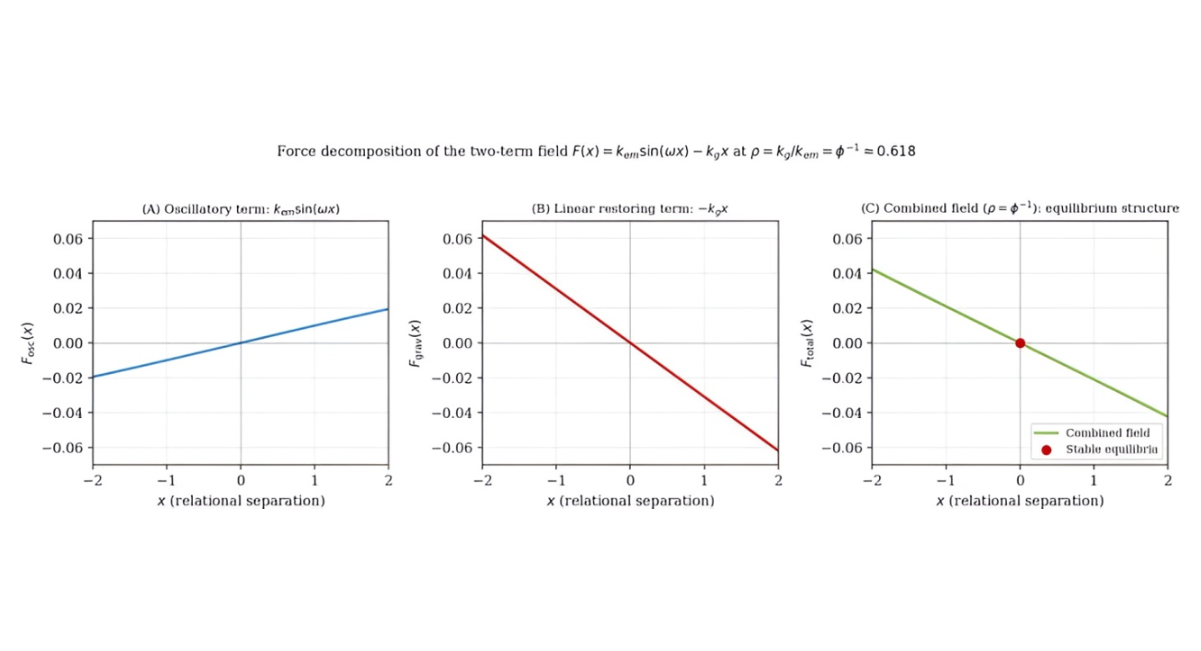
Figure 1: Decomposition of the deterministic field in one dimension. (A) Oscillatory term kem sin(ωx). (B) Linear restoring term −kg x. (C) Superposition, with filled circles indicating the single stable equilibrium at x = 0. Parameters: kem = 0.05, ρ = kg/kem = 0.618, ω = 0.2.
Dependence on Repulsion Strength
We examine the behaviour of the full three-term system as a function of the repulsion parameter α, with ρ = 0.618 held fixed. System behaviour is quantified using the time-averaged mean pairwise distance ⟨D⟩, computed after an initial transient period and normalised by the simulation domain size. Simulations used N = 64 particles, 80 static background repulsors, 1500 timesteps (Δt = 0.01, damping = 0.98, box size = 2.0), with 5 independent random seeds per α value.
Figure 2 shows ⟨D⟩ as a function of α over 0.002 ≤ α ≤ 0.025. The mean pairwise distance increases monotonically from ⟨D⟩ ≈ 0.616 at α = 0.002 to ⟨D⟩ ≈ 0.805 at α = 0.025. No plateau, discontinuity, or sharply defined transition is observed.
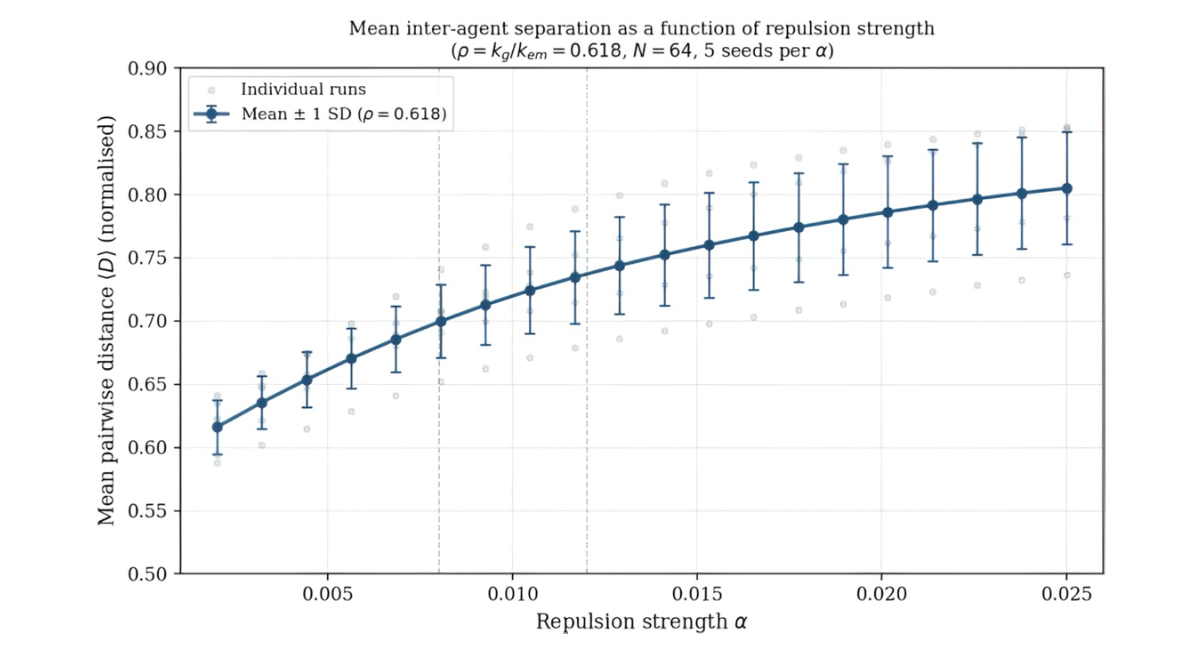
Figure 2: Time-averaged mean pairwise distance ⟨D⟩ as a function of repulsion strength α, with ρ = kg/kem = 0.618 fixed. Points represent means over 5 independent runs; error bars denote ±1 SD. Grey points show individual run values. Distances are normalised by the simulation box size (= 2.0). The response is continuous and monotonic. Dashed lines at α = 0.008 and α = 0.012 are visual aids only and do not represent phase boundaries.
Qualitative Behaviour across Regimes
Although no sharp phase boundaries are observed, qualitative differences can be identified. At low α (≈ 0.004), attractive forces dominate and agents cluster toward the origin. At intermediate α (≈ 0.010), trajectories spread but remain bounded. At high α (≈ 0.020), repulsive forces dominate and agents disperse toward the simulation boundary. These represent gradual changes rather than distinct phases. Figure 3 presents representative trajectories.
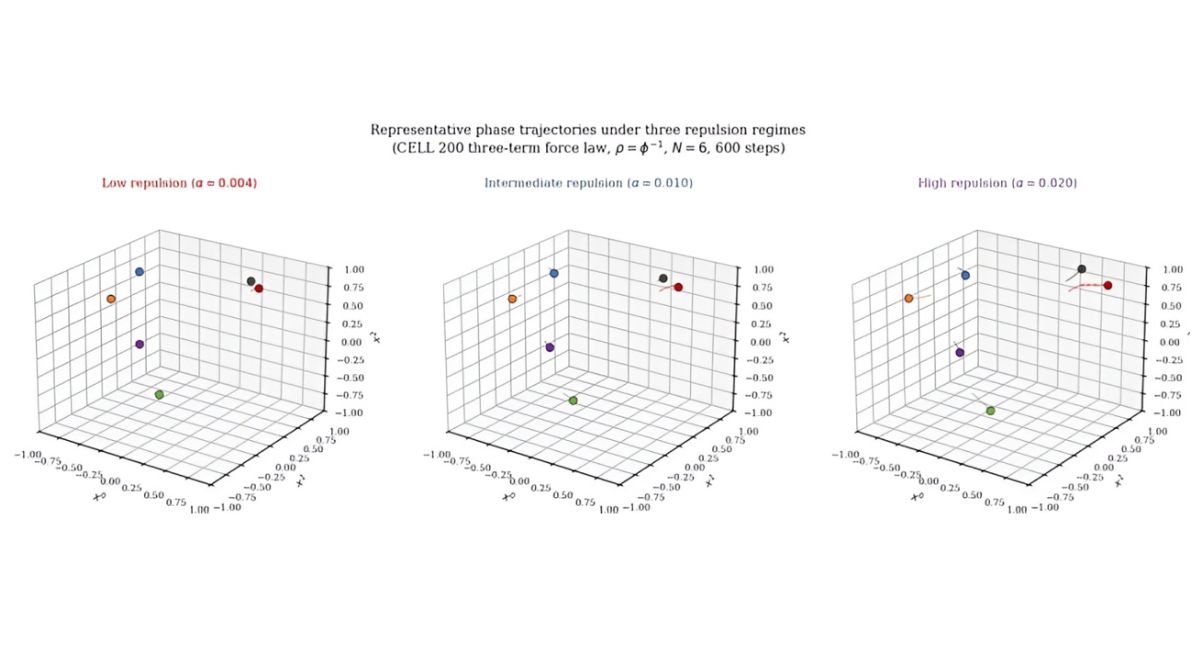
Figure 3: Representative phase trajectories for six particles under three values of repulsion strength α, with ρ = φ⁻¹ = 0.618 fixed. Left (α = 0.004): attraction-dominated particles cluster toward the origin. Centre (α = 0.010): mixed regime trajectories spread but remain bounded. Right (α = 0.020): repulsion-dominated particles disperse, reaching the simulation boundary. Trajectories shown for 600 timesteps; final positions indicated by filled circles. Panels illustrate gradual qualitative differences, not sharp phase transitions.
Summary of Findings
- The deterministic two-term field possesses a single stable equilibrium at x = 0 under the present parameterisation.
- Repulsive interactions are required to prevent collapse and sustain spatial structure.
- Variation in α produces a continuous, monotonic modulation of mean inter-agent separation, with no discrete transition or stability window.
Implications
Continuous Balance as a Relational Analogy
The three-term model exhibits a continuous response to changes in α. Within the analogical mapping to relational dynamics, this suggests that relational configuration varies smoothly with ambient relational pressure. Low α (attraction-dominated) is interpretable as enmeshment or reduced relational differentiation [11]. High α (repulsion-dominated) is interpretable as fragmentation or isolation [12]. Intermediate α corresponds to differentiated but coherent relational functioning.
The continuous nature of the response is the model’s central feature. Research on the transduction of social signals into physiological responses provides independent support for continuous rather than threshold models of relational stress [13]. The graded modulation observed in the present simulations is consistent with a view of relational dysregulation as a quantitative rather than categorical phenomenon. Dynamical systems approaches to social psychology have long emphasised continuous variation over discrete categories [14].
Implications for Multi-Agent Coordination
For distributed multi-agent systems, the model suggests a continuous coupling trade-off. At low α (tight coupling), agents cohere strongly at risk of redundancy. At high α (loose coupling), agents operate independently at risk of incoherence. At intermediate α, a balance between coordination and independence is achieved. The specific value α = 0.01 with ρ = φ −1 represents one point on this continuum not a uniquely optimal configuration. The study of self- organising pattern formation in behavioural systems has identified similar trade-offs between integration and segregation [15,16].
DISCUSSION
Limitations
Parameterisation of ρ
ρ = kg/kem is fixed at φ−1. This is a chosen operating point, not an emergent constant. A systematic sweep over ρ remains future work.
Absence of sharp phase transitions
The mean pairwise distance metric varies monotonically with α. Regime labels are qualitative descriptors of gradual changes, not distinct phases.
Formal stability characterization
Lyapunov exponents and spatial variance measures are not computed.
Finite simulation scope
Simulations use finite particle counts, bounded domains, velocity damping, and soft reflecting boundaries. Sensitivity to these choices is not exhaustively characterised.
Static background field
The repulsive background agents are static rather than co-evolving.
Restricted parameter exploration
Only α is swept systematically
Illustrative trajectories
Figure 3 shows representative trajectories for a single random seed, not statistical summaries.
Interpretive scope
The mapping to psychological constructs is analogical, not empirical.
Absence of empirical validation
The study is simulation-based. No empirical data are incorporated.
Directions for Empirical Investigation
If the continuous balance model bears analogical relation to psychological systems, several directions for empirical work follow:
- Measures of relational distance in dyadic interactions should vary smoothly with ambient social pressure, consistent with the continuous α-response.
- Different configurations of ρ and α should produce systematically different relational patterns in interpersonal process research [17].
- Interventions that reduce ambient relational noise should shift relational configurations in a manner consistent with decreasing α.
These are directions for future research, not validated findings. Developmental dynamical systems research has similarly emphasised the importance of continuous measures in capturing behavioural change [18].
Relationship to Existing Mathematical Models in Psychiatry
The present model joins a growing literature on mathematical approaches to psychiatric phenomena, including Hopfield network models, energy landscape models of depression, catastrophe theory models of therapeutic change, synergetic accounts of self-organising processes, and information-flow approaches to psychotherapy [1,2,13,14,16]. Unlike catastrophe- theoretic models, the present model exhibits graded, continuous changes. The two framings are complementary: continuous and discontinuous models may characterise different relational systems or different parameter regions. The model is closer in spirit to field-theoretic approaches to psychological modelling, with natural dialogue partners including phenomenological psychiatry’s accounts of intersubjective space and Stern’s present moment theory [12-14]. Research in nonlinear dynamical systems analysis for the behavioural sciences has similarly advocated for formal modelling approaches that capture continuous variation [19,20].
CONCLUSION
This paper has introduced a three-term force model combining oscillatory, linear restoring, and inverse-square repulsive interactions. The analytical structure of the two-term deterministic field reveals a single stable equilibrium; repulsive interactions are required to sustain spatial structure. Numerical simulations demonstrate that mean inter-agent separation increases monotonically with repulsion strength, with no sharp phase transition or stability window observed. The golden ratio φ−1 appears as a parameterised coupling ratio, not as an emergent attractor. The model provides a compact framework for studying continuous balance between competing forces, with analogical applications to relational psychopathology and multi-agent coordination. All claims are limited to the internal dynamics of the model; empirical validation remains future work.
ACKNOWLEDGEMENTS
The author thanks Eytan H. Suchard for sustained theoretical correspondence on Geometric Chronon Field Theory, which provided early motivation for exploring the electrogravitational interface. The author thanks Dr. Marcia Maia for contributions to the psychological science frameworks that inform the relational analogies in Section 4. This work was conducted on Kulin Nation Country; the 65,000-year continuous presence of the Kulin peoples is acknowledged as the epistemological ground from which the relational perspective of this research proceeds.
REFERENCES
- Wichers M. The dynamic nature of depression: a new micro-level perspective of mental disorder that meets current challenges. Psychological medicine. 2014;44(7):1349-60. [Crossref] [Google Scholar] [PubMed]
- Hayes AM, Laurenceau JP, Feldman G, Strauss JL, Cardaciotto L. Change is not always linear: The study of nonlinear and discontinuous patterns of change in psychotherapy. Clinical psychology review. 2007 ;27(6):715-23. [Crossref] [Google Scholar] [PubMed]
- CELL Series Independent Research. (2025–2026). 5D Theory: Complete Canonical Manual. Internal archive, Melbourne.
- Vaknin S. Malignant self love: Narcissism revisited. Narcissus Publishing; 2007. [Google Scholar]
- Schiepek G. Systemische Therapie–ein Beitrag zur Therapieintegration. PPmP-Psychotherapie· Psychosomatik· Medizinische Psychologie. 2012;22(06):204-13. [Crossref] [Google Scholar] [PubMed]
- Olthof M, Hasselman F, Strunk G, van Rooij M, Aas B, Helmich MA, et al. Critical fluctuations as an early-warning signal for sudden gains and losses in patients receiving psychotherapy for mood disorders. Clinical Psychological Science. 2020;8(1):25-35. [Crossref] [Google Scholar]
- Kernberg OF. Borderline conditions and pathological narcissism. [Crossref] [Google Scholar]
- Wampold BE. The great psychotherapy debate. PSYCHE-STUTTGART-. 2003;57(7):673-5. [Crossref] [Google Scholar]
- Fuchs T. Phenomenology and psychopathology. In Handbook of phenomenology and cognitive science 2009 (pp. 546-573). Dordrecht: Springer Netherlands. [Crossref] [Google Scholar]
- Bowlby J. A secure base: Parent-child attachment and healthy human development. Basic books; 2008. [Crossref] [Google Scholar]
- Hopfield JJ. Neural networks and physical systems with emergent collective computational abilities. Proceedings of the national academy of sciences. 1982;79(8):2554-8. [Crossref] [Google Scholar] [PubMed]
- Stern DN. The present moment in psychotherapy and everyday life. InO momento presente na psicoterapia e na vida cotidiana 2007 (pp. 305-305). [Crossref] [Google Scholar]
- Tschacher W, Haken H. Intentionality in non-equilibrium systems? The functional aspects of self-organized pattern formation. New Ideas in Psychology. 2007 Apr 1;25(1):1-5. [Crossref] [Google Scholar]
- Slavich GM, Irwin MR. From stress to inflammation and major depressive disorder: a social signal transduction theory of depression. Psychological bulletin. 2014;140(3):774. [Crossref] [Google Scholar] [PubMed]
- Pincus D. Coherence, complexity, and information flow: self-organizing processes in psychotherapy. [Crossref] [Google Scholar]
- Strogatz SH. Nonlinear dynamics and chaos: with applications to physics, biology, chemistry, and engineering. Chapman and Hall/CRC; 2024. [Google Scholar]
- Nowak A, Vallacher RR. Dynamical social psychology. Guilford Press; 1998. [Crossref] [Google Scholar]
- Kelso JS. Dynamic patterns: The self-organization of brain and behavior. MIT press; 1995. [Google Scholar]
- Data UR. Nonlinear dynamical systems analysis for the behavioral sciences using real data. CRC Press: Boca Raton, FL, USA; 2011. [Google Scholar]
- Thelen E, Smith LB. A dynamic systems approach to the development of cognition and action. MIT press; 1994. [Crossref] [Google Scholar]

Article Processing Timeline
| 2-5 Days | Initial Quality & Plagiarism Check |
| 25-35 Days |
Peer Review Feedback |
| 45-60 Days | Total article processing time |
Journal Flyer